

Distributed ledger technology has produced three distinct waves in fifteen years. Only one of them, in my view, changes how capital actually moves.
Over the last few months I have been looking closely at blockchain and crypto — partly to identify where the commercial opportunities sit, and partly to form a view on what this technology will actually be used for a decade from now. That has meant following market developments across jurisdictions, tracking legislation such as the proposed CLARITY Act in the United States, watching the more active jurisdictions in MENA and Europe, and working through the research published by the major strategy houses.
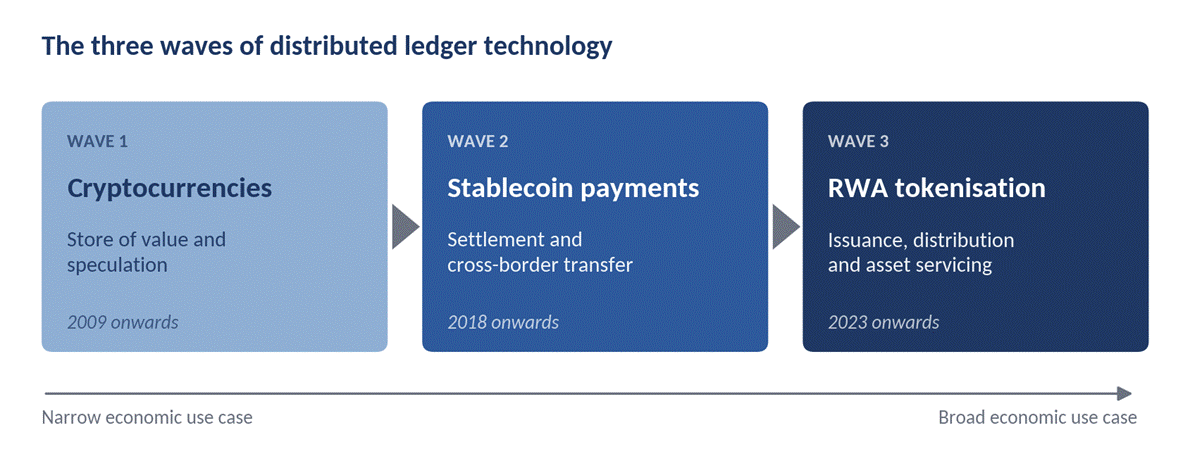
What follows is my own reading of where each layer of this market stands today, and where I think the value will finally settle. The technology has moved through three distinct waves, each with a broader economic use than the one before it.
01 Cryptocurrencies: the first wave, and the weakest case
Cryptocurrencies were the first use case for distributed ledger technology (“DLT”). They opened a genuinely new investment channel for individuals and institutions alike, and they remain the most heavily contested instrument in modern finance — largely because they carry no intrinsic value.
Bitcoin (“BTC”) is the partial exception. Its valuation can at least be anchored to the real cost of processing transactions under proof of work. Assets that run on proof of stake do not have even that anchor, and the market has priced accordingly: most cryptocurrencies have lost more than half their value over the past year.
Looking forward, I do not expect cryptocurrencies — stablecoins aside — to be used for much beyond speculation or, at the margin, the movement of funds outside the regulated system.
My view Cryptocurrencies other than BTC will thin out over time, as capital rotates towards stablecoins and perpetual futures.
02 Stablecoin payments: fast, but not necessarily cheap
Stablecoins are growing quickly as a way to move money across borders at speed. The difficulty is structural. The world still transacts in central bank money, and a stablecoin system is, in effect, an attempt to build a parallel one. Few governments will accept that easily, because it cuts against monetary sovereignty and against the governance and compliance architecture built around it. That is a large part of why stablecoins still settle less than 1% of global cross-border transaction volume.
The second constraint is cost, and it is the one most often overlooked. Moving value on-chain is close to free. Getting fiat on and off the chain is not. Both ends of the corridor have to be served by a regulated financial institution — in practice, a bank — and there is still a foreign exchange conversion in the middle, which typically costs between 1% and 5% of the amount transferred. Stablecoins therefore make cross-border transfer faster. They do not automatically make it cheaper.
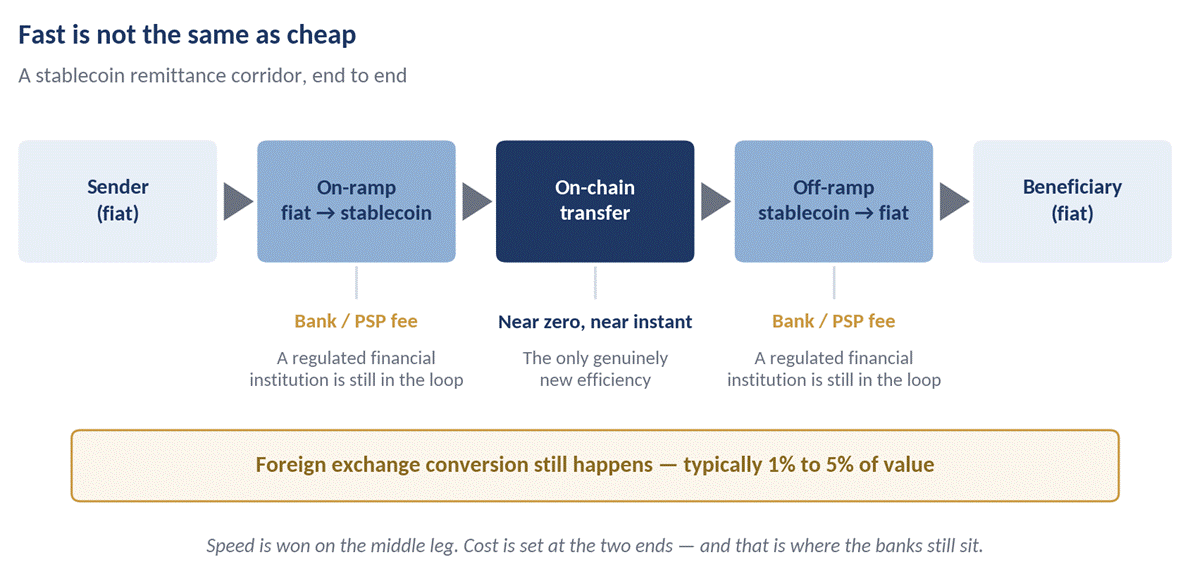
There is nonetheless a real retail opportunity. Infrastructure providers that aggregate volume can compress the margins banks currently charge on small-ticket remittances, and a single platform is simply more convenient than the correspondent chain. But that depends on two things: regulation settling, and banks accepting a smaller role in cross-border payments than they hold today.
At the large-corporate end, the case is considerably weaker. High-value transfers on traditional rails are manually validated, and the fee is small relative to the principal. For treasury flows of that size, the existing banking system will be difficult to displace.
My view Stablecoins have a credible retail case on both cost and speed. Institutional and corporate adoption remains an open question.
03 Real-world asset tokenisation: where the value actually sits
Tokenisation of real-world assets (“RWA”) is still nascent, but it addresses problems that genuinely exist. It applies to assets that carry real value; it solves for issuance and distribution; and it lowers the ongoing cost of administering an asset.
The regulatory picture is unsettled. Most jurisdictions already operate demanding capital markets regimes, but tokenised assets do not sit neatly inside them. Some are legislating — the United States is working through the CLARITY Act, which cleared the House in July 2025 and remains before the Senate — while others are still deciding on the right approach. What is striking is how uniformly bullish the major strategy houses are. BCG’s May 2026 analysis sets out the trajectory clearly.
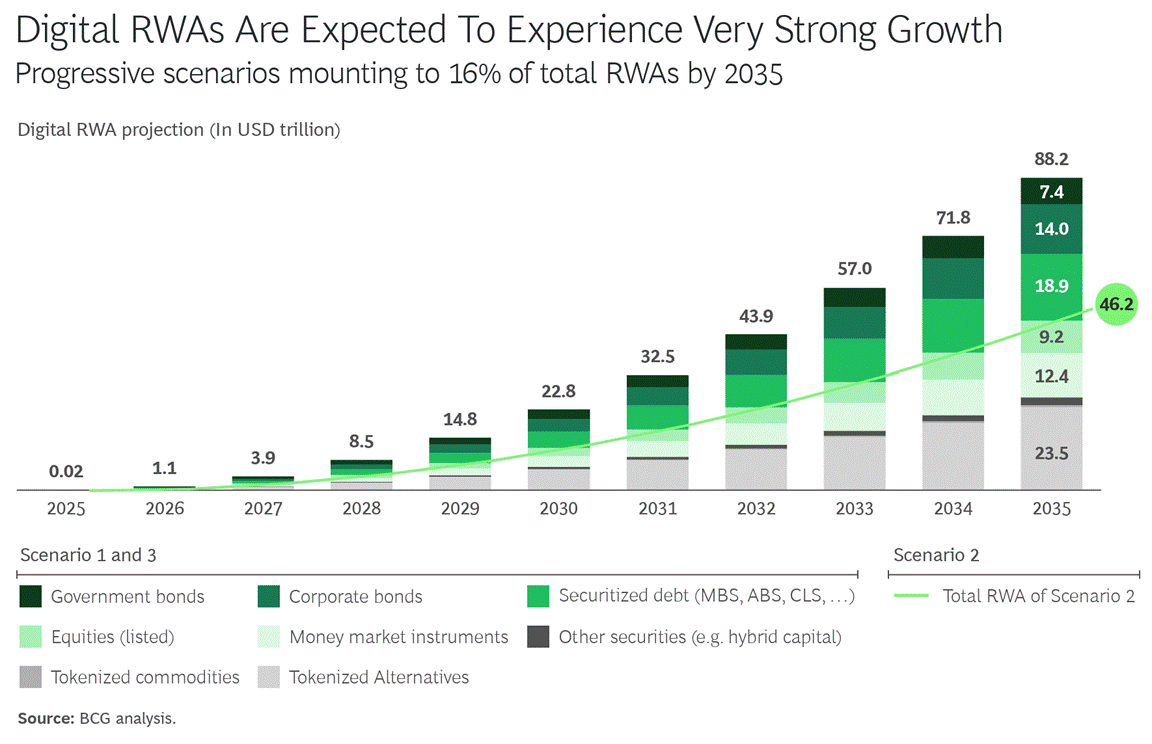
Figure: Digital RWA projection to 2035. Source: BCG, The Future of Digital Assets in Finance (May 2026).
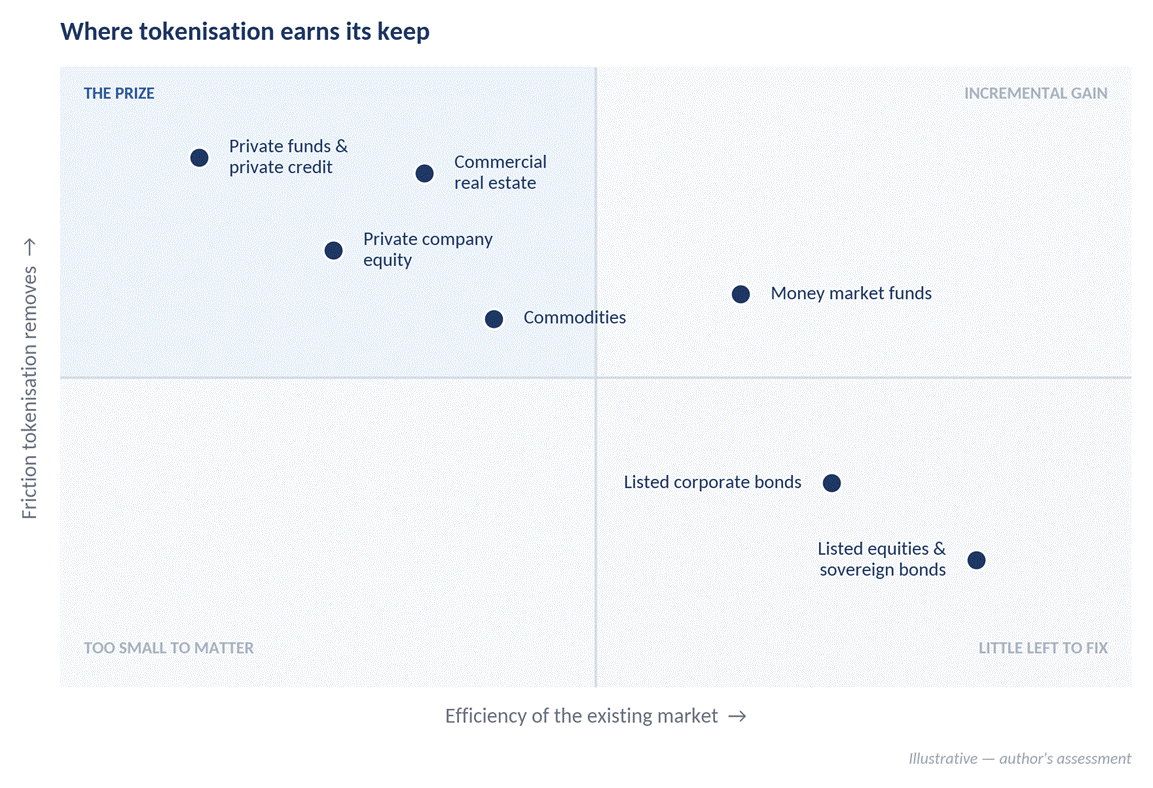
That growth will not be evenly distributed. Where capital markets are already efficient — listed equities, sovereign bonds — tokenisation adds little, because the friction it removes has largely been engineered out already. What tokenisation genuinely contributes is a reliable, technology-native transaction that is accepted without regard to geography. The value therefore concentrates in assets where issuance and distribution remain slow, manual and jurisdictionally trapped.
The direction of travel is already visible. Over the last two to three months, institutions including BlackRock and Mubadala have tokenised more than US$30 billion of private investments.
Two obstacles still stand in the way.
Tokenised assets remain trapped on the platform that issued them. They are not distributed across exchanges. Institutions may be willing to live with that; for retail investors it makes the proposition close to unusable.
Much of what is marketed as tokenisation is not tokenisation. In real estate in particular, offerings such as PRYPCO and Stake provide fractional ownership rather than tokenised ownership, with no peer-to-peer on-chain transfer.
What the market needs is a single deal-management platform, available without geographical restriction, that serves institutions and retail investors on the same rails. That would also achieve something the sector badly needs — separation from the crypto exchanges. At present, governments and investors see tokenised RWAs and cryptocurrencies in the same colour, and that association is the single biggest barrier to acceptance.
My view RWA tokenisation is where DLT finally earns a place in mainstream finance — but only once distribution is solved.
The final take
DLT began with cryptocurrencies at its core and has evolved through stablecoins to real-world assets, each wave broader in economic use than the last. Stablecoin payment infrastructure will keep growing, the constraints above notwithstanding. But the real value will be created by RWA tokenisation, and that is what will drive the next phase of this technology.
Segment
Direction of travel
My verdict
Cryptocurrencies
Consolidation around BTC; capital rotating towards stablecoins and perpetual futures
Little use beyond speculation
Stablecoin payments
Retail-led growth, constrained by on-ramp and off-ramp cost and by FX
Real, but narrower than the headlines suggest
RWA tokenisation
Early but institutionally backed; over US$30 billion already tokenised
The genuine prize, if distribution is solved
The views expressed above are personal and are based on publicly available information as at the date of writing. Nothing here constitutes investment advice.