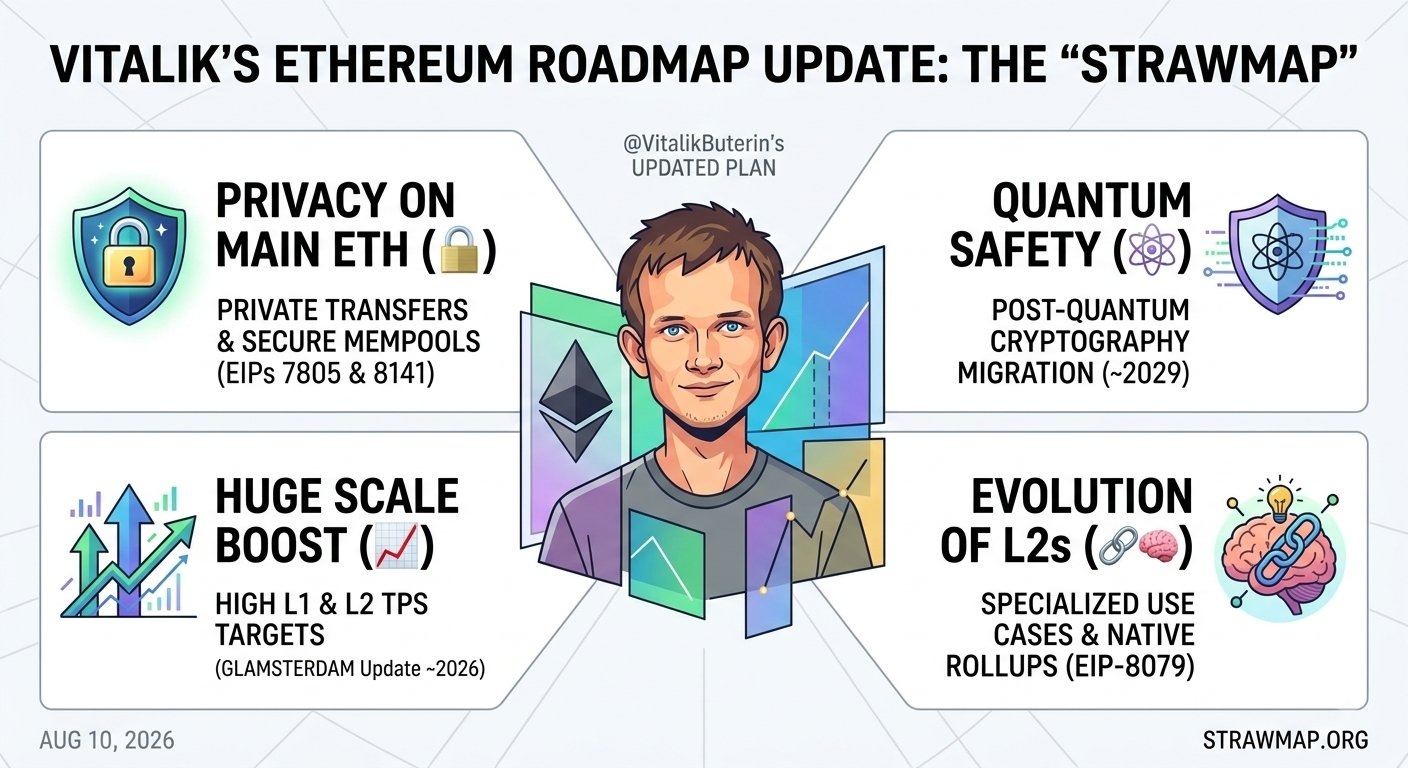

VITALIK HAT SOEBEN ETHEREUMS GROßEN PLAN AKTUALISIERT 🚨👀📅
Am 10. August 2026 stellte @VitalikButerin seinen 2023-Plan neben die neue Strawmap (Ethanreums öffentlicher Entwurf für die nächsten Jahre) auf strawmap.org.
4 Produktänderungen, die Main Ethereum und jedes L2 treffen. ⚙️
1) Privatsphäre auf Main Ethereum (nicht nur in Side-Apps) 🔐
Problem heute:
Bei normalen Ethereum-Transfers kann die Öffentlichkeit normalerweise sehen, wer gesendet hat, wer empfangen hat und wie viel. Institutionen mit riesigem Kapital mögen dieses Modell nicht.
Ziel:
Menschen und Unternehmen können Geld auf Main Ethereum bewegen, ohne jedes Detail der ganzen Welt zu veröffentlichen.
Was sie bauen wollen, in einfachen Worten:
✅ Privates Geld bewegt sich auf Main Ethereum
✅ Es ist für einen Validator schwieriger, deine private Transaktion aus dem nächsten Block herauszuhalten
Bedeutung:
Deine private Transaktion liegt zuerst im Mempool (dem Pool unbestätigter Transaktionen, die darauf warten, in einen Block aufgenommen zu werden).
Ein Validator hilft zu entscheiden, welche Mempool-Transaktionen in den nächsten Block kommen.
Heute kann ein Validator deine Transaktion absichtlich überspringen, sodass sie nie bestätigt wird.
EIP-7805 macht das schwieriger: Wenn viele ehrliche Netzwerk-Knoten deine Transaktion schon in der Mempool gesehen haben, wird erwartet, dass der Block sie aufnimmt.
✅ Wallets können die digitale Signaturmethode wechseln, die verwendet wird, um einen Send freizugeben
Wörtliche Bedeutung:
Um Coins zu senden, muss dein Wallet eine digitale Signatur erstellen (mathematischer Beweis, dass du diese Transaktion genehmigt hast).
Heute verwenden die meisten Wallets eine alte Signaturmethode.
EIP-8141 ermöglicht es Wallets, neuere Signaturmethoden zu verwenden.
Diese neueren Methoden helfen jetzt bei privaten Transaktionen und später bei quantensicheren Wallets.
Wann:
Der Großteil davon zielt auf die Hegotá-Phase ab (nach Glamsterdam). Grobes Zeitfenster: Ende 2026 bis 2027.
2) Quanten-Sicherheit (zukünftige Computer, die die alte Kryptografie- Mathematik knacken können) ⚛️🛡️
Heute verwendet Ethereum digitale Signaturen, um zu beweisen: „Dieses Wallet hat diese Überweisung erlaubt.“
Ein starkes zukünftiges Quantencomputersystem könnte diese alte Mathematik knacken.
So wollen sie es tun (einfache Route):
🟥 Nutzer bekommen EIP-8141, damit Wallets im Laufe der Zeit auf quantensichere Genehmigungs-Methoden umschalten können
🟧 Validator-Abstimmung neu aufbauen mit hash-basierten Signaturen (neuer Stil, den Quantenmaschinen eher nicht knacken können), dann die größeren Daten mit Beweisen komprimieren, damit das Netzwerk weiterläuft
🟨 Daten und App-Beweise in Richtung STARK-artige / hash-basierte Systeme verschieben, die gegen Quantenangriffe sicherer sind
Wann:
📅 Die Kernarbeiten für Post-Quantum sind um 2029 auf dem Lean-Ethereum-Pfad ausgerichtet
📅 Frühere Wallet-Flexibilität startet früher (EIP-8141 ungefähr im Hegotá-Zeitfenster)
📅 Die vollständige Migration für alle Nutzer und Apps dauert danach länger
3) Main Ethereum will viel schneller werden 📈
Entwurfs-Zielvorgaben zum Skalieren auf dem Strawmap:
💎 Main Ethereum (L1): etwa 10.000/tps Transaktionen pro Sekunde als Zielklasse. (heute 25–30 tps)
💠 Alle L2s zusammen: etwa 10 Millionen Transaktionen pro Sekunde als Zielklasse (hauptsächlich, indem man L2s mehr günstigen Datenraum gibt)
Kurzfristiges Upgrade für Skalierung:
Glamsterdam (ungefähr auf Ende 2026 zielt)
Das bereinigt, wie Blöcke gebaut werden und wie Clients Blockdaten lesen, damit das Netzwerk die Kapazität sicher erhöhen kann.
Der Plan ist NICHT „L2s löschen“.
Der Plan ist: „Main Ethereum stärken – und trotzdem L2s hart skalieren.“
4) Was passiert dann mit den L2s? 🔗🧠
Alte Geschichte (2020–2024):
L2s existieren hauptsächlich, weil Main Ethereum teuer ist.
Leute nutzten @base, @Arbitrum, @Optimism und andere meist für günstigere Gebühren.
Neue Story aus diesem Roadmap:
Ethereum (Main) will schneller, noch privater und quantensicher werden.
L2s bekommen immer noch einen riesigen Datenpfad (das „teragas L2“-Ziel).
Es gibt außerdem EIP-8079 (native Rollups, noch im Entwurf): Einige L2s könnten die eigenen Checks von Main Ethereum wiederverwenden, sodass sie einfacher werden und näher an die Sicherheit des Mainnets kommen.
🟥 Wenn die Gebühren auf Main Ethereum stark fallen, werden reine „ich bin nur günstigeres Ethereum“-L2s darunter leiden
🟨 L2s, die trotzdem gewinnen, sind die mit einem echten zusätzlichen Produkt:
große Nutzerverteilung, besondere App-Regeln, Unternehmens-/Compliance-Bedarf, einzigartige Consumer-Apps oder deutlich bessere UX
🟩 Native Rollups, falls sie ausgeliefert werden, töten keine L2s. Sie machen nur schwerer zu überleben.
Wenn Main Ethereum schneller und privater wird: Brauchen dann die meisten Nutzer immer noch jeden Tag ein L2, oder nur für spezielle Apps?