
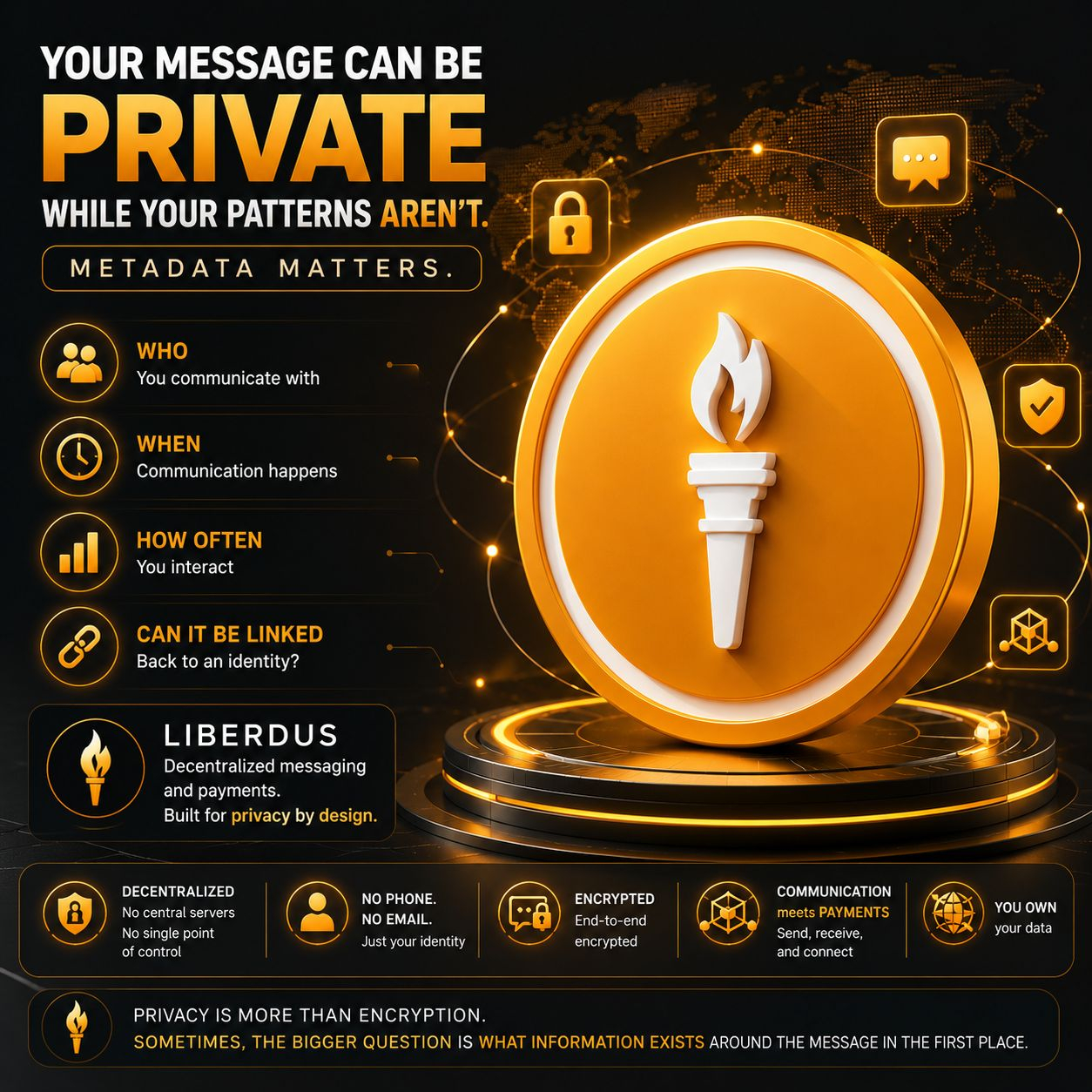
Your message can be private while your communication patterns aren’t.
That’s where metadata matters.
Even when message content is protected by encryption, information like who communicates with whom, when, and how frequently can reveal surprisingly detailed patterns.
Someone may never read your messages, yet still learn who you interact with regularly, when your activity increases, or how often certain accounts communicate.
So privacy shouldn’t stop at:
“Is it encrypted?”
We should also ask:
• What metadata is generated? • Who can access it? • How long is it retained? • Can it be linked to an identity? • Does the system need to collect it at all?
This is where decentralized communication becomes interesting.
Liberdus takes a different architectural approach, combining decentralized messaging and payments with accounts that don't require a phone number or email.
I’ve already talked about the encryption side of Liberdus, and there’s another important part of its security architecture I’ll cover separately.
For this post, the bigger question is:
Instead of asking only, “How securely is our data stored?”
Should we also ask:
“Why does a communication platform need to hold so much of it in the first place?”
That’s the privacy conversation I think deserves more attention.