

For weeks, the White House had been quietly building toward an off-ramp. Let the Strait of Hormuz reopen, call the war won, and worry about the nuclear file some other day. Trump had reportedly floated the idea privately to senior aides: he would walk away without a nuclear deal if Tehran fully restored shipping through the strait, according to U.S. officials who spoke to the Wall Street Journal.
Then Saturday arrived, and Iran named its price. Tehran's list, according to the Journal's sourcing, is no longer modest. Billions of dollars in compensation. A full withdrawal of American forces from the region. An end to the naval blockade that has squeezed Iranian ports for months.
What started as conditions for a broader nuclear settlement have, in the space of a few weeks, hardened into the entry fee for simply letting tankers move again — a shift that narrows Trump's options for wrapping up the war before the midterms, which is exactly the outcome the White House had hoped to avoid.
One administration official described the mission in narrower terms: the U.S. has already met its military objectives against Iran, the official said, and is now focused on restoring the flow of energy through the strait while keeping further strikes on the table if Iran targets ships again.
A President Content to Wait
If the shift rattled Washington, Trump didn't show it. In a brief phone interview with Axios published Sunday, he summed up the administration's posture in five words: "We are low-keying it."
The president framed the standoff as a war of attrition fought with inflation figures rather than airstrikes, telling Axios his administration was content to watch Iran's economy buckle rather than resume major combat operations, given Tehran's mounting inflation and dwindling reserves. Trump had reportedly been leaning toward a return to large-scale strikes just a week earlier, according to officials briefed on the deliberations, before being talked down — one argument being that active fighting lets the Iranian regime avoid confronting the economic wreckage the war has caused.
Asked how it would all end, he reached for a metaphor rather than a prediction, likening the standoff to a long game of chess and betting that patience — as always, he said — would pay off. Separately, officials told Axios that despite the absence of a full Hormuz agreement, roughly eight million barrels a night are already moving out of the Gulf through the strait's southern lane in coordination with the U.S. military. Patience, in other words, is now the stated strategy. Whether Tehran plays along is a different question.
Tehran Insists It Isn't Negotiating
Iran, for its part, wants the world to know it isn't at the table. Foreign Minister Abbas Araghchi told reporters in Tehran on Sunday that no direct talks with Washington are underway, though contact continues through go-betweens: "messages are being exchanged through intermediaries," he said, in remarks carried by Iranian state media.
Araghchi did claim progress was being made with Oman. A deal governing a new shipping route through the strait is close, he said, though he was careful to separate that arrangement from the larger question of reopening Hormuz to unrestricted traffic, which he tied to what Tehran considers unresolved American violations of the June memorandum of understanding. Until Washington makes amends for those violations, he said, there is no basis for negotiations to resume. Qatari and Pakistani mediators had reportedly hoped to announce the Iran-Oman traffic agreement earlier in the week; that timeline slipped, and officials on the American side now describe deepening disagreement inside Iran's own government over how far to bend.
The Red Sea Front Widens
While the diplomatic track stalls, the shooting war keeps spreading south. Yemen's Houthi movement said Sunday it had struck Saudi Aramco's Jazan refinery again, two days after Saudi Arabia signed a defense pact with Turkey and Pakistan built around collective deterrence, under which an attack on any one signatory would be treated as an attack on all three.
Satellite imagery from the European Union's Sentinel-2 orbiter, captured after the claimed strike, showed fire at one storage tank inside the sprawling 400,000-barrel-a-day complex, along with smoke rising from a flare tower on the site's eastern edge — flare towers being the safety valves refineries rely on to burn off excess gas.
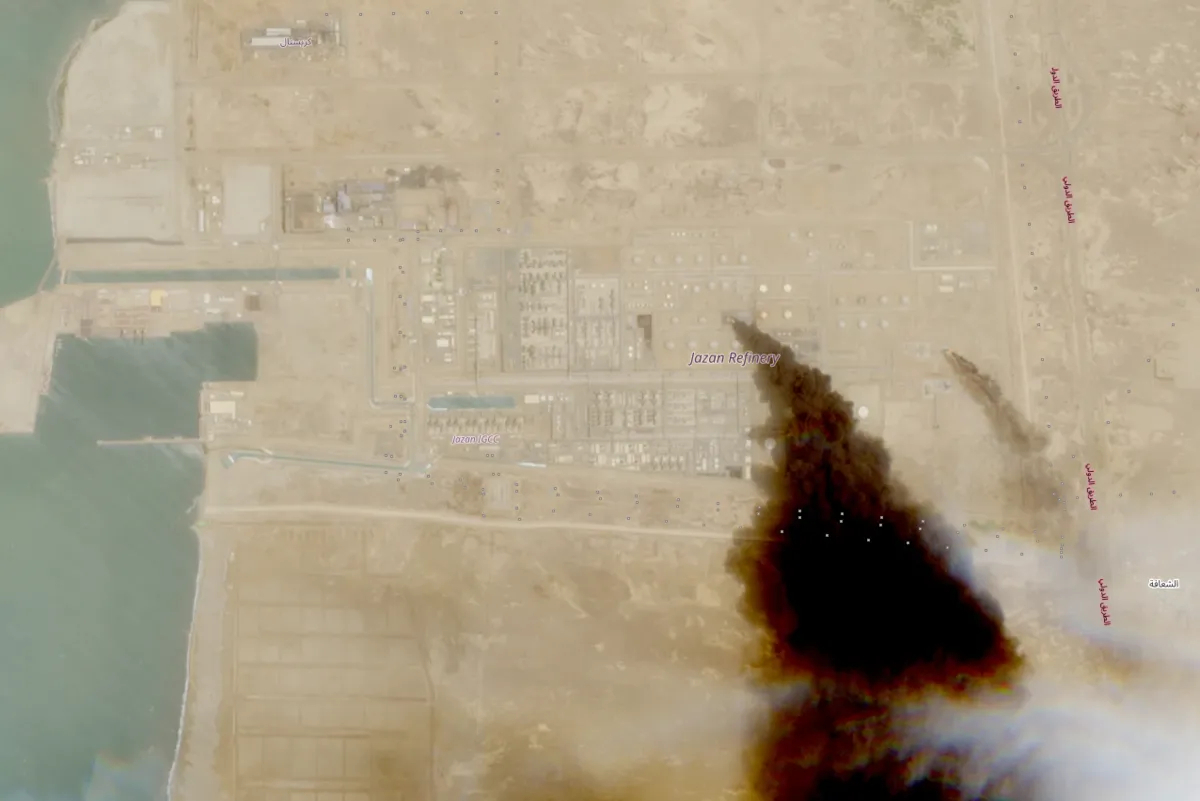
Whether the fire disrupted operations at the plant wasn't immediately clear; the imagery suggests the damage was confined to storage tanks, though smoke drifting over tanks further south made a full assessment difficult. Saudi Arabia's energy ministry confirmed a fire had broken out and was later extinguished, with no injuries reported, without specifying a cause. Houthi military spokesman Yahya Saree said the group used a drone against the Jazan site and claimed a separate strike the same weekend against the export hub at Yanbu, on the kingdom's Red Sea coast — a location the group has hit before.
Hormuz Stays on a Knife's Edge
Back at the strait itself, the maritime security picture darkened further over the weekend. The Joint Maritime Information Center's latest advisory warns that a deliberate, hostile attack in the Strait of Hormuz is highly likely in the days ahead, an assessment issued just after the most recent confirmed incident: an attack on a tanker on August 8 that UK Maritime Trade Operations logged as case number 108-26.
That case involved a vessel belonging to Abu Dhabi's state oil company, ADNOC, struck early Friday morning. Nobody aboard was hurt. A fire that broke out during the attack was extinguished, and the tanker completed its voyage, returning safely to Fujairah. UKMTO has recorded the incident as an attack on an unidentified tanker, bringing the tally of confirmed maritime security incidents in the region since March 1 to 84.
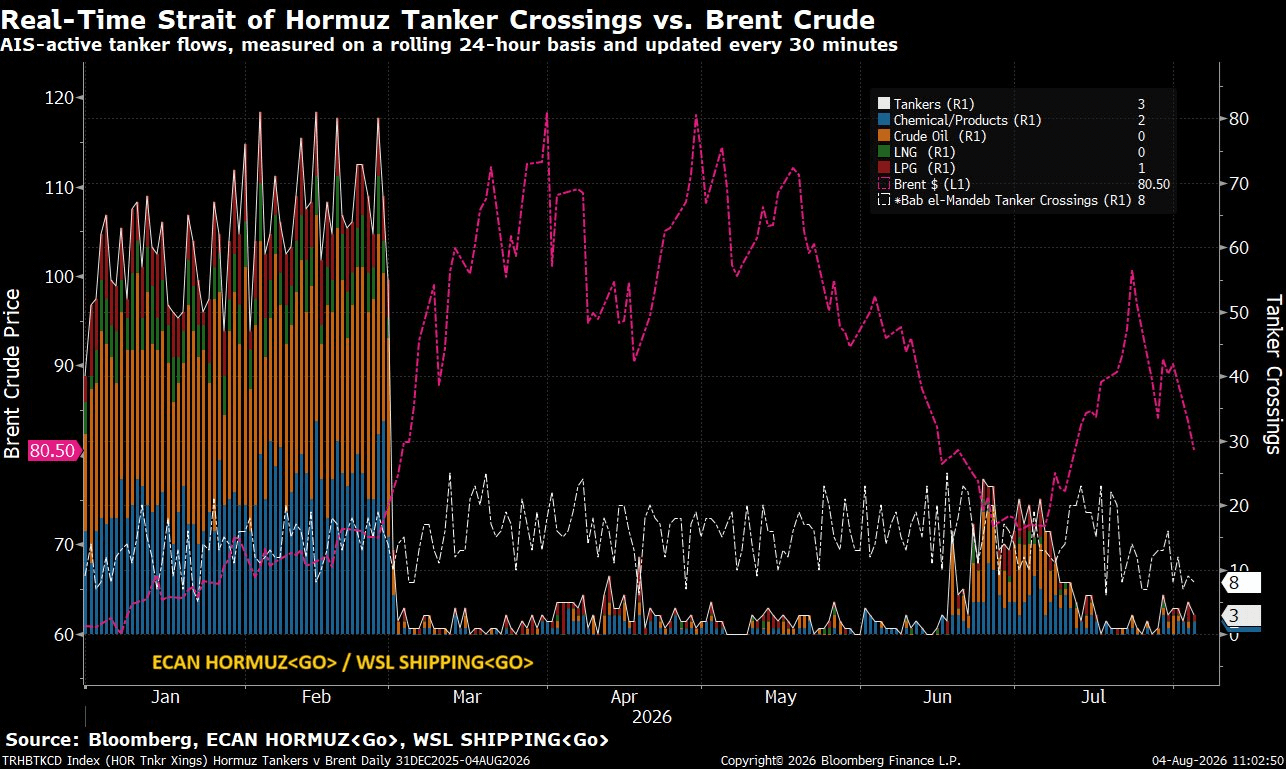
Traffic through the strait has all but evaporated as a result. While roughly 138 vessels a day typically passed through Hormuz last year, only 40 U.S.-facilitated transits were recorded across the three days from August 6 to 8. On August 8 alone, eight cargo vessels made the crossing — six heading east, two west — alongside just two tankers.
Down at Bab el-Mandeb, where the historical daily average runs closer to 61 vessels, 82 transits were logged over that same three-day window, a smaller relative drop, though traffic there remains well short of normal given the blockade the Houthis declared against Saudi-linked shipping in July. The two figures aren't directly comparable, JMIC notes, since the Hormuz count captures only U.S.-facilitated movements while the Bab el-Mandeb figure tracks cargo vessels above 1,000 deadweight tonnes.
The threats extend beyond missiles and drones. Iran's Islamic Revolutionary Guard Corps continues to hail and monitor merchant vessels using drone overflights, according to JMIC, while the waters near Oman's Limah, Khasab and Kumzar have seen a steady pattern of projectile strikes and near-miss explosions. Drifting or uncharted mines remain a hazard in the shipping lanes, the advisory warns, and GPS and navigation-signal jamming continues to disrupt safe passage across the strait, the Gulf of Oman and the wider Arabian Gulf.
Pentagon Tells Contractors to Move Faster
While diplomats haggle over the strait, the Pentagon is confronting a more immediate problem: it is running low on the hardware needed to keep defending against Iranian strikes.
Deputy Defense Secretary Steve Feinberg sent a letter dated August 5 to Boeing, Lockheed Martin, RTX and other major contractors demanding faster production of air-defense sensors, missile interceptors, tracking systems and surveillance equipment, according to a memo reported first by the Washington Post. His message left little room for interpretation: "Years-long development cycles are not acceptable." Companies have until late August to submit plans for accelerated delivery schedules, expanded production capacity, or both.
The urgency reflects months of attrition. U.S. forces have spent the war intercepting Iranian drones and missiles aimed at American bases across the region, and a recent analysis from the Center for Strategic and International Studies warned that stockpiles of Patriot and THAAD interceptors have thinned to the point where commanders may need to ration their use if hostilities resume — a shortage that could, in practice, mean letting more incoming fire through. Feinberg's letter reaches beyond the immediate conflict, too, flagging satellite communications and Lockheed's Next Generation Interceptor, the program meant to shield the U.S. homeland from intercontinental ballistic missiles, as priorities that can no longer wait behind years-long development timelines.
Oil Gives Back the Week's Gains, Then Some
All of that uncertainty showed up in the price of crude. Both benchmarks fell sharply over the trading week of August 3 to 7, whipsawed by a reversal early in the week after Washington called off planned strikes on Iran, a move traders read as opening the door to a diplomatic deal that could put barrels back on the market, before Iran's hardline demands on Saturday scrambled that optimism again. Brent's decline for the week came in at more than 7%, a steeper drop than some early figures suggested, while WTI fell by a comparable margin to settle near $78 a barrel on Friday. Both benchmarks clawed back some ground into the close, with Brent finishing the session back above $83.
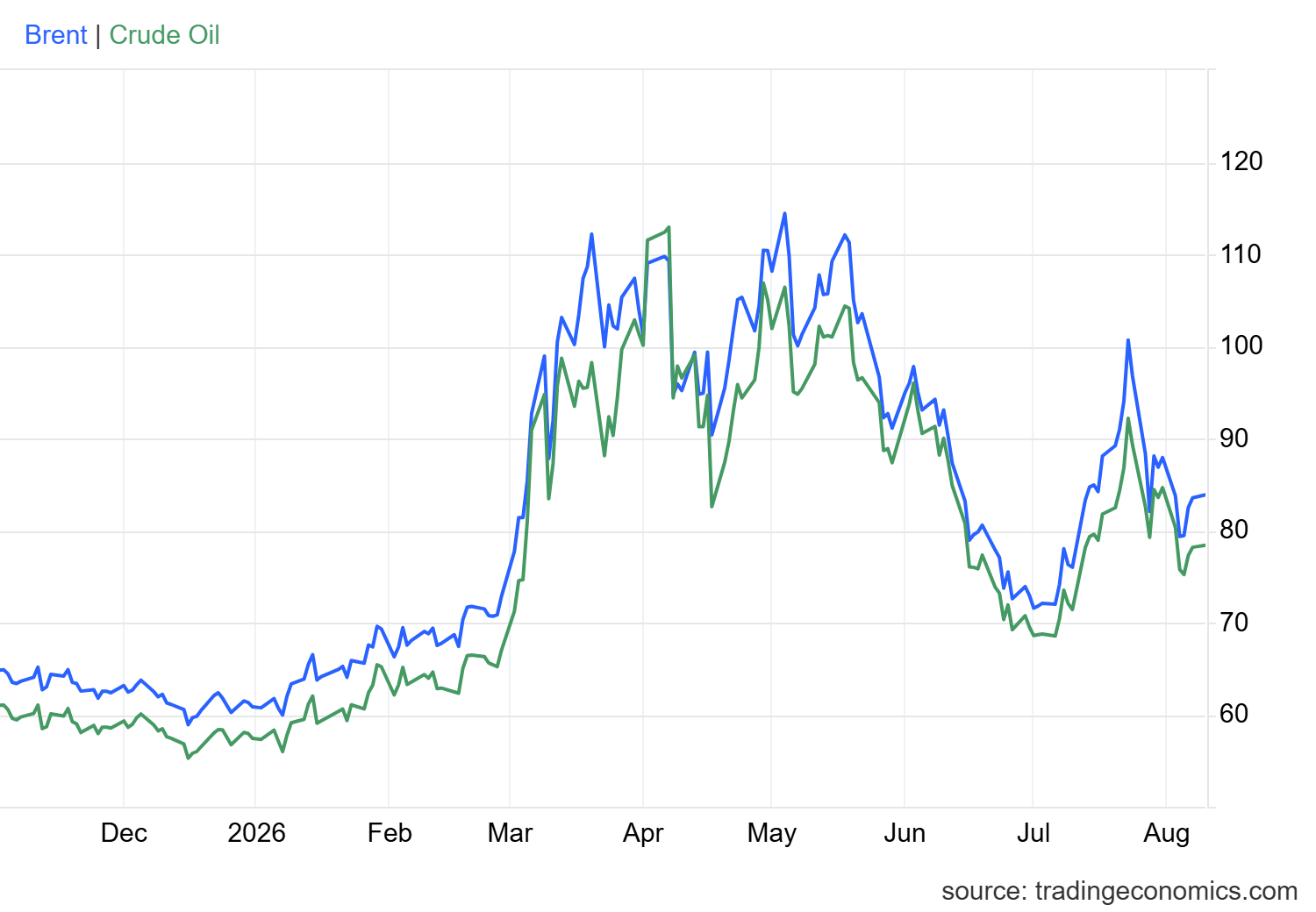
Early Monday trading in Asia showed oil holding onto Friday's modest bounce, with both benchmarks ticking higher — WTI hovering just below $79 a barrel, Brent trading closer to $84 — as the market waited for a clearer signal out of either Muscat or Tehran.
A Second Front for Trump, in Gaza
Iran isn't the only Middle East file testing Trump's patience this week. Israeli Prime Minister Benjamin Netanyahu used a televised cabinet meeting Sunday to restate, unambiguously, that his government will not accept Trump's 15-point plan for ending the war in Gaza, even as Israel's own military has largely paused operations in the territory under pressure from Washington.
The plan, unveiled last month as what Trump called a breakthrough, envisions a phased Israeli withdrawal running in parallel with Hamas's disarmament, backstopped by an international stabilization force working alongside a newly formed Palestinian police service. Netanyahu wants none of that sequencing. "Israel does not accept the 15-point document," he told his ministers, adding that Israeli forces will not move until Hamas is disarmed in full.
Axios's Barak Ravid reported that a senior U.S. official waved off the significance of the remarks, telling him the White House isn't troubled by Netanyahu's statement and views it largely as posturing tied to Israel's own election calendar rather than a substantive break with Washington. Whether that reading holds up is likely to become clear only once Hamas responds to the plan, and once Trump decides how much daylight he's willing to tolerate between his own diplomatic centerpiece and a key partner publicly rejecting it.