

One swap request, one signature, one confirmation — and behind that single interaction, a real decision-making process just picked between potentially dozens of possible paths your trade could have taken. Most traders never see that decision happen. This piece looks at how Omniston, the routing layer behind STON.fi, actually decides where your order goes.
🗨️ "Omniston queries multiple liquidity sources, including AMM DEXs like STON.fi, RFQ resolvers, and soon cross-chain bridges. The protocol analyzes the quotes and determines the optimal path for execution, minimizing slippage and maximizing value." — independent Omniston protocol breakdown, 2025
▔▔▔▔▔▔▔▔▔▔▔▔▔▔▔▔▔▔▔▔▔▔▔▔▔▔▔▔▔▔▔▔▔
🎯 The Four-Step Process Behind Every Route
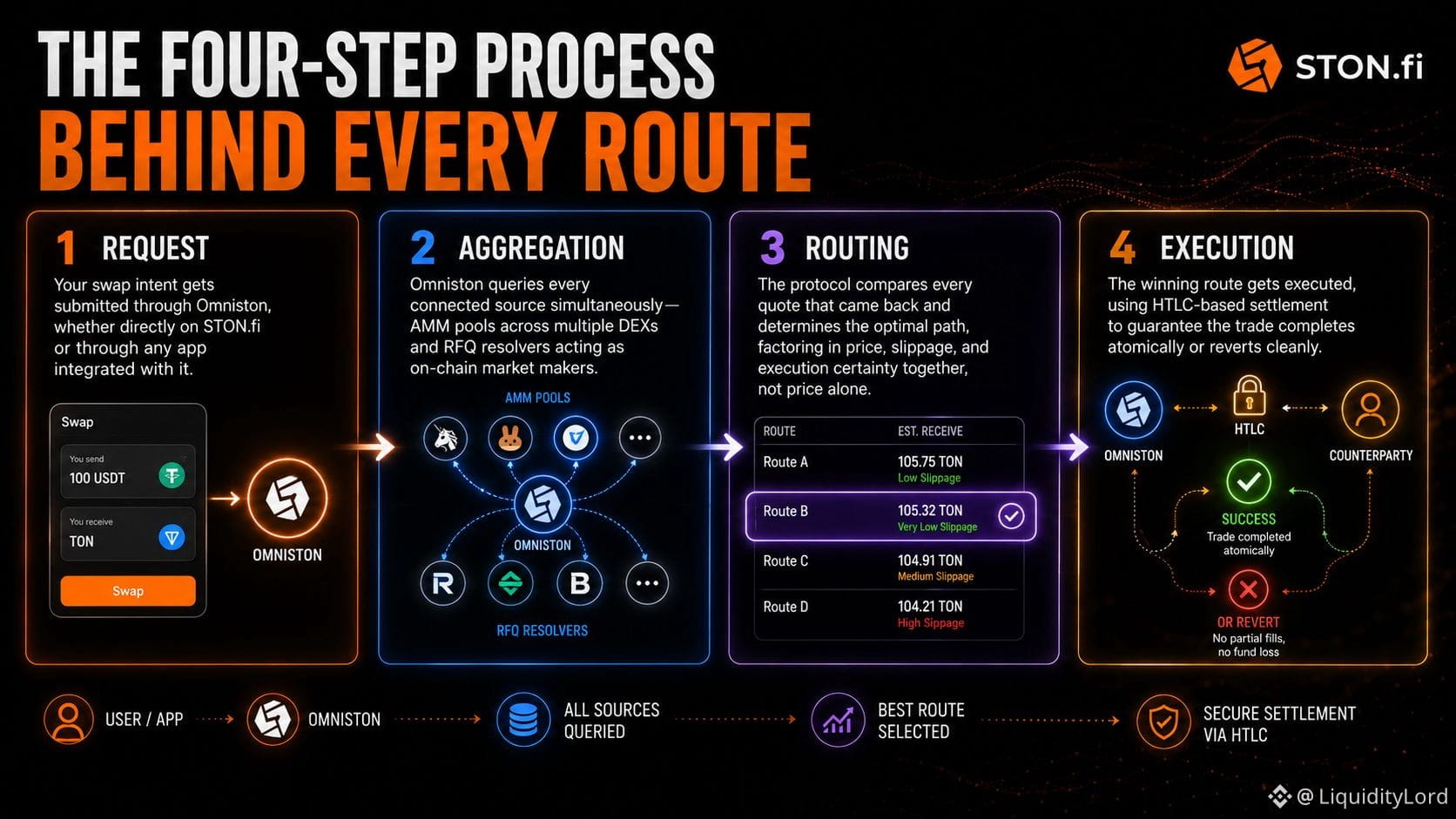
Route selection isn't a single calculation — it's a defined sequence, and each stage narrows down the possibilities before the next one runs:
🔺 Request. Your swap intent gets submitted through Omniston, whether directly on STON.fi or through any app integrated with it.
🔷 Aggregation. Omniston queries every connected source simultaneously — AMM pools across multiple DEXs and RFQ resolvers acting as on-chain market makers.
✴️ Routing. The protocol compares every quote that came back and determines the optimal path, factoring in price, slippage, and execution certainty together, not price alone.
🔶 Execution. The winning route gets executed, using HTLC-based settlement to guarantee the trade completes atomically or reverts cleanly.
That sequence runs in the background of what feels like one instant swap.
▔▔▔▔▔▔▔▔▔▔▔▔▔▔▔▔▔▔▔▔▔▔▔▔▔▔▔▔▔▔▔▔▔
The Part That Actually Surprised Me: "Best" Isn't Always One Pool
The instinct is to assume "best route" means "the single best-priced pool." That's often true, but not always — and the cases where it isn't are exactly where routing earns its keep.
🗨️ "Omniston figures out the best route, whether it uses one pool or splits the trade across multiple DEXs. All I see is the final, optimized rate." — STON.fi user writeup, Medium, 2025
Behind that "optimized rate" is a route that can be a single pool, a multi-hop path through an intermediate token, or a trade split across several venues at once — each piece routed to wherever it individually performs best. The routing engine isn't choosing a venue, it's constructing an execution plan.
▔▔▔▔▔▔▔▔▔▔▔▔▔▔▔▔▔▔▔▔▔▔▔▔▔▔▔▔▔▔▔▔▔
🧭 The Actual Decision Criteria, One by One
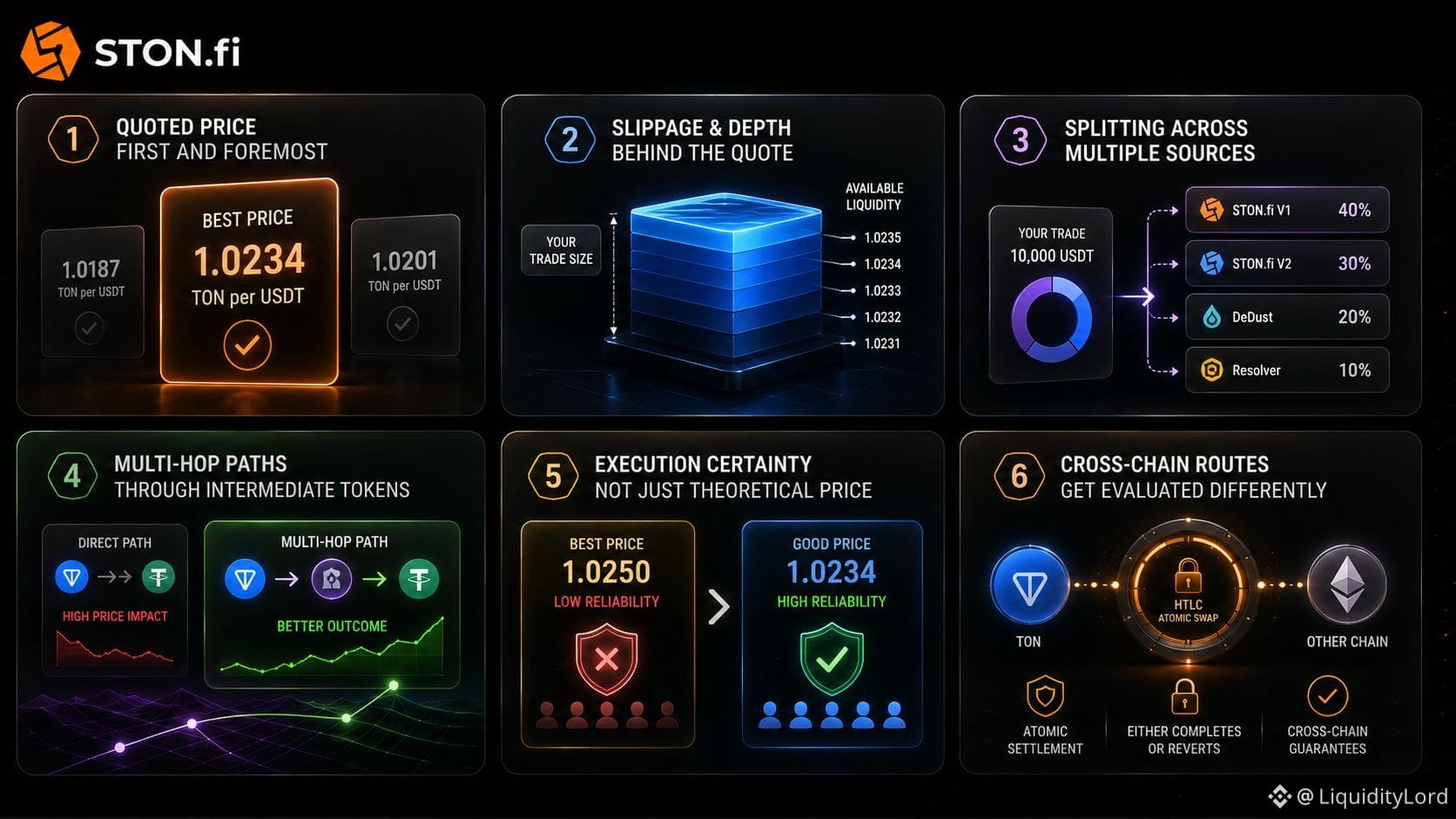
📐 Quoted price, first and foremost Every connected source returns a price for the requested trade, and this remains the primary factor — a route offering a materially worse price than an available alternative rarely wins, all else equal.
💠 Slippage and depth behind the quote A quote isn't just a number; it comes with the depth backing it. Routing accounts for how much of the requested size a source can actually fill at that price, not just the headline rate for a small test amount.
🔻 Splitting across multiple sources when it beats any single one If no single pool or resolver can absorb the full trade size without meaningful price impact, the route can split the order across several sources simultaneously — StonFiV1, StonFiV2, external AMMs like DeDust and TonCo, or resolver liquidity — each portion routed to wherever it individually performs best.
⭐ Multi-hop paths through intermediate tokens When a direct pair lacks deep liquidity, routing can path a trade through an intermediate token instead, provided that indirect path nets a better outcome than forcing the trade through a thin direct pool.
🔷 Execution certainty, not just theoretical price A quote that looks best on paper but comes from a source with weak execution reliability isn't automatically the winner — the protocol weighs whether a route is actually likely to settle on the quoted terms, not just whichever number is largest.
✴️ Cross-chain routes get evaluated differently For swaps crossing between TON and another chain, the same RFQ mechanism applies, but settlement runs through HTLC-based atomic swaps instead of a single-chain transaction — meaning route selection also has to account for cross-chain settlement guarantees, not price alone.
▔▔▔▔▔▔▔▔▔▔▔▔▔▔▔▔▔▔▔▔▔▔▔▔▔▔▔▔▔▔▔▔▔
🗺️ Comparing on the Dimensions That Actually Matter
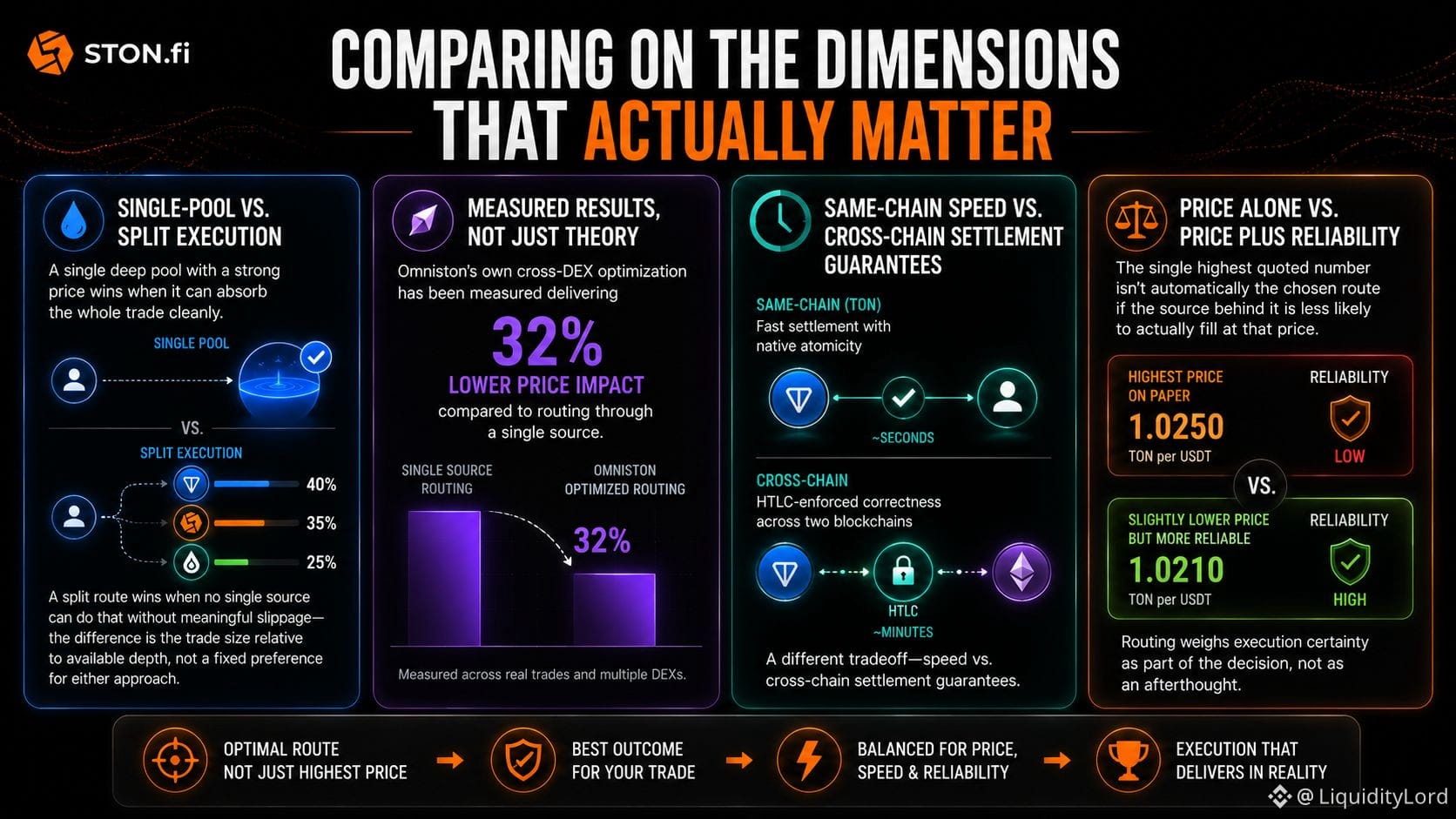
💧 Single-pool vs. split execution. A single deep pool with a strong price wins when it can absorb the whole trade cleanly. A split route wins when no single source can do that without meaningful slippage — the difference is the trade size relative to available depth, not a fixed preference for either approach.
🧭 Measured results, not just theory. Omniston's own cross-DEX optimization has been measured delivering a 32% lower price impact compared to routing through a single source — a concrete, quantified outcome of exactly this decision process, not just a marketing claim.
⏱️ Same-chain speed vs. cross-chain settlement guarantees. A same-chain route settles with TON's native atomicity almost immediately. A cross-chain route trades some of that speed for HTLC-enforced correctness across two separate blockchains — a genuinely different tradeoff, not simply "faster is always better."
⚖️ Price alone vs. price plus reliability. The single highest quoted number isn't automatically the chosen route if the source behind it is less likely to actually fill at that price — routing weighs execution certainty as part of the decision, not as an afterthought.
▔▔▔▔▔▔▔▔▔▔▔▔▔▔▔▔▔▔▔▔▔▔▔▔▔▔▔▔▔▔▔▔▔
✅ What Genuinely Drives the Route Selection
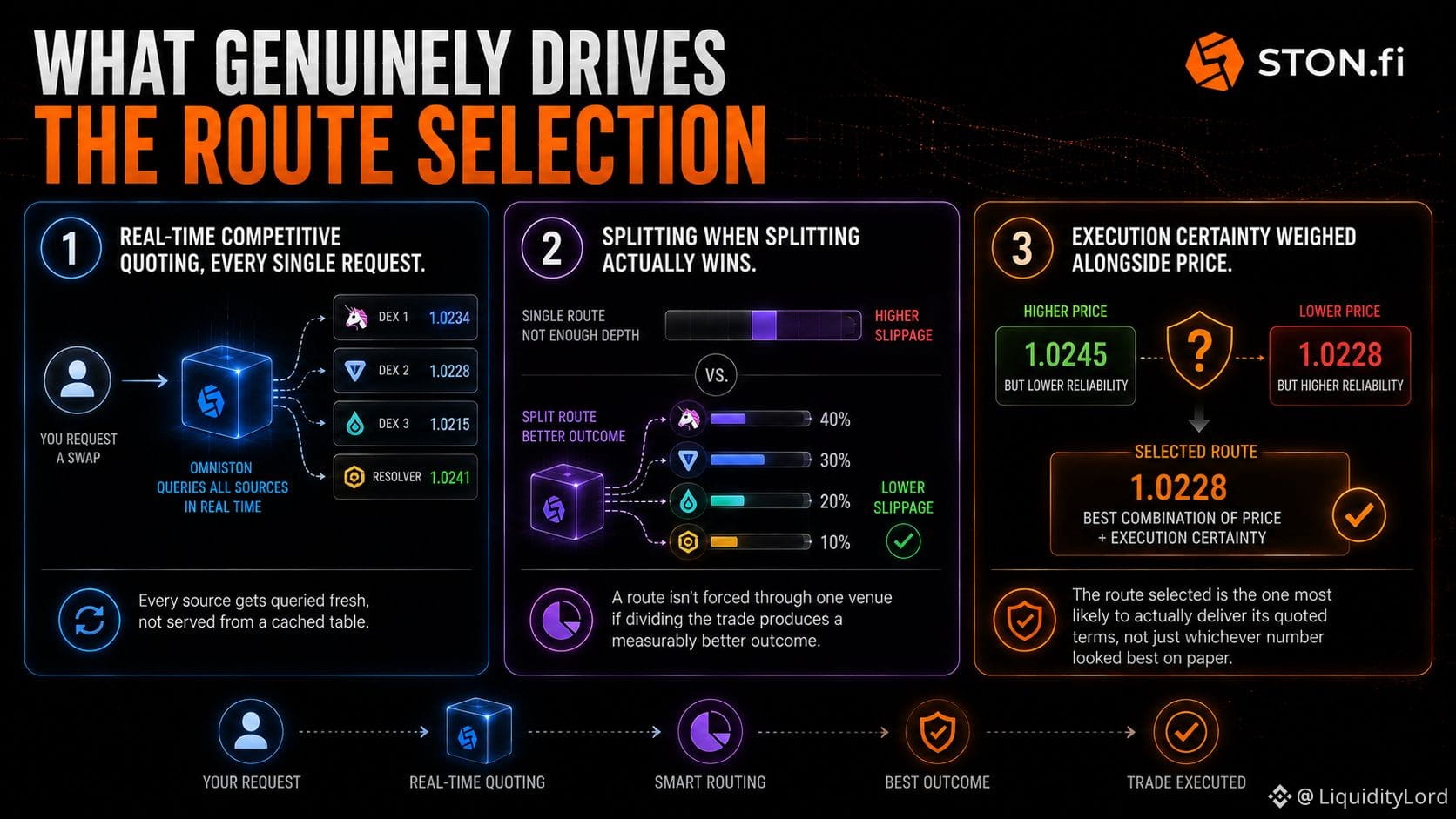
Real-time competitive quoting, every single request. Every source gets queried fresh, not served from a cached comparison table.
Splitting when splitting actually wins. A route isn't forced through one venue if dividing the trade produces a measurably better outcome.
Execution certainty weighed alongside price. The route selected is the one most likely to actually deliver its quoted terms, not just whichever number looked best on paper.
⚠️ What's Worth Understanding Correctly
"Best route" doesn't always mean "single best pool." A split or multi-hop route can outperform any individual venue, and the routing engine treats that as the default possibility, not an exception.
A quoted price still depends on size. The rate returned for a small test amount doesn't guarantee the same rate holds at your actual trade size — depth behind the quote matters as much as the number itself.
Cross-chain routing carries different tradeoffs. HTLC-based settlement adds correctness guarantees a same-chain trade doesn't need, which can affect timing even when the quoted price looks equally competitive.
🏁 Bottom Line
STON.fi's route selection through Omniston isn't a single price comparison — it's a four-step process that queries every connected source in real time, weighs price against depth and execution certainty, and constructs whatever combination of single-pool, split, or multi-hop execution actually produces the best outcome for that specific trade. The measured 32% reduction in price impact from cross-DEX optimization isn't a coincidence; it's the direct, quantified result of that decision process running on every swap, whether the trader ever sees it happen or not.
$XRP
