
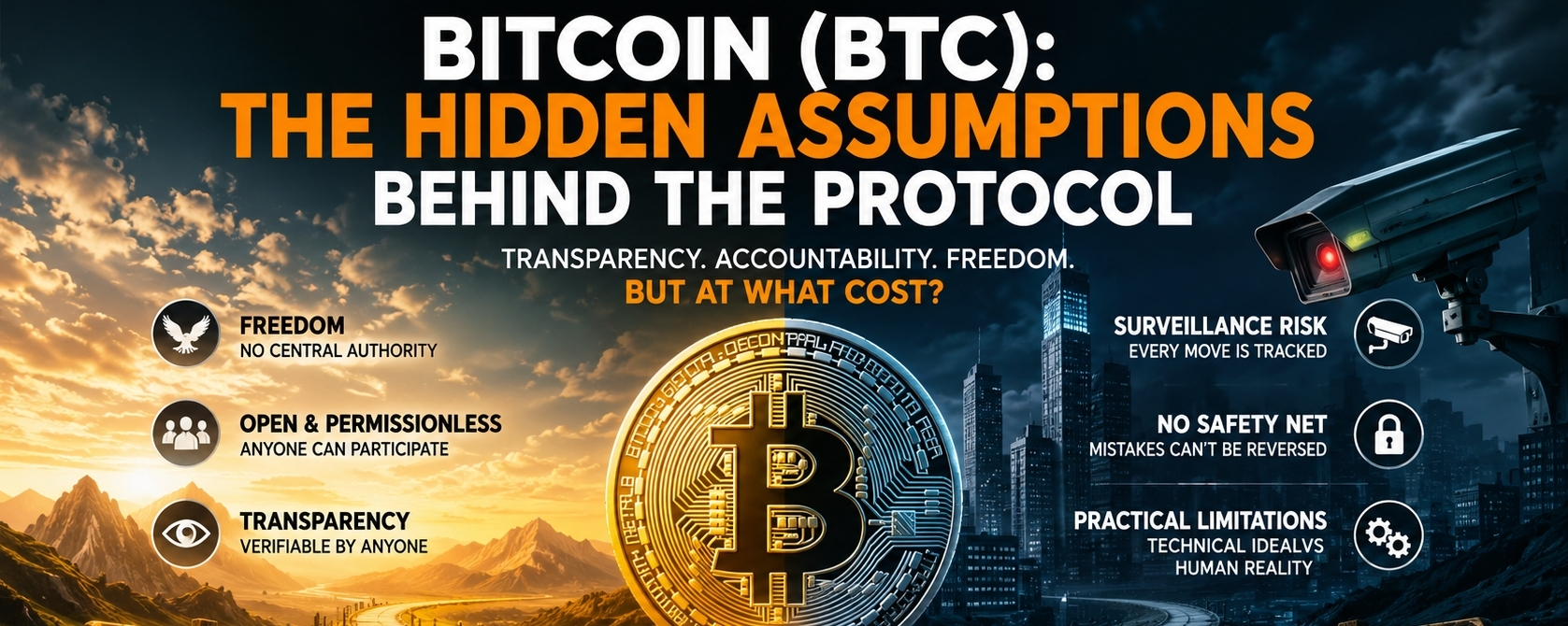

I've been thinking about Bitcoin (BTC) less as a breakthrough technology these days and more as a long-running experiment in what happens when trust is replaced by rules. That assumption still feels powerful, but it also raises questions that don't disappear with time. Transparency gives anyone the ability to verify the system independently, yet the same transparency can become a form of financial surveillance when every transaction leaves a permanent public record. Privacy isn't completely absent, but it often depends on users understanding tools and trade-offs that many never fully grasp.
What keeps Bitcoin (BTC) interesting isn't that it solved every problem—it clearly didn't—but that it exposed the cost of solving one problem by creating another. Accountability without a central authority is valuable because no single institution decides who participates. At the same time, that same resistance to intervention means mistakes, theft, and lost keys often have no practical remedy. Removing control from trusted intermediaries also removes many of the safety nets people have come to expect.
I keep coming back to the idea that Bitcoin (BTC) succeeds not because it's perfect, but because it forces us to rethink assumptions about money itself. Innovation often begins by rejecting old constraints, yet long-term adoption usually depends on working within human realities rather than purely technical ideals. The protocol has remained remarkably consistent, but the debates surrounding it continue to evolve, suggesting that the hardest problems were never just about code—they were always about balancing openness, responsibility, and the imperfect ways people actually use technology.
