
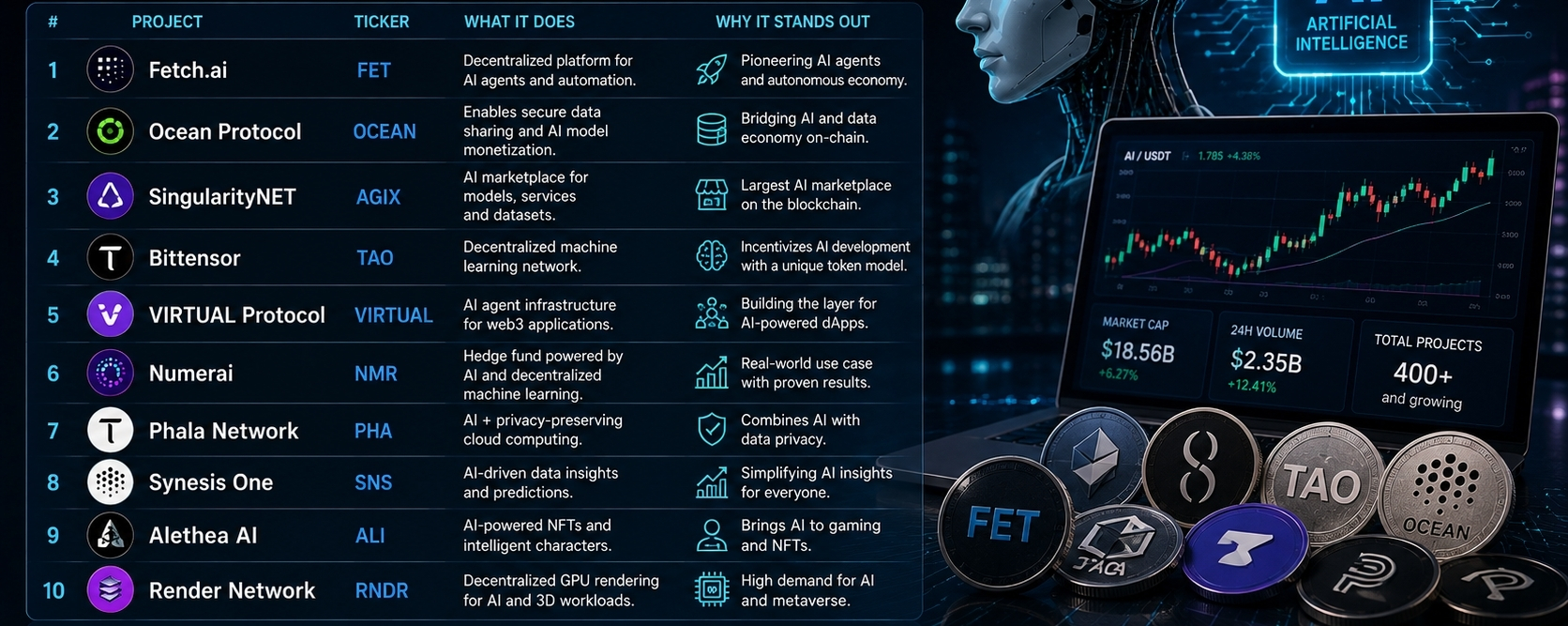

Artificial intelligence remains one of crypto’s most active narratives in 2026. But the sector is becoming more selective: the important question is no longer whether a project uses the word “AI,” but whether it provides useful infrastructure for AI models, agents, computing power or decentralized applications. Binance Academy recently highlighted several projects working across these areas.
Bittensor ($TAO )
Bittensor is one of the best-known decentralized AI networks. Its ecosystem uses specialized subnets where participants compete to provide useful machine-learning and AI-related services.
That makes $TAO interesting because its narrative is directly connected to decentralized intelligence rather than simply adding AI branding to an existing blockchain. Still, research has identified challenges around incentive design and concentration, so adoption and network economics are important to monitor.
Render ($RENDER)
AI requires enormous amounts of computing power, especially GPUs. Render approaches this problem through a distributed GPU network.
The project originally became known for graphics rendering, but GPU infrastructure also has applications in AI workloads. If demand for decentralized computing continues growing, Render could remain an important project at the intersection of AI, crypto and physical computing infrastructure.
Artificial Superintelligence Alliance ($FET)
The Artificial Superintelligence Alliance brings together major AI-focused blockchain efforts, including Fetch.ai, SingularityNET and Ocean Protocol initiatives.
Its broader vision focuses heavily on decentralized AI and autonomous agents. AI agents are particularly interesting because they could eventually perform tasks and interact with blockchain applications with less direct human involvement.
NEAR Protocol ($NEAR)
NEAR is broader than a pure AI token because it is a Layer-1 blockchain, but AI has become an important part of its ecosystem strategy.
The network is exploring infrastructure for AI applications and agents while continuing to provide the underlying blockchain environment developers need to build decentralized applications. Binance Academy lists NEAR among notable projects combining AI and blockchain.
Internet Computer ($ICP)
Internet Computer takes another approach by providing decentralized computing infrastructure capable of hosting applications and services on-chain.
Its AI opportunity comes from combining this computing environment with AI-powered applications. The challenge will be proving that decentralized infrastructure can provide meaningful advantages for AI developers compared with conventional cloud services.
Akash Network ($AKT)
Akash focuses on decentralized cloud computing. Instead of AI developers relying entirely on large centralized cloud providers, Akash aims to create a marketplace where computing resources can be supplied through a decentralized network.
As AI demand increases the need for compute, decentralized cloud infrastructure could become an interesting supporting sector for the wider AI economy.
Story ($IP)
Story brings a different angle to the AI narrative: intellectual property. AI creates complicated questions around ownership, licensing and the use of creative material.
Story is building blockchain infrastructure around programmable intellectual property. That could become increasingly relevant if creators and AI developers need better systems for tracking ownership and licensing digital content. Binance Academy includes Story among notable AI-and-blockchain projects in its July 2026 overview.
What Matters More Than the AI Hype?
The AI crypto sector is still emerging, and research has pointed out that some projects remain heavily dependent on off-chain computation or have yet to demonstrate clear advantages over centralized alternatives.
That means real users, developer activity, useful computing infrastructure, sustainable token utility and actual demand matter more than simply having an AI narrative.
$TAO, $RENDER, $FET, $NEAR, $ICP, $AKT and $IP represent different parts of the AI-crypto stack—from decentralized intelligence and AI agents to GPUs, cloud computing and intellectual property.
The projects that ultimately matter most may be the ones that turn the AI narrative into something people actually use.
For educational purposes only, not financial advice