
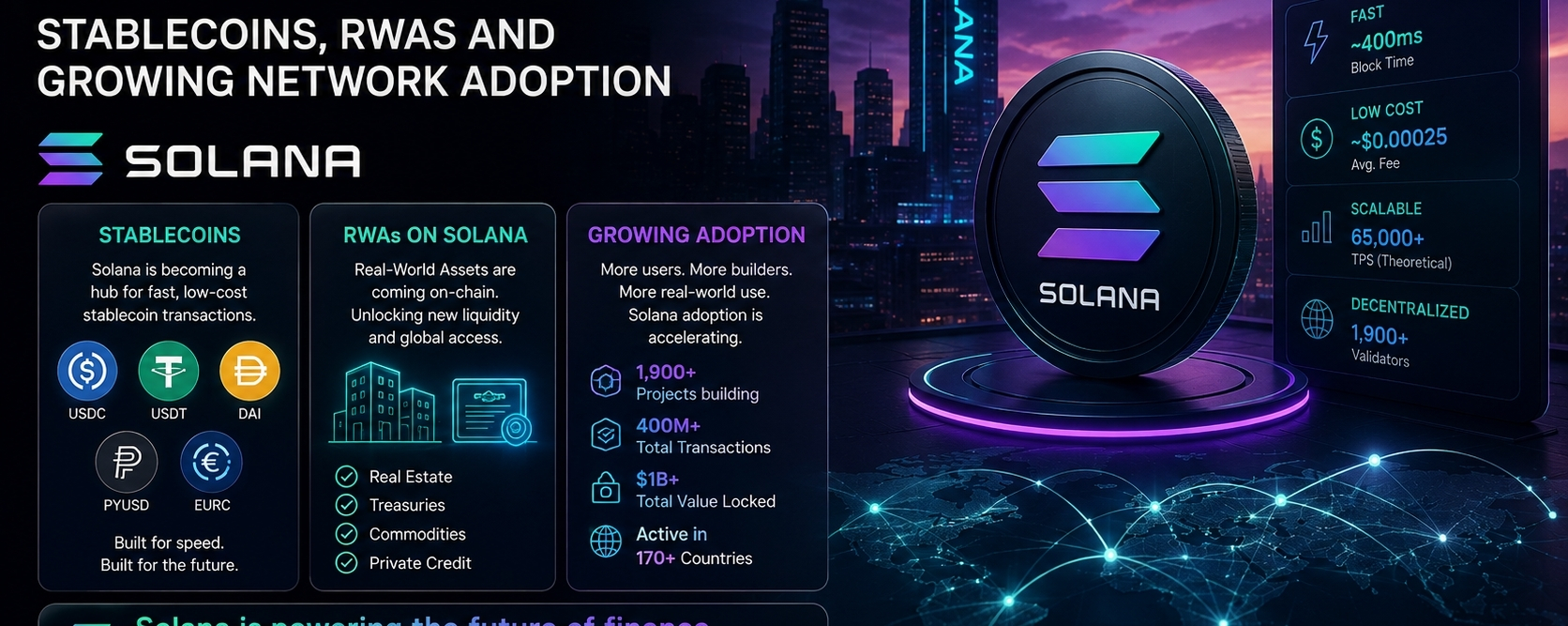

Solana is entering an important phase of its development. The conversation around the network is no longer limited to fast transactions, memecoins or NFT activity. Increasingly, attention is shifting toward stablecoin payments, tokenized real-world assets (RWAs), institutional infrastructure and everyday blockchain applications.
Stablecoins Could Become a Major Growth Engine
Stablecoins are one of the clearest examples of practical blockchain usage. They allow users to move dollar-linked value on-chain without dealing with the volatility normally associated with cryptocurrencies.
Solana's combination of fast settlement and relatively low transaction costs makes it suitable for stablecoin transfers. Major stablecoins such as USDC and USDT operate on Solana, giving the network infrastructure that can support payments, trading and DeFi.
If stablecoin usage continues expanding globally, the networks processing those transactions could benefit from higher activity and deeper liquidity.
RWAs Bring Traditional Finance On-Chain
Real-world asset tokenization is another major opportunity. RWAs can represent assets such as government securities, funds, stocks or commodities on a blockchain.
Solana already hosts tokenized financial products, and major asset managers have explored the network. [BlackRock](https://www.blackrock.com/?utm_source=chatgpt.com), for example, expanded its BUIDL tokenized money-market fund to Solana in 2025.
That matters because institutional participation could create a different kind of network activity from speculative crypto trading. Instead of depending mainly on market hype, blockchain infrastructure could increasingly be used to issue, transfer and manage traditional financial assets digitally.
Payments Are Another Important Opportunity
Solana's speed makes payments an obvious use case. A blockchain payment can potentially operate continuously and settle without relying on the same processes used by traditional card networks.
[Visa](https://www.visa.com/?utm_source=chatgpt.com) has previously used Solana as part of its stablecoin settlement work, demonstrating that established payment companies are experimenting with public blockchain infrastructure.
The bigger opportunity is not simply people paying directly with SOL. Stablecoins running on Solana could potentially become the more important payment layer.
DeFi Is Still Part of the Story
Solana also has an active decentralized-finance ecosystem covering decentralized exchanges, lending, liquid staking and other financial applications.
Growing stablecoin liquidity can strengthen this ecosystem because stablecoins are heavily used across DeFi. More liquidity can support trading and lending activity, which can then attract additional users and developers.
This creates a possible cycle: more assets → more liquidity → more applications → more users → greater network activity.
Institutional Adoption Could Change Solana's Image
For years, Solana was often associated with highly speculative crypto activity. That remains part of its ecosystem, but institutional adoption could gradually broaden that image.
If banks, payment companies, fintech platforms and asset managers increasingly use Solana-based infrastructure, the network could become more closely associated with financial settlement and tokenization.
That transition would arguably be more important for Solana's long-term future than any single memecoin cycle.
What Could Slow the Growth?
Competition remains intense. Ethereum and its Layer-2 networks are also pursuing stablecoins, RWAs and institutional adoption, while other Layer-1 networks want the same users and liquidity.
Solana therefore needs to demonstrate more than transaction speed. Reliability, decentralization, developer activity, security and sustainable application demand will all matter.
Network adoption should also be measured by genuine economic activity rather than transaction numbers alone.
The Bigger Picture for $SOL
Solana's next chapter could be very different from its previous one.
Memecoins and speculative trading helped bring enormous attention to the network, but stablecoins, RWAs, payments and institutional applications could provide more sustainable sources of demand.
For investors watching $SOL, the most important question may therefore be shifting from “How high can SOL go?” to “How much real financial activity can Solana attract?”
If that activity keeps expanding, Solana could strengthen its position as more than a fast Layer-1 it could become an increasingly important part of on-chain financial infrastructure.
For educational purposes only, not financial advice.