
Retail trading tools have optimized the wrong variable for a decade. Charting got faster, data got cheaper, execution got tighter. None of that touched the actual bottleneck, which is that a market runs 1,440 minutes a day and a human runs roughly 40 before attention fragments.
TradeOS is a bet that the bottleneck is an interface problem. The economic structure underneath it, a chain that takes a share of application revenue instead of collecting rent, is a separate bet worth examining on its own terms.
Attention Is the Binding Constraint, and Both Existing Fixes Fail
Two products already claim to solve the coverage gap.
Price alerts compress a thesis into a threshold. The trader sets a level because a squeeze was compressing or a moving average was about to cross, and the alert preserves the level while discarding everything that made it meaningful. The result is a notification at 3am with no context, which reliably produces decisions on wicks that reverse within seconds.
Automated strategies fail from the other side. They preserve the logic and hide it behind a subscription and a backtest curve. A trader cannot interrogate why the system went flat for eleven days, and cannot adjust it without writing code in Pine Script or Python. That requirement eliminates most people who hold opinions worth encoding.
The common root is the encoding layer. Turning a view into something that runs has meant either collapsing it to one number or expressing it in a programming language.
From Prompt to Persistent Agent
TradeOS accepts a sentence.
"Analyze QQQ 1D chart with Trend Analysis using Moving Average, MACD, Squeeze Momentum, ATR."
That string instantiates an agent. The agent runs continuously against the named assets, drawing from a universe the platform lists at over 13,000 instruments spanning equities, crypto, forex, commodities, ETFs, and thematic baskets including AI compute, defense tech, and copper and uranium.
Output arrives as a verdict in a feed rather than a ping. "NVDA Trend Analysis, Detected 3 Trends." "Gold Trend Analysis, Detected 0 Trends." A zero is a usable result, because it confirms the described condition is absent rather than leaving the trader guessing whether anything ran.
Indicators attach as composable objects. Moving Average, MACD, Squeeze Momentum, ATR, Ichimoku, SuperTrend, Z-Score Bands, and market-structure tools such as BOS and MSS are selectable rather than programmable. The agent handles composition. The trader handles description.
This preserves what alerts throw away and exposes what bots conceal. The reasoning survives, and it survives in a form the trader can read and edit.
The Indicator Catalog Is Where the Defensibility Lives
The chat interface will get copied. Every competitor with a language model and a data feed can ship a prompt box within a quarter.
The layer that resists copying is Alpha Indicators, a catalog of analytical primitives with public subscriber counts attached.
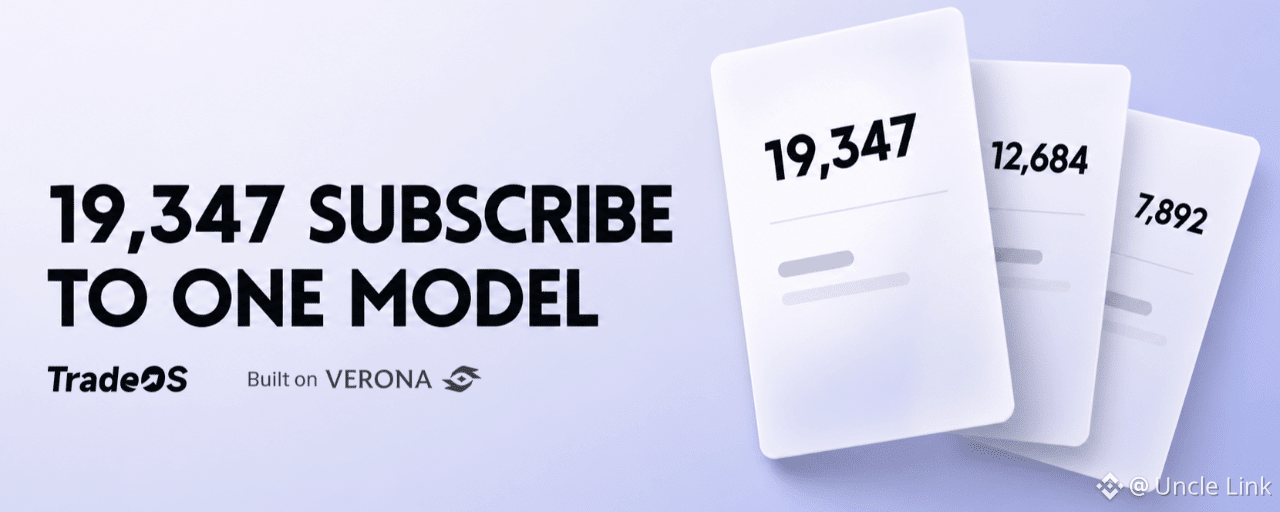
S&P 500 Premarket carries 19,347 subscribers, analyzing premarket gap-ups and volume spikes to forecast the open. BTC Prediction Model carries 16,582, built on order book imbalances, liquidity sweeps, and funding rates. DXY sits at 13,914, the VIX at 11,203, the US 10-Year Treasury Yield at 8,761, and Options Flow Analytics at 7,438.
The tail is more informative than the head. Fed Decision pulls 5,829 subscribers by tracking implied FOMC probabilities from decentralized prediction markets, positioned explicitly as a higher-frequency alternative to CME FedWatch. US Treasury Curve pulls 4,617 by quantifying 2s10s and 3m10s spreads as a recession signal. BTC Orderbook Depth pulls 1,736 by reading notional-weighted bid and ask ratios across venues to locate liquidity walls.
Packaged strategies carry heavier numbers. Gold vs SPY holds 49,500 subscribers, Ether Pulse 43,200, Market Mirror 40,300, and Z-score Arbitrage 38,100.
Read those figures as evidence of two-sided behavior. A trader with a genuine edge in premarket gap dynamics no longer needs to build a platform to monetize it, and a trader without that edge can rent it immediately rather than spending two quarters rebuilding it badly. Supply sides take years to assemble and are the reason platforms survive competitors with better feature lists.
Verona Runs a Revenue Share, Not a Rent
TradeOS is built on Verona, the chain from Burnt, and Verona earns a share of what the applications on it earn.
That arrangement diverges sharply from standard chain economics. The conventional model collects gas fees and distributes ecosystem grants, which means the chain profits from raw transaction volume regardless of whether any application on top ever becomes a business. Incentives point toward activity, and activity is cheap to manufacture.
A revenue share points the incentive somewhere harder to fake. Verona is paid when TradeOS is paid, so wash activity and inflated wallet counts produce nothing for the chain.
The structural consequence is selection. A landlord accepts any tenant who covers rent and has no stake in whether the tenant's business survives the year. A revenue-share partner has to underwrite, because a dormant application on the network contributes zero. That pushes a chain toward fewer and better applications, which is an unusual posture in an industry that has spent years optimizing for deployment counts.
The second input is provenance. The teams behind these rails handled money at eBay, PayPal, ByteDance, and American Express. Payment infrastructure at that scale produces a specific and useful bias, because those operators have watched a bad rail cost real money and someone's job. They select for reliability under sustained load rather than for peak throughput on a slide.
For an agent platform this is more than a credential. An agent fleet running 24/7 across 13,000 instruments generates continuous state, and settlement, custody, and permissioning have to hold at 4am on a Sunday with nobody watching the dashboard.
What to Watch Over the Next Two Quarters
TradeOS is free to start and took a Product Hunt Product of the Day slot, which measures launch execution rather than durability.
Two metrics carry real signal.
The first is the shape of the indicator catalog. If the top three indicators retain the overwhelming majority of subscribers, TradeOS is a product with a leaderboard attached. If indicators ranked twentieth through hundredth begin pulling four-figure subscriber counts, a market has formed and the platform stops depending on any individual publisher.
The second is whether other applications adopt Verona under the same revenue-share terms. One application on a partnership model is a deal. Several applications on the same terms, with the chain visibly declining others, would establish revenue share as a working alternative to grant-funded ecosystem growth.
The prompt box is the demo. The tail of the catalog and the second signed application are the evidence.
verona.tradeos.xyz