
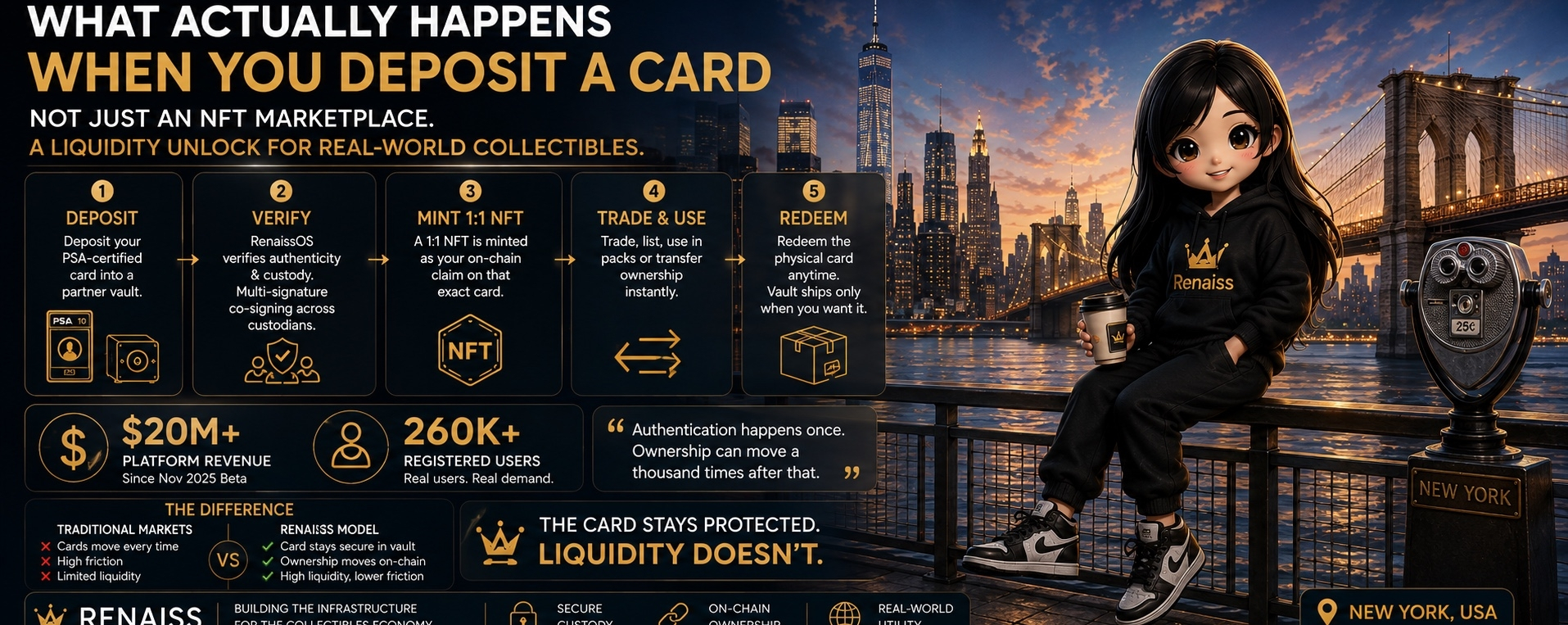

Most people scrolling past @Renaissxyz assume it's another NFT marketplace with a collectibles theme.
It isn't.
And I think that's why many people are missing what the product is actually building.
Here's what really happens.
You deposit a PSA certified physical trading card into a partner vault.
RenaissOS verifies its authenticity and custody, then issues a 1:1 on chain NFT representing ownership of that exact physical card. Verification is secured through cryptographic multi signature validation across custodians rather than relying on a single centralized database.
From that point onward, the card doesn't need to move every time ownership changes.
You can trade it.
List it on the marketplace.
Use it in collectible packs.
Transfer ownership instantly.
Or redeem the physical card whenever you choose.
The vault only ships the asset when someone actually wants the physical collectible back.
That may sound like a small change.
I think it's the entire business model.
Traditional collectible markets repeatedly move the asset.
Renaiss keeps the asset secure and lets ownership move instead.
That dramatically reduces friction while making collectibles significantly more liquid.
The interesting part isn't the technology.
It's the outcome.
According to publicly shared figures, Renaiss has generated more than $20 million in platform revenue and attracted over 260,000 registered users since its Beta launched in November 2025, all before introducing a native token economy.
To me, that's the strongest validation possible.
People aren't participating because they're farming incentives.
They're paying because the product solves a real problem.
That also changes how I think about the project's future.
Many crypto projects launch a token first and hope demand follows.
Renaiss appears to be doing the opposite.
Build the marketplace.
Prove people will use it.
Generate revenue.
Then let any future token expand an ecosystem that already has real economic activity.
That's a much stronger foundation.
The biggest innovation here isn't turning collectibles into NFTs.
It's separating ownership from physical movement.
The card stays protected.
Liquidity doesn't.
And I think that's the distinction many people still haven't noticed.
What do you think is the bigger breakthrough for RWA: putting assets on chain, or making traditionally illiquid assets trade like digital ones?
@Renaissxyz $ACE