
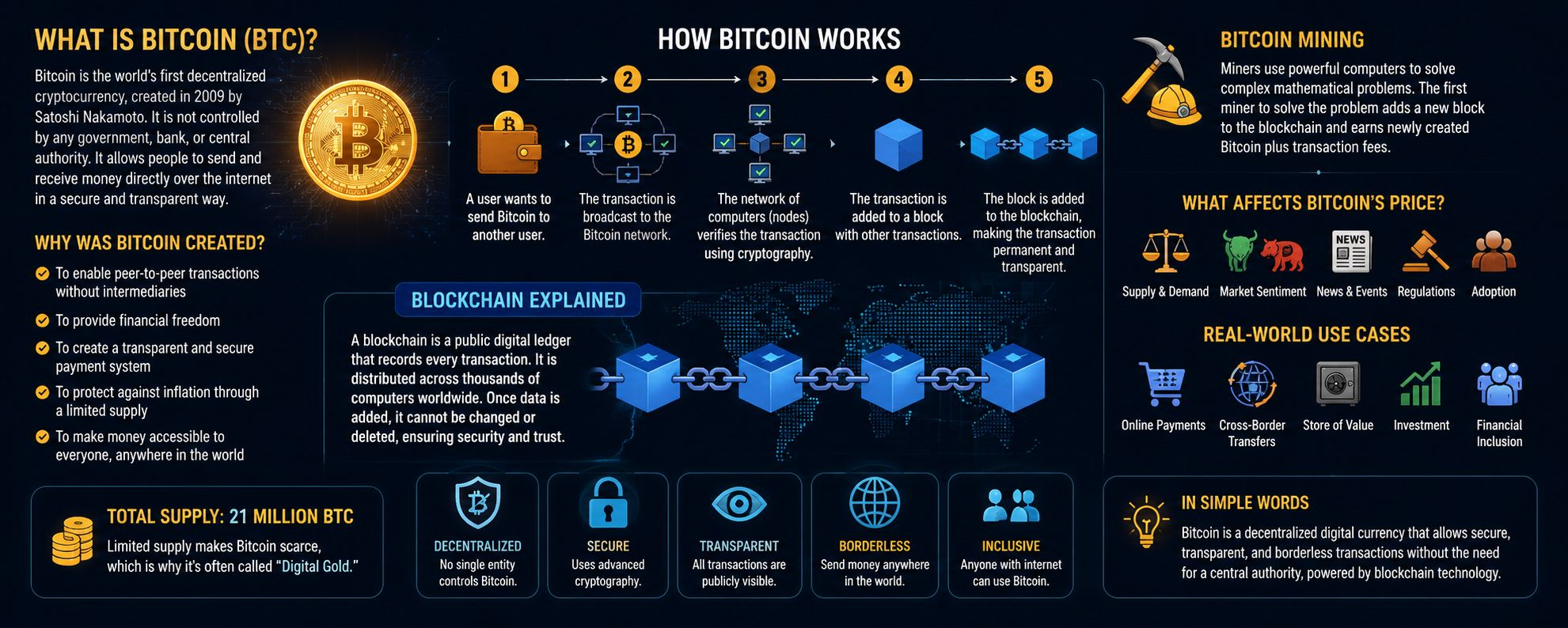
Bitcoin (BTC) is the world's first decentralized cryptocurrency and the foundation of the modern crypto industry. It was introduced in 2009 by an anonymous person or group using the name Satoshi Nakamoto. Unlike traditional currencies such as the US Dollar, Euro, or Indian Rupee, Bitcoin is not issued or controlled by any government, bank, or central authority. Instead, it operates on a decentralized network where thousands of computers around the world work together to maintain the system.
The idea behind Bitcoin was simple but revolutionary: create a digital form of money that anyone could send or receive without depending on banks or financial institutions. Before Bitcoin, online payments usually required trusted third parties to verify transactions. Satoshi Nakamoto believed that people should be able to exchange value directly with each other, just like handing over cash, but in a secure digital environment.
One of Bitcoin's most important features is decentralization. No single organization has the power to control the network, freeze accounts, or print more coins whenever it wants. Every transaction is verified by participants on the network, making Bitcoin transparent, secure, and resistant to censorship.
Bitcoin works using a technology called blockchain. A blockchain is a public digital ledger that records every Bitcoin transaction ever made. Think of it as a giant online accounting book that is shared across thousands of computers worldwide. Every transaction is grouped into a "block," and each new block is connected to the previous one, forming a continuous chain. Once information is added to the blockchain, it becomes extremely difficult to change or delete, ensuring the integrity of the network.
When someone sends Bitcoin, the transaction follows a simple process. First, the sender uses a crypto wallet to create and sign the transaction with a private key. The transaction is then broadcast to the Bitcoin network, where thousands of computers verify that the sender actually owns the Bitcoin being spent and that the same coins have not already been used. After verification, the transaction is added to a new block, which becomes part of the blockchain. Once confirmed, the receiver gains access to the Bitcoin.
Another important part of the Bitcoin ecosystem is mining. Mining is the process through which specialized computers validate transactions and secure the network. Miners compete to solve complex mathematical problems, and the first miner to solve the problem earns the right to add the next block to the blockchain. As a reward, miners receive newly created Bitcoin along with transaction fees paid by users. Mining not only creates new Bitcoin but also keeps the network decentralized and secure.
Unlike traditional currencies, Bitcoin has a fixed supply. Only 21 million BTC will ever exist. This limited supply is built directly into Bitcoin's code and cannot be changed without overwhelming agreement from the network. Because of this scarcity, many investors compare Bitcoin to gold and often refer to it as "Digital Gold." While governments can print more money during economic crises, Bitcoin's supply remains predictable, making it attractive to people looking for protection against inflation.
Bitcoin's price is determined by supply and demand. When more people want to buy Bitcoin than sell it, the price rises. When selling pressure increases, the price falls. Many factors influence Bitcoin's market value, including investor sentiment, institutional adoption, government regulations, macroeconomic conditions, technological developments, and global financial events. This is why Bitcoin is known for its price volatility.
Security is another major strength of Bitcoin. Every wallet is protected by cryptographic keys. A public key works like an account number that people can use to send Bitcoin to you, while a private key acts like a secret password that gives you control over your funds. Anyone who gains access to your private key can spend your Bitcoin, which is why protecting it is extremely important.
Bitcoin has several real-world use cases. It allows people to send money across borders without relying on banks, often at lower costs than traditional international transfers. Many investors hold Bitcoin as a long-term asset because they believe its limited supply will increase its value over time. Businesses in various countries accept Bitcoin as payment, and in some regions it has even become legal tender. It also provides financial access to people who may not have access to traditional banking services.
Although Bitcoin offers many advantages, it also has challenges. Its price can fluctuate significantly, transaction speeds may be slower during periods of high network activity, and users are responsible for securing their own wallets. Losing access to a private key usually means losing access to the associated Bitcoin permanently. Governments around the world also continue to develop regulations that could affect its adoption and use.
Over the years, Bitcoin has inspired the creation of thousands of other cryptocurrencies, often called altcoins. While many of these projects focus on smart contracts, decentralized finance (DeFi), gaming, artificial intelligence, or other specialized applications, Bitcoin remains the largest and most recognized cryptocurrency in the world. It is widely viewed as the benchmark for the entire crypto market.
In conclusion, Bitcoin is much more than just a digital coin. It introduced the concept of decentralized money, proved that secure peer-to-peer transactions are possible without intermediaries, and laid the foundation for blockchain technology. Whether viewed as a payment system, a store of value, or an innovative financial technology, Bitcoin has permanently changed how people think about money and digital ownership. As adoption continues to grow, Bitcoin is likely to remain one of the most influential innovations in the history of finance and technology.