

@Dusk Network is a blockchain project that only truly clicks once you stop viewing it through a typical crypto lens and instead approach it from the perspective of traditional financial institutions. Launched in 2018, Dusk was never designed to chase hype, viral narratives, or retail speculation. Its mission has always been more focused and far more complex: enabling blockchain-based finance that satisfies regulatory demands without sacrificing privacy. While most blockchains embrace radical transparency as a default feature, Dusk begins with a different premise—within financial systems, unrestricted transparency often creates more problems than it solves.
At its core, Dusk tackles a fundamental issue that has long limited blockchain adoption in regulated environments. Public blockchains reveal too much. Transaction histories, balances, and smart contract interactions are permanently visible to everyone. That openness may suit experimental or permissionless systems, but it becomes unworkable when dealing with regulated securities, institutional trading desks, or confidential corporate activity. Banks cannot expose customer balances. Corporations cannot publicly display internal capital movements. Regulators require visibility, but not universal disclosure. Legacy financial systems function because they balance confidentiality with accountability. Dusk’s argument is that blockchain infrastructure should follow the same principle.
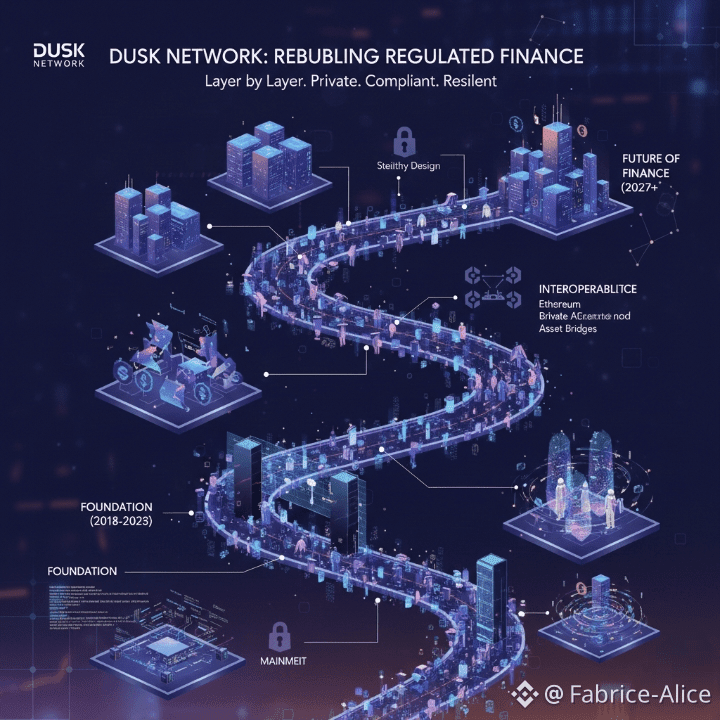
Instead of treating privacy and compliance as add-ons, Dusk embeds them directly into the protocol. The network allows on-chain activity to remain confidential by default while still enabling verification and audits by approved parties. This is not about evading oversight; it is about minimizing unnecessary data exposure while preserving the defining strengths of blockchain systems—immutability, provable execution, and final settlement.
From a technical standpoint, Dusk is built with a clean, modular architecture. The base layer handles consensus, security, and settlement finality, and it is optimized for deterministic outcomes and fast resolution—both critical for financial instruments. Once a transaction is finalized on Dusk, it is final in both technical and legal terms. On top of this foundation, the network supports multiple execution environments tailored to different application needs. Some require deep privacy guarantees and zero-knowledge verification, while others prioritize compatibility with existing Ethereum tooling. Dusk deliberately avoids enforcing a single execution model across all use cases.
This architectural flexibility is one of Dusk’s understated strengths. The network includes a native privacy-focused execution environment that integrates zero-knowledge proofs, enabling smart contracts whose logic can be verified without revealing sensitive data. Alongside this, Dusk also offers an Ethereum-compatible environment, allowing Solidity contracts and familiar development tools to be used with minimal changes. Both environments ultimately settle on the same base layer, sharing security and finality despite serving very different purposes.
The transaction model reflects this same adaptable philosophy. Dusk supports both transparent, account-based transactions and fully shielded, output-based transfers within a single system. Applications and users can choose the appropriate level of privacy depending on context. Routine interactions can remain public and efficient, while sensitive financial operations can be protected without relying on external privacy layers or mixers. This adaptability is essential in regulated settings, where confidentiality requirements vary by transaction type.
Consensus on Dusk is achieved through a proof-of-stake system built around committee-based participation rather than network-wide voting. In each round, one group proposes blocks, another verifies them, and a third provides ratification. Once ratified, blocks achieve immediate finality. There is no probabilistic settlement or risk of deep reorganizations. For financial infrastructure, this certainty often matters more than maximum throughput. Reliable settlement is a prerequisite for trust.
The DUSK token serves a functional, infrastructure-focused role within the ecosystem. It is used to pay transaction fees, deploy smart contracts, and secure the network through staking. Validators stake DUSK to participate in consensus and earn rewards for maintaining network integrity. While inflation exists, it is designed to decline gradually over time, with issuance decreasing as the network matures. Transaction fees are redistributed to validators, aligning network usage with long-term security incentives.
Staking on Dusk is designed to be inclusive rather than restrictive. Any participant who meets the minimum requirements can operate a node. Penalties for misbehavior are generally soft rather than aggressively punitive, reflecting an emphasis on network stability over adversarial economics. Over time, the protocol also enables smart contracts and services to stake on behalf of users, paving the way for institutional staking products and liquid staking solutions without compromising core security assumptions.
Dusk also distinguishes itself through its approach to interoperability. Rather than operating in isolation, the network is designed to connect with the broader blockchain ecosystem. By supporting Ethereum compatibility and standardized cross-chain communication, Dusk enables assets and data to move between networks while maintaining compliance constraints. Assets issued on Dusk are not confined to its ecosystem; they can be bridged or integrated elsewhere using established infrastructure instead of bespoke solutions.
This focus on interoperability is backed by real-world partnerships rather than abstract promises. One of Dusk’s most notable collaborations involves a regulated European exchange that issues and trades tokenized equities and bonds. These are not experimental representations or synthetic assets, but legally recognized financial instruments issued under existing regulatory frameworks and settled on-chain. This kind of deployment reflects the practical use cases blockchain has long aspired to support.
To accommodate institutional requirements, Dusk integrates with professional custody providers, allowing assets to be held securely without reliance on retail wallets or centralized exchanges. The network also supports regulated stablecoins, including euro-denominated digital currencies issued under European compliance standards. This enables on-chain payments, dividends, and settlements using instruments that institutions and regulators already recognize.
Growth within the Dusk ecosystem has been deliberate rather than explosive. The main network launched after extensive research and prolonged testnet phases. Validator participation has expanded steadily, resulting in a decentralized set of operators securing the chain. Rather than prioritizing aggressive marketing, the project has focused on delivering core infrastructure. As a result, Dusk often remains under the radar despite its technical depth—a reflection of conscious prioritization rather than oversight.
Challenges remain, however. Regulatory frameworks evolve slowly and vary widely across jurisdictions. Even with compliant infrastructure, adoption depends on legal clarity, institutional risk tolerance, and broader market conditions. On the technical side, Dusk relies on advanced cryptographic systems that demand flawless implementation. Privacy-preserving technologies leave little margin for error. Competition is also increasing, with other platforms pursuing similar goals from both blockchain-native and traditional finance origins.
Scalability presents another open question. Issuing tokenized assets is only the first step; building liquid, global markets around them is far more complex. Dusk’s long-term success will depend on whether substantial economic activity chooses to settle on-chain rather than merely being mirrored there. Achieving this will require patience and sustained collaboration with institutions that are, by nature, cautious and methodical.
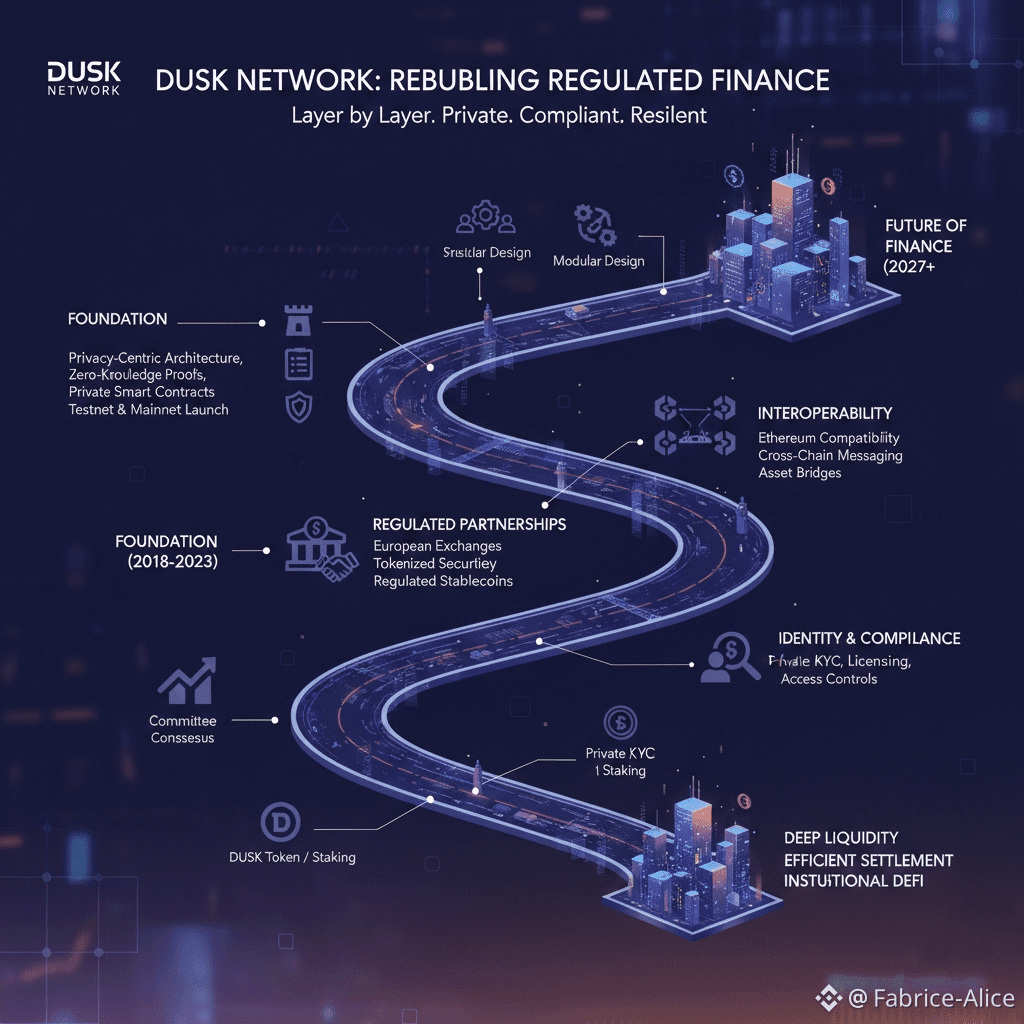
Looking ahead, Dusk’s roadmap remains consistent with its original vision. Plans focus on expanding execution environments, enhancing interoperability, and onboarding additional regulated partners. Identity and compliance tooling continues to evolve, enabling KYC, licensing, and access controls without compromising user privacy. If successful, this could allow decentralized applications that resemble traditional financial platforms in form while benefiting from blockchain efficiency behind the scenes.
Dusk is not attempting to overhaul the financial system overnight. Instead, it is methodically reconstructing its foundational infrastructure, applying blockchain where it delivers clear advantages and refusing to trade privacy or compliance for convenience. In an industry often driven by speculation and noise, this disciplined approach may prove to be its defining advantage. Whether Dusk ultimately becomes a cornerstone of regulated digital finance or remains a specialized platform will depend on execution, regulation, and timing. Regardless, it already stands out as a thoughtful attempt to reconcile blockchain innovation with the real-world constraints of modern finance.
