Waiting for a transaction to settle can feel surprisingly stressful. Not during a chaotic meme-coin launch, but on an ordinary day when a simple transfer refuses to go through. You watch the wallet spinner, check the gas fee, and realize something important: in financial markets, speed is not a luxury. It is part of risk management.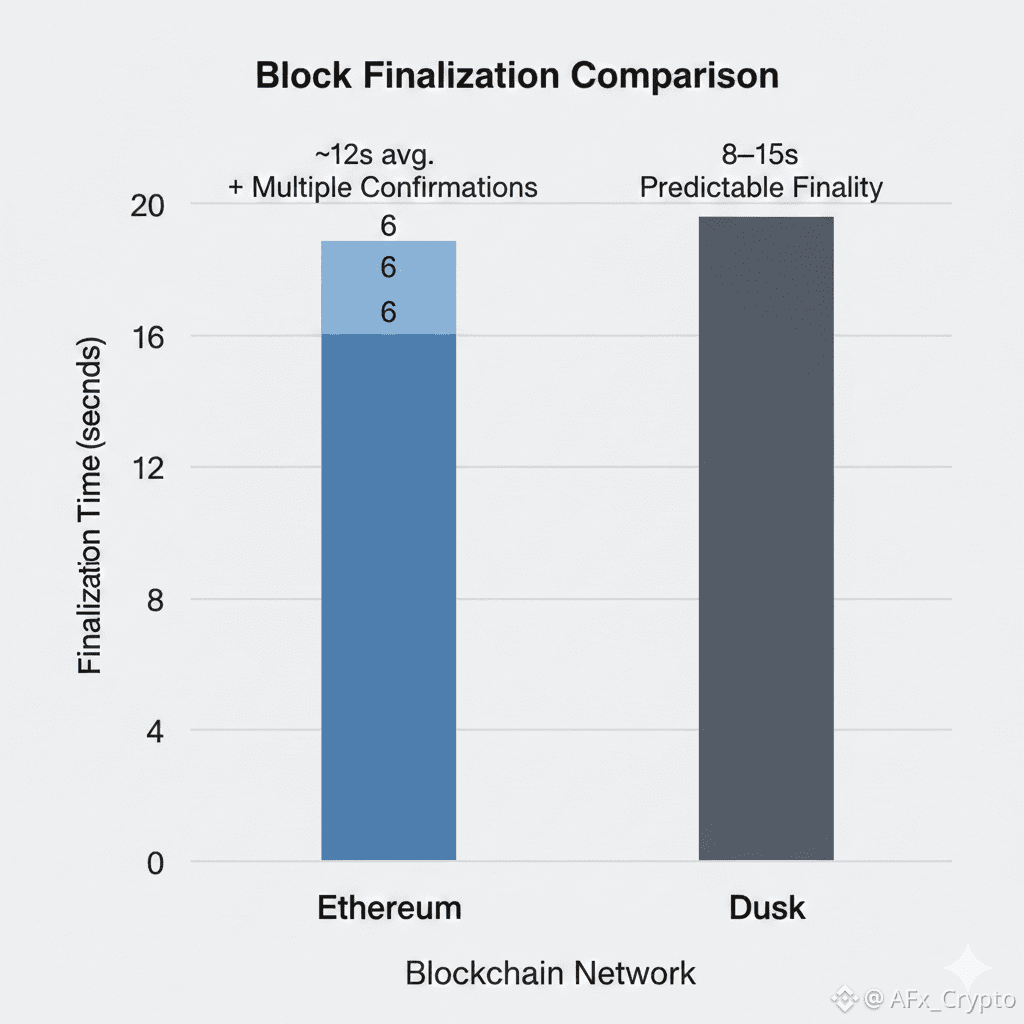
When people talk about “fast blockchains,” they often focus on bragging rights. But speed is not about marketing. It is about how quickly capital can move, how predictable execution is, and how much uncertainty a trader must tolerate. This is where Dusk’s positioning becomes interesting, especially when compared to Ethereum from a practical, execution-focused perspective.
Ethereum operates as a global settlement layer. Its average block time is around twelve seconds, which sounds fast on paper. In reality, most applications wait for multiple confirmations before treating a transaction as final. During normal periods, this can stretch basic actions into minutes. When network activity surges, the mempool becomes competitive. Users either pay higher fees or wait longer. Execution becomes uncertain, and timing becomes harder to control.
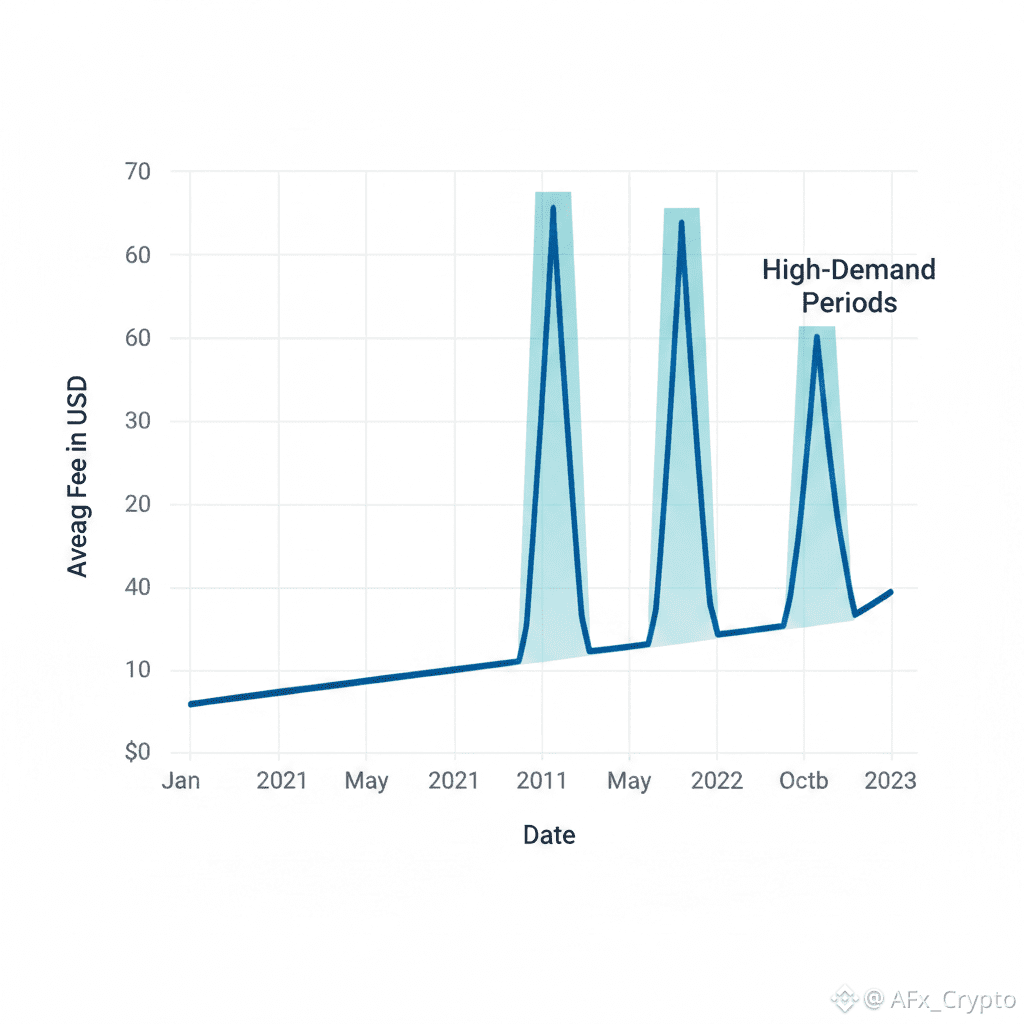
Chart Suggestion 1: Ethereum Fee Volatility (Historical)
Caption: “Daily average Ethereum transaction fees show significant volatility, especially during high-demand periods — highlighting unpredictability in cost.”
Why: Supports your point about fee volatility.
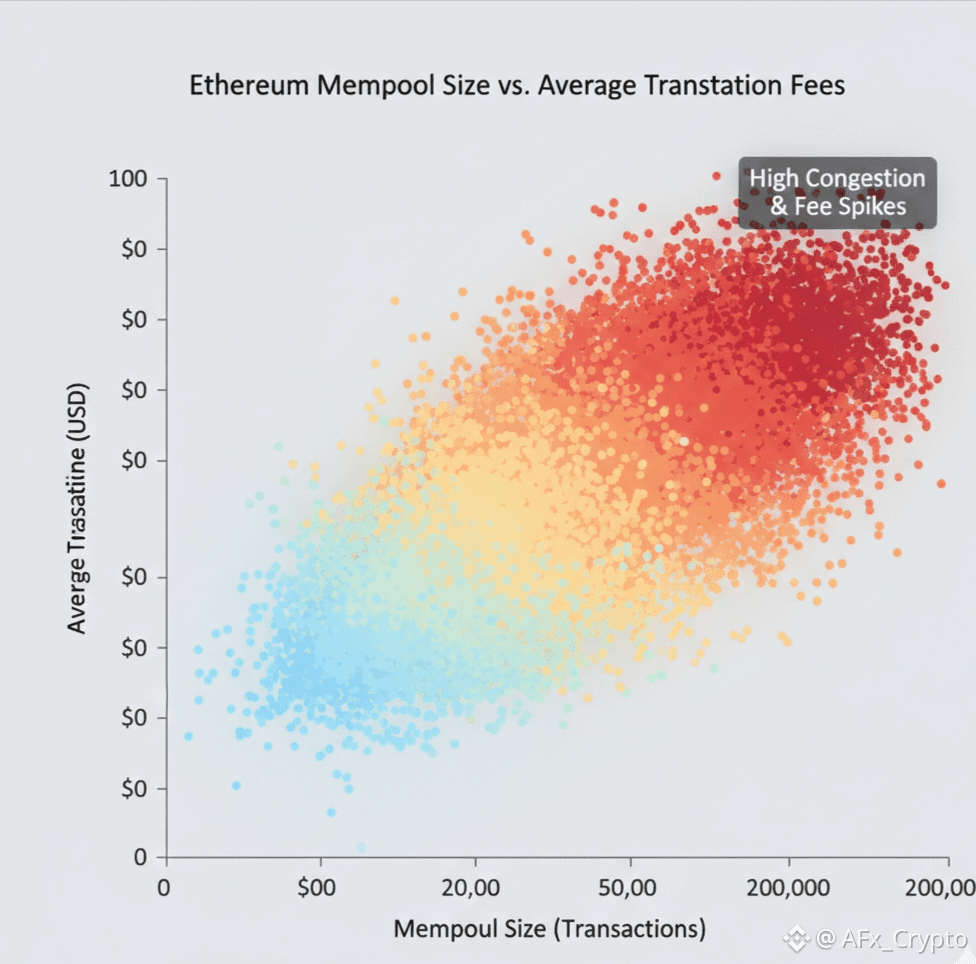
Fees add another layer of unpredictability. Ethereum’s average transaction costs may appear moderate at times, but averages hide volatility. During sudden market events, onchain demand rises sharply. Swaps, liquidations, and bridge activity increase at the same time. Fees can spike quickly, and traders are forced to choose between speed and cost. This uncertainty turns execution into a probability game rather than a precise strategy.
Chart Suggestion 2: Mempool Congestion vs Transaction Fees
Caption: “Network congestion directly impacts fees, creating unpredictable execution costs during high-demand periods.”
Why: Visualizes mempool bidding wars.
Dusk approaches this problem from a different angle.
The network is designed specifically for regulated finance, where privacy and compliance must coexist. Instead of pushing all activity into a fully transparent public mempool, Dusk uses a privacy-preserving architecture aligned with institutional workflows. Its consensus model focuses on structured finality, with block confirmation designed to remain predictable under defined conditions.
Chart Suggestion 3: Block Finalization Times: Dusk vs Ethereum
Caption: “Comparison of effective finality times shows that Dusk’s architecture aims for smoother and more predictable settlement compared to Ethereum.”
Why: Reinforces predictable finality argument.
According to Dusk’s economic model, block finalization targets a minimum of eight seconds in ideal conditions, with a block time around fifteen seconds. While this is not dramatically faster than Ethereum in raw numbers, the real difference lies in execution reliability. Ethereum serves every possible use case, which means users compete with DeFi traders, NFT mints, arbitrage bots, and liquidation flows. Dusk focuses on a narrower lane: tokenized assets, compliant finance, and institutional settlement.
Dusk’s consensus process includes leader selection through Proof-of-Blind Bid and structured agreement phases for block finalization. In simple terms, blocks are not just produced quickly; they are finalized through a defined process that prioritizes predictable settlement. For traders and institutions, predictability is more valuable than marginal speed improvements.
The real pain point in crypto is not that Ethereum is slow. It is that Ethereum is unpredictable. When networks are unpredictable, traders must adjust position sizes, entry timing, and exit strategies to account for delays and fee spikes. Execution becomes less precise, and risk increases.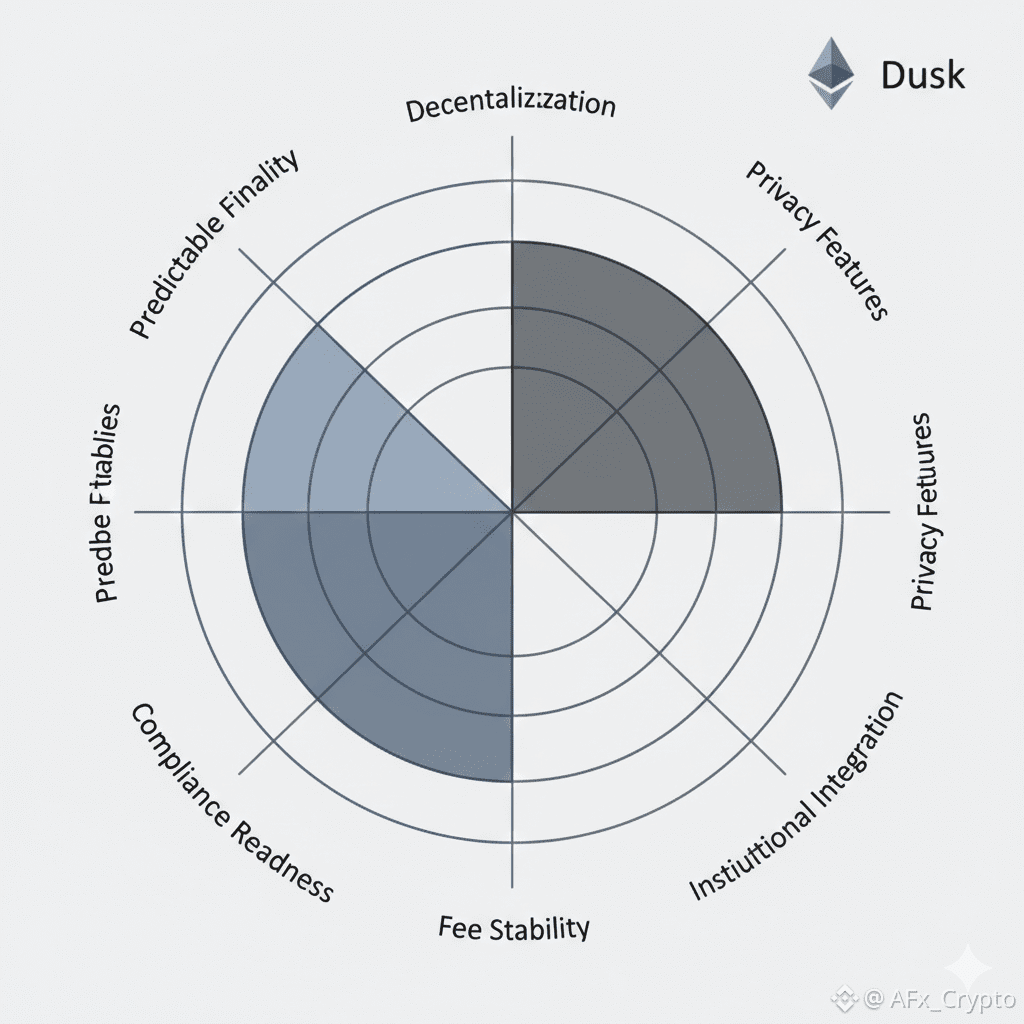
Now consider the broader trend shaping the market: tokenization and regulated onchain finance. This is not the retail-driven DeFi cycle. It is the world of tokenized securities, real-world assets, and institutional capital. These participants care about auditability, controlled privacy, and compliance. Dusk is designed around these requirements from the ground up.
Affordability plays a role here as well.
Ethereum can be affordable when demand is low, but costs rise during congestion. Dusk’s long-term appeal is tied to its purpose-built design for regulated finance. In environments where financial products require predictable costs, fee volatility becomes a structural problem rather than a temporary inconvenience. A specialized network reduces the likelihood of global bidding wars for blockspace.
Dusk is not trying to replace Ethereum. Ethereum remains deeply embedded, liquid, and widely adopted. The more accurate comparison is this: Ethereum is a general-purpose settlement layer where blockspace is rented in a global market. Dusk is building a specialized highway designed for regulated assets, privacy-aware transactions, and institutional behavior.
Speed only matters when it comes with reliability.
Outpacing Ethereum’s wait times does not mean shaving one second off block production. It means creating an environment where execution is smoother, confirmation is more predictable, and transaction costs do not feel like a surprise tax. For traders and institutions, that is not just a better experience. It is lower risk, better strategy, and more efficient capital movement.
Chart Suggestion 4: Use Case Comparison: Ethereum vs Dusk
Caption: “Dusk focuses on regulated finance and predictable execution, while Ethereum prioritizes decentralization and global reach.”
Why: Summarizes key value proposition visually.