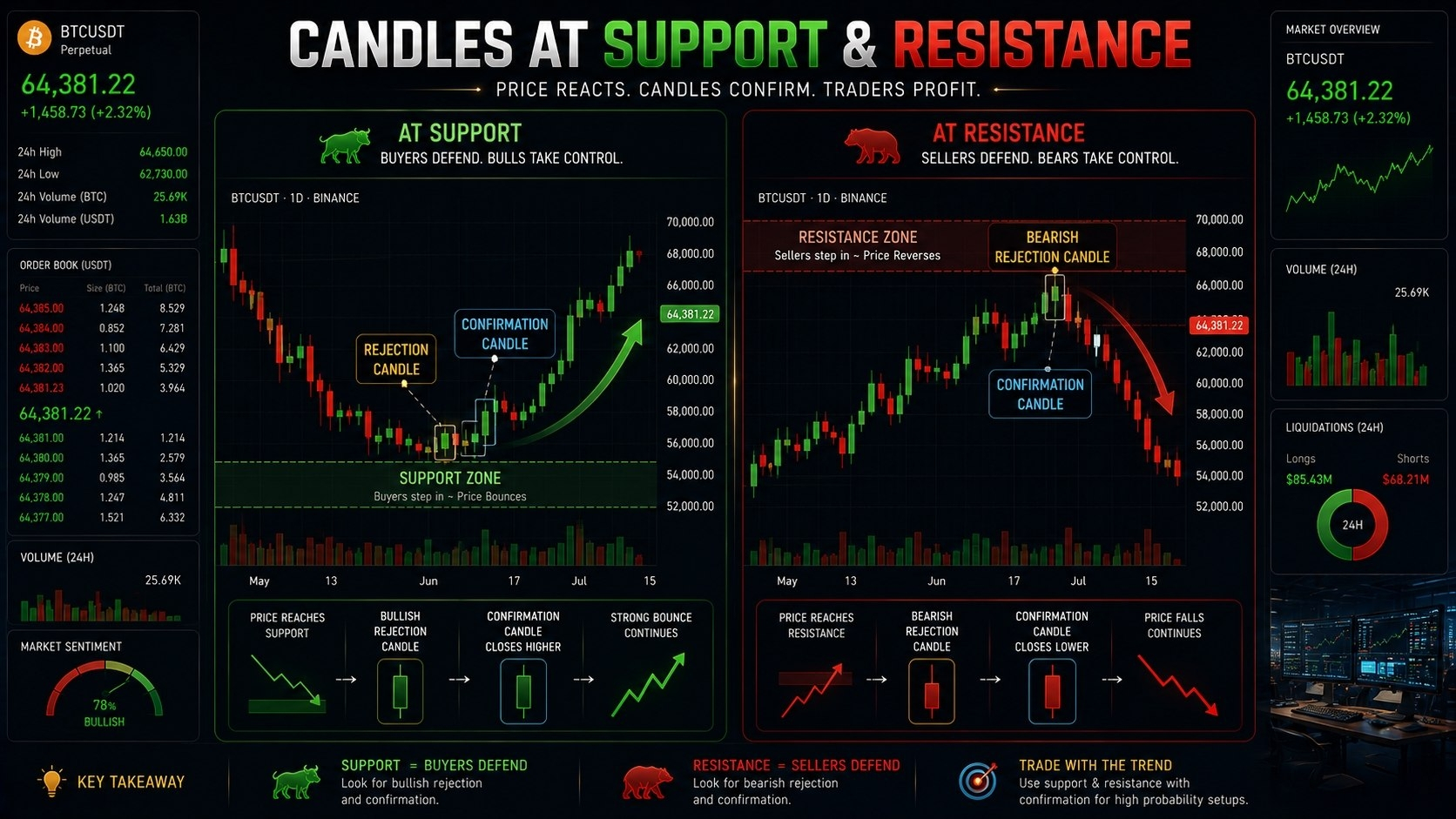
Imagine you spot a beautiful bullish rejection candle on the Bitcoin chart.
It looks perfect.
Without hesitation, you enter a Long trade.
Minutes later...
Bitcoin continues falling.
The next day, you see the exact same candle.
This time, BTC rallies for several hours.
What changed?
Not the candle.
The location. 🧠
Professional traders know that candles become meaningful only when they form around important price levels.
That's why Support and Resistance are the foundation of price action.
🔹️ Why Support and Resistance Matter
A candlestick doesn't create a trading opportunity on its own.
Its meaning depends on where it forms.
Support is an area where buyers have previously stepped in.
Resistance is an area where sellers have previously taken control.
When candles react at these levels, they reveal the battle between buyers and sellers.
📈 Bullish Rejection at Support
Imagine $BTC has been falling for several hours.
Price reaches a strong support level where buyers have defended before.
A candle forms with a long lower wick and closes near its high.
What happened?
Sellers pushed price lower.
Buyers absorbed that selling pressure and forced the market back up.
The rejection tells us buyers are defending support.
But professional traders still wait for confirmation.
A strong bullish candle, rising volume, or a break above the previous candle's high adds confidence to the setup.
📉 Bearish Rejection at Resistance
Now imagine BTC rallies into a major resistance zone.
Buyers push the price above resistance for a moment.
Then sellers step in aggressively.
The candle closes well below its high, leaving a long upper wick.
This tells us buyers lost control at resistance.
Again, professionals don't rush into a trade.
They wait for confirmation that sellers are truly taking over.
🚀 Why Breakout Candles Need Confirmation
A breakout candle can look exciting.
Price closes above resistance or below support.
Many beginners enter immediately.
Professionals ask one more question:
"Can the breakout hold?"
They wait for:
▪️ A strong candle close.
▪️ Follow-through in the same direction.
▪️ Increasing volume.
▪️ The broken level acting as new support or resistance.
Confirmation separates real breakouts from false ones.
⚠️ Why Fake Breakouts Happen
Markets don't move in straight lines.
Sometimes price briefly breaks above resistance or below support...
Only to reverse moments later.
This is called a fake breakout.
It often traps traders who enter too early.
Without confirmation, what looks like the start of a trend can quickly become a losing trade.
That's why patience is one of the most valuable trading skills.
🎯 Five Questions Every Trader Should Ask
Before entering any trade, ask yourself:
▪️ Is price at support?
▪️ Is price at resistance?
▪️ Is this candle showing rejection?
▪️ Is this a genuine breakout or a possible fakeout?
▪️ Is volume confirming the move?
These simple questions will improve your decision-making far more than memorizing dozens of candlestick patterns.
📌 Candles tell you what happened.
Support and resistance tell you why it matters.
When you combine price levels, candle psychology, confirmation, and volume, you stop reacting to random candles and start understanding the story the market is telling.
💬 Open today's Bitcoin chart and identify the nearest support and resistance levels.
Then study how the latest candles behaved around those areas.
That's where high-probability price action begins.
Follow this academy series as we continue mastering the language of the market—one candle at a time. 🚀