Everyone says Bitcoin is the strongest form of collateral. The question I kept asking myself was different: if Bitcoin enters DeFi, does it have to sacrifice the very properties that made it trustworthy in the first place?
That thought stayed with me while I was exploring Babylon's Trustless Bitcoin Vaults (TBV).
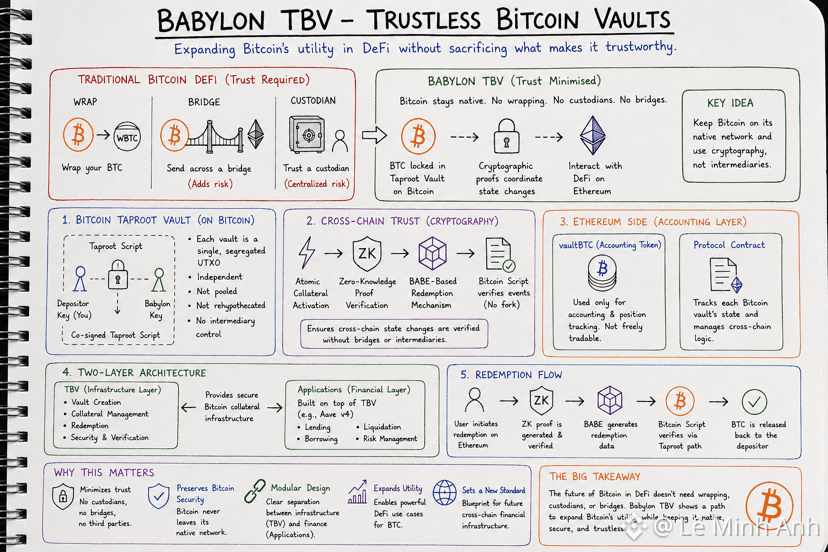
Most Bitcoin DeFi models I've come across begin with the same requirement. Wrap your BTC, send it across a bridge, or trust a custodian to hold it on your behalf. TBV challenges that pattern by keeping Bitcoin inside a Taproot vault on the Bitcoin network instead of moving it elsewhere. The asset stays native while cryptographic proofs coordinate its interaction with Ethereum.
What I found particularly interesting is how the protocol approaches trust. Rather than asking users to rely on an intermediary, it replaces much of that responsibility with cryptographic verification. A BABE-based redemption mechanism, combined with zero-knowledge proof verification, is designed to validate cross-chain events while avoiding the traditional bridge model. That shifts the discussion from who controls the Bitcoin to how the protocol proves ownership and state changes.
Of course, reducing trust assumptions doesn't remove every challenge. The architecture is still technically sophisticated, and long-term Bitcoin DeFi adoption will depend on whether users can understand the system as easily as they can trust its cryptography.
My biggest takeaway is that the most meaningful innovation isn't simply bringing Bitcoin into DeFi. It's finding ways to expand Bitcoin's utility without relying on wrapping, custodians, or bridges and TBV offers an interesting perspective on what that future could look like.
#baby @BabylonLabs_io $BABY