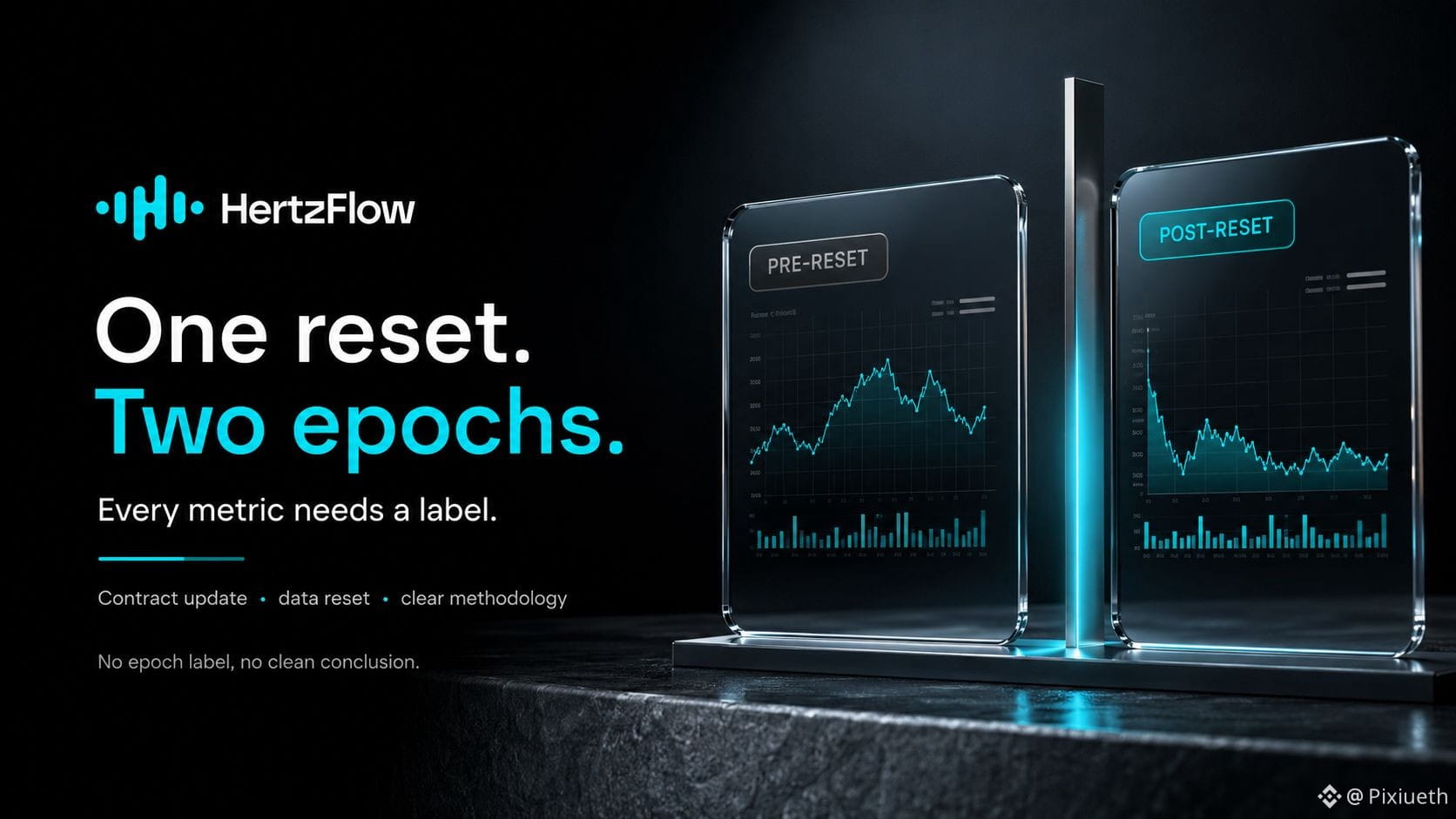
Der Reset ist nicht das rote Warnsignal. Unlabelled Data ist es.
@Hertzflow_xyz hat am 29. Juli die Testnet-Contract-Records zurückgesetzt, nachdem es ein Contract-Update gab, während die Referral-Records unangetastet blieben. Die alte „Traction“ war also nicht verschwunden, aber im Diagramm wurde ein harter Schnitt gesetzt. Von hier an muss jede Kennzahl eindeutig sagen, zu welcher Contract-Epoche sie gehört.
Das ist entscheidend, weil die Vaults nach dem Reset jetzt etwa 3,99 Mio. USD TVL zeigen, während die Daten vor dem Reset 157 Mio.–169 Mio. USD TVL und ein kumuliertes Volumen in Milliardenhöhe ausgewiesen hatten. Beide Zahlen können real sein. Sie können nur nicht ohne Label im selben Topf leben.
Die Lösung ist sauber: Contract-Version, Reset-Zeitpunkt, Pre/Post-Epoche und Metriktyp direkt neben jede Dashboard-Zahl setzen. Aktuelles AUM ist keine kumulierte Historie. Neue Liquidität ist nicht die alte Traction. Saubere Labels machen den Reset von einer Daten-Panne zu einer stärkeren Methodik.
Mein Fazit: HertzFlow muss den Reset nicht verstecken. Es muss die Trennung so machen, dass sie sich unmöglich falsch interpretieren lässt.
Kein Epoch-Label, kein sauberes Fazit.
@Hertzflow_xyz hat am 29. Juli die Testnet-Contract-Records zurückgesetzt, nachdem es ein Contract-Update gab, während die Referral-Records unangetastet blieben. Die alte „Traction“ war also nicht verschwunden, aber im Diagramm wurde ein harter Schnitt gesetzt. Von hier an muss jede Kennzahl eindeutig sagen, zu welcher Contract-Epoche sie gehört.
Das ist entscheidend, weil die Vaults nach dem Reset jetzt etwa 3,99 Mio. USD TVL zeigen, während die Daten vor dem Reset 157 Mio.–169 Mio. USD TVL und ein kumuliertes Volumen in Milliardenhöhe ausgewiesen hatten. Beide Zahlen können real sein. Sie können nur nicht ohne Label im selben Topf leben.
Die Lösung ist sauber: Contract-Version, Reset-Zeitpunkt, Pre/Post-Epoche und Metriktyp direkt neben jede Dashboard-Zahl setzen. Aktuelles AUM ist keine kumulierte Historie. Neue Liquidität ist nicht die alte Traction. Saubere Labels machen den Reset von einer Daten-Panne zu einer stärkeren Methodik.
Mein Fazit: HertzFlow muss den Reset nicht verstecken. Es muss die Trennung so machen, dass sie sich unmöglich falsch interpretieren lässt.
Kein Epoch-Label, kein sauberes Fazit.