
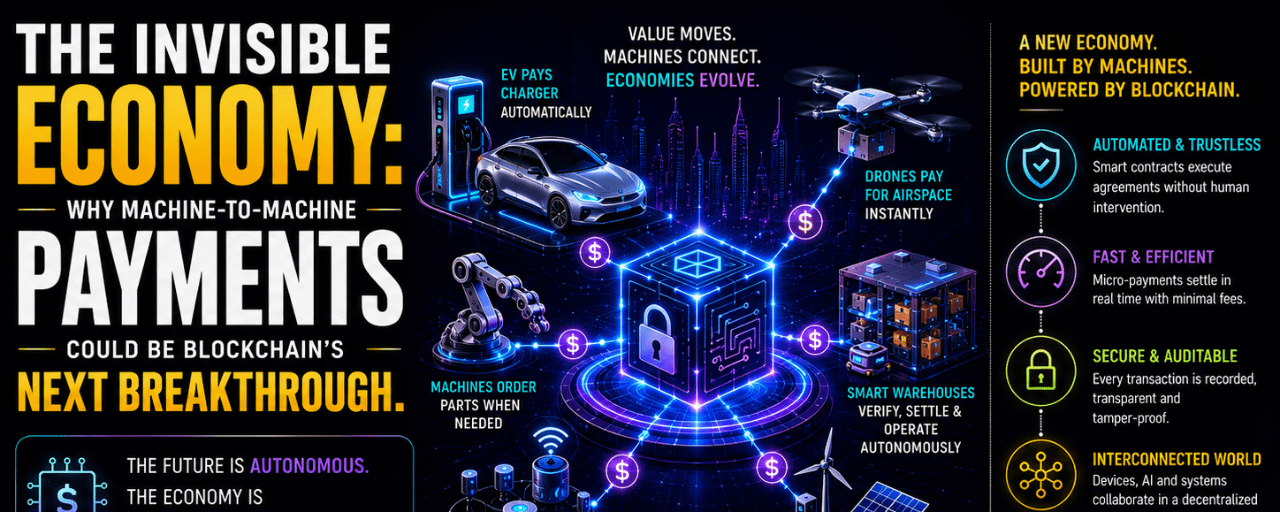
Most financial systems were designed for people. We send money, sign contracts, and approve transactions. But as artificial intelligence, robotics, and the Internet of Things continue to expand, a new type of economy is beginning to emerge, one where machines interact directly with other machines. In this future, autonomous devices will need a secure, efficient way to exchange value without waiting for human approval. Blockchain is increasingly viewed as the technology capable of making this possible.
Imagine an electric vehicle paying a charging station automatically after receiving power. A delivery drone purchasing airspace access for a specific route. A factory machine ordering replacement parts when sensors detect wear. These transactions are often small, frequent, and time-sensitive. Traditional payment systems were not built for this level of automation, but blockchain networks and programmable digital assets offer a foundation where payments settle quickly and smart contracts execute predefined rules without manual intervention.
This concept is often described as the Machine Economy. Instead of people initiating every transaction, connected devices become active participants in economic activity. Sensors generate data, AI analyzes the information, and blockchain records agreements while transferring value securely. The result is an ecosystem where devices collaborate continuously, creating more efficient supply chains, smarter transportation networks, and automated industrial operations.
The rise of tokenized assets strengthens this vision. Machines are no longer limited to exchanging currency alone. They can verify ownership, access digital licenses, activate software features, and interact with tokenized infrastructure. A smart warehouse, for example, might automatically allocate storage space, verify inventory ownership, and settle payments through blockchain-based protocols without requiring constant human oversight.
Artificial intelligence plays an equally important role. AI systems enable machines to make informed decisions, while blockchain provides an immutable record of those decisions and the transactions that follow. Together, they create an environment where automation remains transparent, auditable, and resistant to tampering. This combination is attracting interest from industries including logistics, manufacturing, energy, telecommunications, and smart cities.
Significant challenges remain before machine-to-machine economies become commonplace. Networks must support higher transaction volumes, interoperability between devices continues to improve, and cybersecurity remains a critical priority. Regulatory frameworks will also need to evolve as autonomous systems begin handling greater economic responsibility.
Even so, momentum is building. Around the world, companies are investing in connected infrastructure, edge computing, AI-driven automation, and blockchain-based payment systems. These technologies are converging toward a future where billions of connected devices communicate, cooperate, and transact with minimal human involvement.
For years, blockchain has been associated primarily with cryptocurrencies. The next chapter, however, may focus less on people trading digital assets and more on intelligent machines creating value together. If the internet connected people, the Machine Economy could connect the world's devices into a living, self-operating financial network. It is a vision still taking shape, but one with the potential to redefine how commerce works in the decades ahead.