

The headline numbers on Wall Street look calm, but the underlying mechanics are fracturing. If you only look at the main index values, everything appears stable. Look beneath the surface, and you will find a massive tug of war happening between different market sectors. Institutional data shows that extreme internal volatility is reaching levels we have not experienced outside of major historical financial crises.
❍ The Widening Gap Between Sectors
The distance between the best and worst performing areas of the stock market has expanded rapidly.
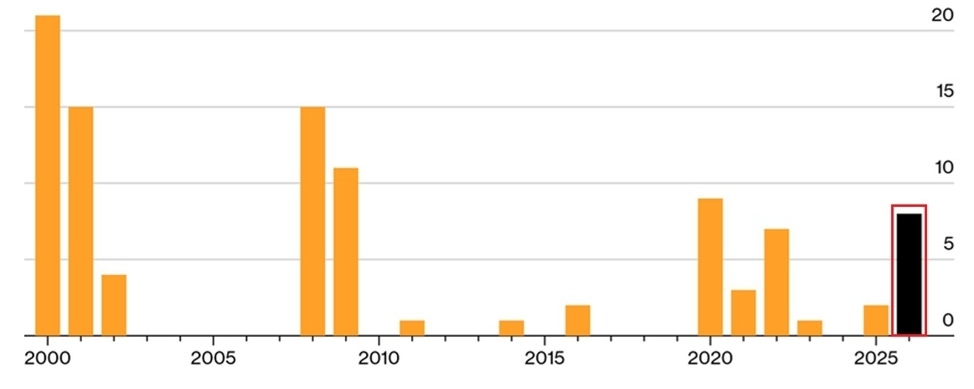
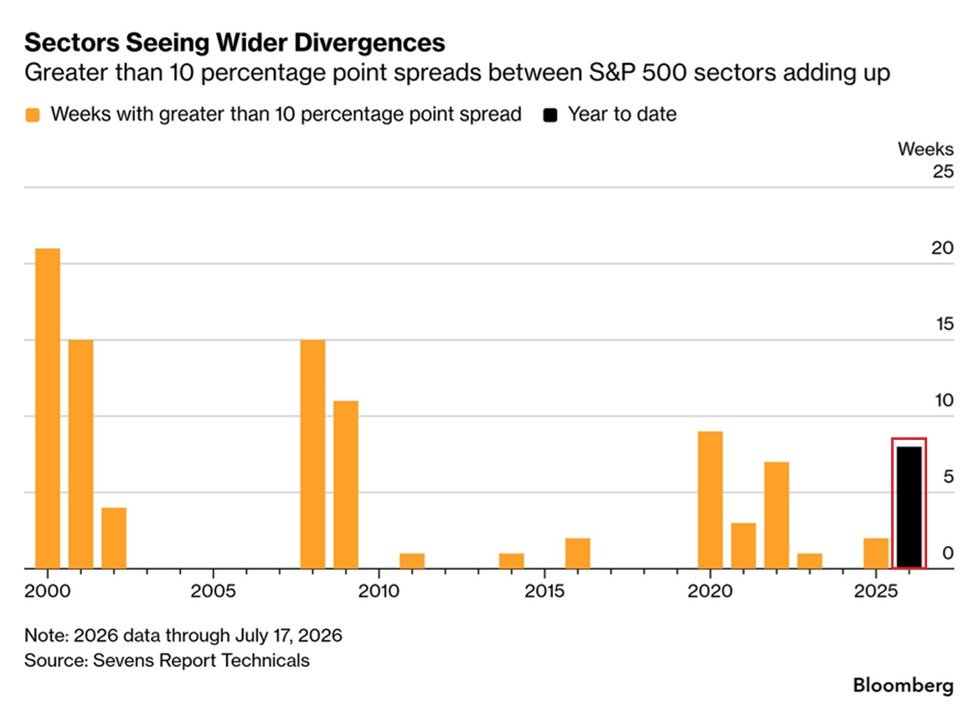
The performance gap between the S&P 500 best and worst performing sectors has exceeded 10 percent in eight separate weeks so far in 2026. This represents the highest count recorded since the 2020 pandemic.
Half of these eight extreme episodes have occurred since late May alone, even though the overall index itself has remained relatively flat.
This internal turbulence points to a market structure where capital is rotating violently from one industry to another rather than moving up or down in a straight line.
❍ Parallels to Past Market Stress
When internal market dispersion reaches this extreme pace early in the calendar year, history shows it is usually a warning sign.
The only three other times this level of sector divergence has happened at this point in the year were in 2000, 2001, and 2009. Each of those years marked periods of severe macroeconomic stress.
The full year record for these wide dispersion weeks was set back in 2000 at 21 weeks, followed closely by the 2008 Financial Crisis with 15 weeks.
Major institutions are aggressively repositioning their portfolios behind closed doors, creating massive performance splits between winning and losing sectors.
Some Random Thoughts 💬
A quiet index can be the most dangerous place in finance because it hides the chaos happening underneath. When the S&P 500 stays flat while individual sectors swing by double digits every single week, it tells you that smart money is violently rotating out of overcrowded trades and hunting for safety. In the crypto and decentralized finance markets, we see this exact same behavior before major trend reversals.
Big funds never exit the entire market at once. They chop prices up, rotate capital across different narratives, and let retail investors assume everything is fine until the broader index finally breaks. Paying attention to sector dispersion is the ultimate way to see what institutional investors are actually doing with their capital before the mainstream financial news catches up.