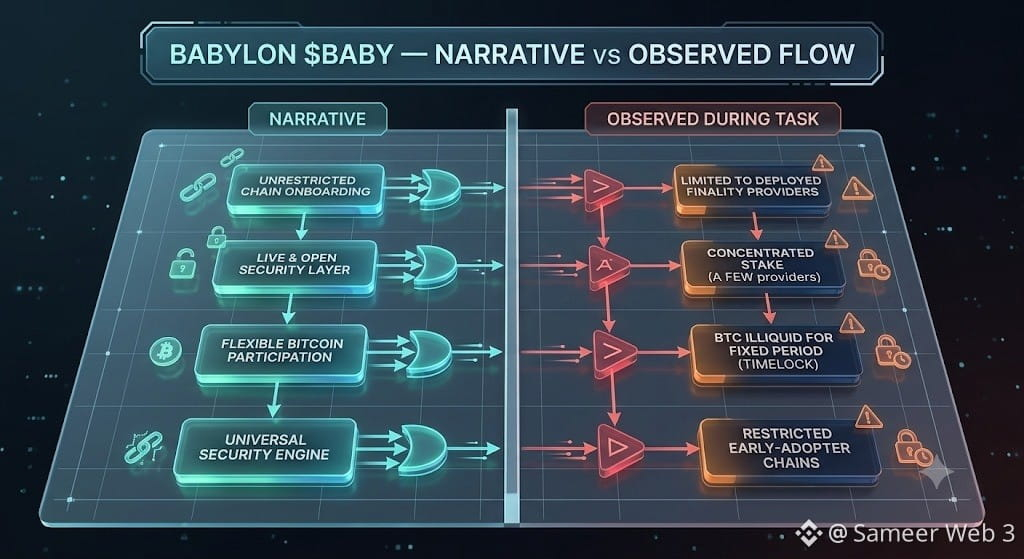
Spent an hour tracing how Babylon's Bitcoin staking actually routes rather than reading the pitch again. Babylon, $BABY , #baby , @BabylonLabs_io frames itself as a security layer any chain can borrow, but the flow only works if a chain has already deployed a finality provider integration — the "any blockchain" story is really "the handful of chains that built the connector first." What stayed with me: unbonding isn't instant. Staked BTC sits through a timelock script before it's liquid again, so the security guarantee for the borrowing chain is stronger than the exit guarantee for the staker. Delegation is also lumpy — a few established finality providers absorb most of the delegated stake early, while newer providers advertised as "coming soon" wait on the same page. It's not deceptive, just sequenced: infrastructure first, universality later, marketed as if both already exist. Watching the delegation dashboard update in near real time made this obvious in a way the whitepaper diagrams don't — the security engine is real, but right now it's running for a short list of early adopters, not the open field the framing implies. Does that gap close, or become permanent structure?
@BabylonLabs_io
#baby
$BABY
@BabylonLabs_io
#baby
$BABY