

The Layer-1 blockchain race has never been just about speed — it's about who can turn blockchain technology into something ordinary people actually use. NEAR Protocol and Solana represent two distinct philosophies chasing that same goal, and comparing them reveals a lot about where the industry is headed.
Different Problems, Different Solutions
NEAR Protocol was built around a simple insight: blockchain adoption fails when the technology is too confusing for everyday users. Its answer is a sharded architecture called Nightshade, paired with the Doomslug consensus mechanism, that lets the network scale horizontally as demand grows. But NEAR's real differentiator is usability — human-readable account names like "alice.near" instead of cryptographic strings, built-in meta-transactions, and account abstraction that lowers the barrier for newcomers. More recently, NEAR has leaned hard into chain abstraction and AI-crypto integration, positioning itself as infrastructure for a future where users interact with many chains without ever thinking about which one they're on.
Solana took a different bet: raw performance wins. Its combination of Proof of History and Tower BFT consensus creates a shared sense of time across the network, enabling extremely fast block production and sub-second finality. Rather than sharding, Solana scales as a monolithic chain, betting that hardware improvements and software optimization can keep pace with demand. That bet has paid off in specific arenas — Solana is now the dominant chain for decentralized exchanges like Raydium and Jupiter, and NFT marketplaces like Magic Eden, with a growing mobile presence through its Saga phone initiative.
Tokenomics: Inflation Both Ways, Different Trajectories
Neither token is deflationary. NEAR has a capped max supply near 1 billion tokens, though circulating supply has already crept past that mark under its inflationary issuance model — a nuance worth understanding before assuming "max supply" means a hard ceiling. Solana has no max supply cap at all, instead targeting a roughly 1.5% long-term inflation rate to fund staking rewards. Both tokens share the same core utility: paying gas fees, securing the network through staking, and enabling governance participation.
Where They Stand Today
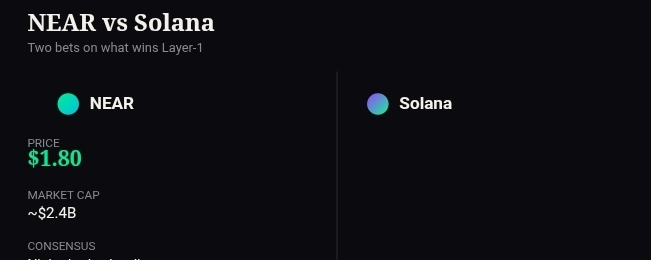
At current market prices, NEAR trades near $1.80–$1.90, while SOL trades in the $73–$74 range — down significantly from its all-time high above $290 in early 2025. Market capitalization tells a clearer story about scale: Solana's roughly $43 billion cap dwarfs NEAR's approximately $2.4 billion, reflecting Solana's deeper liquidity and dominant DeFi/NFT activity. Prices in this space move quickly, so treat any snapshot as a moment in time rather than a fixed reference point.
The Bigger Picture
NEAR and Solana aren't really competing for the same use case. NEAR is optimizing for the next wave of users who've never touched crypto before, betting that friction not throughput — is the real adoption bottleneck. Solana is optimizing for the traders, builders, and applications that already need speed at scale, today. Both approaches are legitimate answers to the scalability trilemma, and both carry real technical and market risk. As with any crypto asset, this overview is informational only, not financial advice — do your own research before making investment decisions.