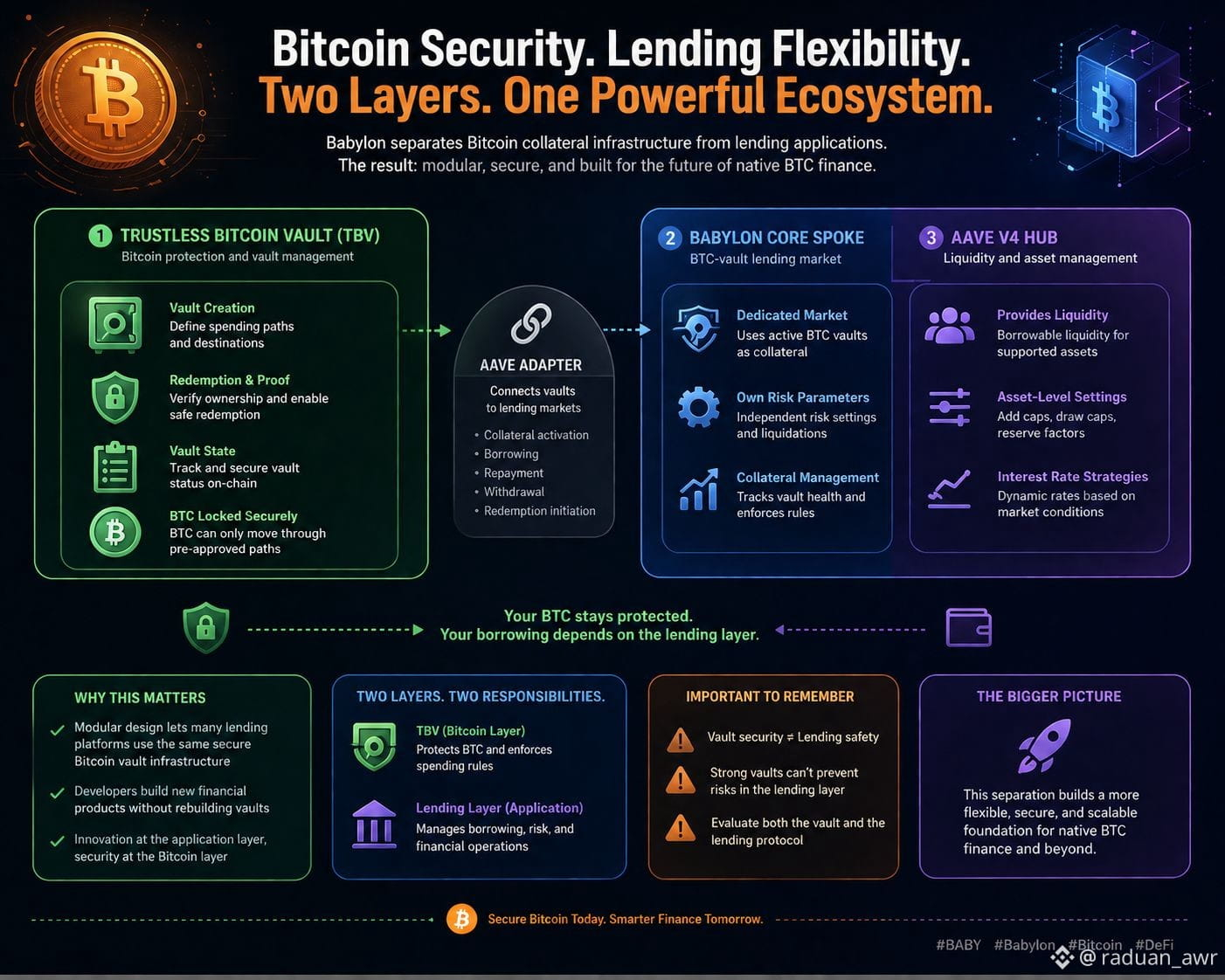
Bitcoin-backed lending becomes much easier to understand when the infrastructure is viewed as separate building blocks instead of a single all-in-one system.
In Babylon's approach, the Trustless Bitcoin Vault (TBV) is responsible for protecting the BTC, verifying ownership, managing vault operations, and ensuring funds can only move according to the rules defined when the vault is created. The lending application, however, operates independently and determines how that Bitcoin is used as collateral for borrowing.
This modular architecture offers flexibility. Different lending platforms can build their own borrowing markets, interest models, liquidation mechanisms, and risk controls while relying on the same secure Bitcoin vault infrastructure. As a result, developers don't need to redesign the vault system every time a new financial product is introduced.
At the same time, users should remember that vault security is only one part of the equation. The overall safety of a borrowing position also depends on the lending protocol's smart contracts, collateral parameters, oracle pricing, and liquidation logic. Even if the Bitcoin vault remains highly secure, weaknesses in the lending layer can still affect borrowers.
A modular design encourages innovation and allows native BTC to be integrated across multiple applications more efficiently. The key question is whether this separation creates a stronger ecosystem by letting each layer specialize, or whether users must carefully evaluate both the vault infrastructure and the lending platform before trusting the system with their Bitcoin.
#baby #Babylon
In Babylon's approach, the Trustless Bitcoin Vault (TBV) is responsible for protecting the BTC, verifying ownership, managing vault operations, and ensuring funds can only move according to the rules defined when the vault is created. The lending application, however, operates independently and determines how that Bitcoin is used as collateral for borrowing.
This modular architecture offers flexibility. Different lending platforms can build their own borrowing markets, interest models, liquidation mechanisms, and risk controls while relying on the same secure Bitcoin vault infrastructure. As a result, developers don't need to redesign the vault system every time a new financial product is introduced.
At the same time, users should remember that vault security is only one part of the equation. The overall safety of a borrowing position also depends on the lending protocol's smart contracts, collateral parameters, oracle pricing, and liquidation logic. Even if the Bitcoin vault remains highly secure, weaknesses in the lending layer can still affect borrowers.
A modular design encourages innovation and allows native BTC to be integrated across multiple applications more efficiently. The key question is whether this separation creates a stronger ecosystem by letting each layer specialize, or whether users must carefully evaluate both the vault infrastructure and the lending platform before trusting the system with their Bitcoin.
#baby #Babylon