

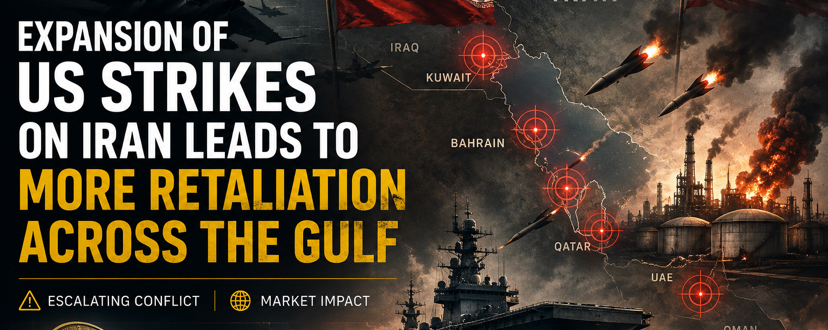

The conflict between the United States and Iran has entered a more dangerous phase as Washington expands its military campaign and Tehran responds with retaliatory attacks across the Gulf region.
The latest escalation follows a new round of U.S. strikes on Iranian targets, which American officials say are intended to weaken Iran’s military capabilities and protect commercial shipping through the Strait of Hormuz. Iran, however, has responded by targeting U.S.-linked military facilities and other strategic sites in several countries hosting American forces.
The widening confrontation has increasingly drawn Gulf states into the conflict. Iran has carried out or claimed attacks involving locations in Bahrain, Kuwait and Jordan, while reports have also described damage to infrastructure and facilities connected to the regional military presence. The developments have raised concerns that the conflict could spread beyond direct U.S.-Iranian exchanges and place additional pressure on neighboring countries.
At the center of the escalating crisis is the Strait of Hormuz, one of the world’s most important energy corridors. The waterway carries a significant share of global oil shipments, making any disruption a major concern for international markets. Both Washington and Tehran have sought to shape the security environment around the strait, with the United States saying its operations are aimed at preserving freedom of navigation and Iran warning of further consequences for countries supporting the American military presence.
The cycle of attack and retaliation has also increased the risks for U.S. personnel stationed across the region. The Pentagon has confirmed American military deaths in recent Iranian attacks, adding further pressure on Washington as the campaign continues. At the same time, Iran faces growing military pressure from repeated U.S. strikes and the possibility of an even broader confrontation.
The conflict’s economic consequences are also becoming more significant. Uncertainty around shipping through the Strait of Hormuz threatens to disrupt energy supplies and raise transportation costs. Any prolonged closure or instability in the waterway could affect oil prices and global trade, particularly if commercial vessels begin avoiding the region.
The latest developments underline the difficulty of containing the conflict. Every new U.S. strike risks triggering another Iranian response, while attacks on American forces or regional partners could prompt Washington to expand its campaign further. Gulf governments are now caught between their security relationships with the United States and the danger of becoming targets in the wider confrontation.
With military operations continuing and diplomatic efforts struggling to keep pace, the conflict appears to be moving into a period of heightened uncertainty. The central question is whether the expanding strikes will eventually force negotiations—or create a broader regional war that becomes increasingly difficult to control.