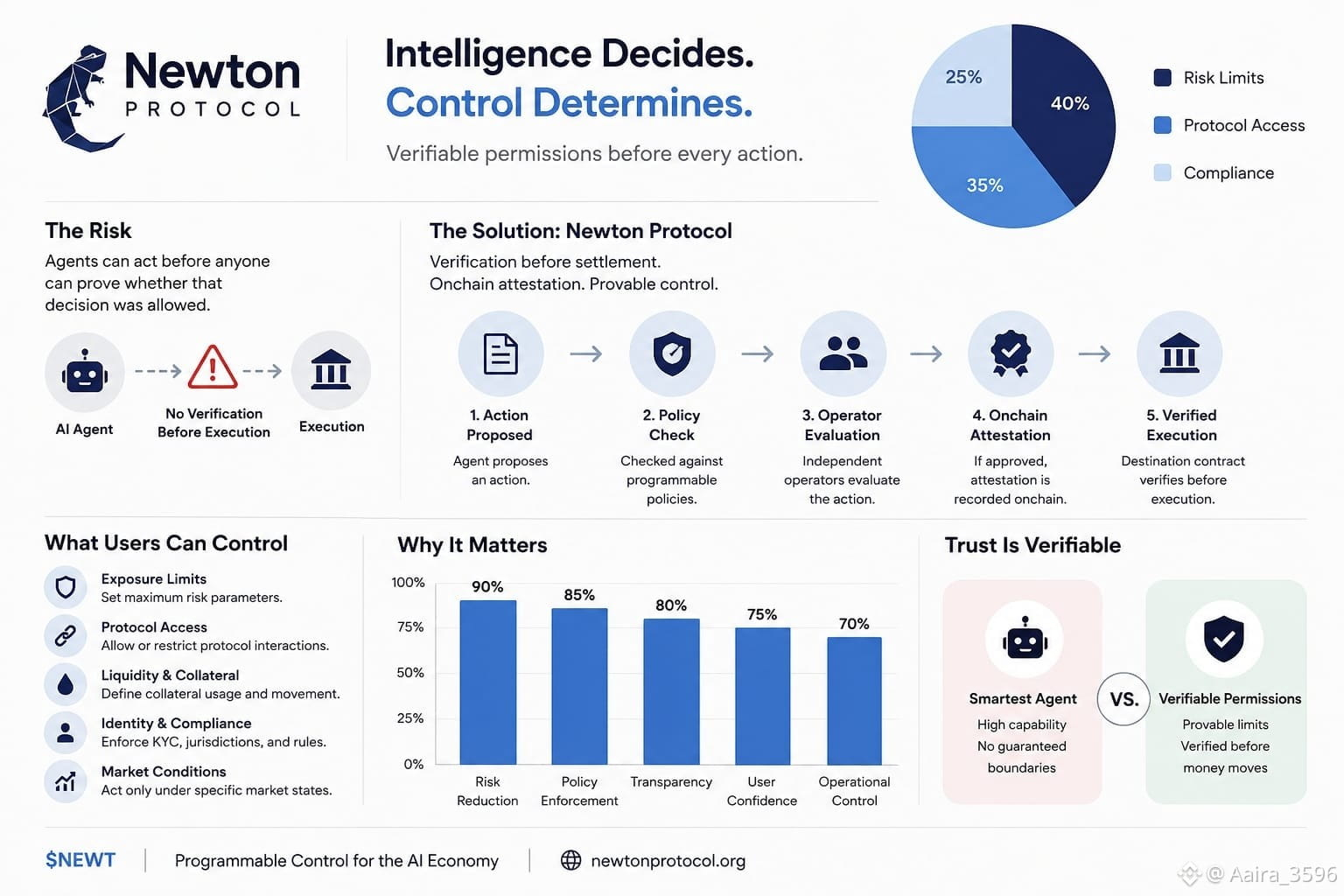
I think the biggest risk in AI-powered finance is not that an agent makes a bad decision. It is that the agent can act before anyone can prove whether that decision was allowed.
That distinction matters. Trading bots, automated vaults, and onchain agents are getting faster and more capable, but execution speed is not the same as control. An agent may identify a profitable rebalance, move collateral, or route capital across protocols, yet still operate outside a user’s risk limits, approved markets, or compliance rules.
My framework is simple: intelligence decides what to do; control determines whether it has the right to do it.
That is where @NewtonProtocol ’s Mainnet Beta becomes interesting. Newton inserts a verification layer before settlement. A proposed action is checked against programmable policies, and independent operators evaluate whether it satisfies the required conditions. If it passes, the network produces an onchain attestation that the destination contract can verify before execution.
In practice, that could let users define boundaries around exposure, protocol access, liquidity, identity, or market conditions without giving an AI agent unrestricted authority. Think of it less like improving the trader and more like installing a risk desk between the trader and the final order.
I find that more important than another promise of smarter automation. Intelligence can create edge, but verifiable limits create confidence. My skepticism is that the system will only matter if policies remain transparent, data inputs stay reliable, and integration is simple enough for real applications to adopt.
If AI agents begin managing serious capital, will investors trust the smartest agent, or the one whose permissions can be proven before money moves?
$NEWT #Newt $LAB
That distinction matters. Trading bots, automated vaults, and onchain agents are getting faster and more capable, but execution speed is not the same as control. An agent may identify a profitable rebalance, move collateral, or route capital across protocols, yet still operate outside a user’s risk limits, approved markets, or compliance rules.
My framework is simple: intelligence decides what to do; control determines whether it has the right to do it.
That is where @NewtonProtocol ’s Mainnet Beta becomes interesting. Newton inserts a verification layer before settlement. A proposed action is checked against programmable policies, and independent operators evaluate whether it satisfies the required conditions. If it passes, the network produces an onchain attestation that the destination contract can verify before execution.
In practice, that could let users define boundaries around exposure, protocol access, liquidity, identity, or market conditions without giving an AI agent unrestricted authority. Think of it less like improving the trader and more like installing a risk desk between the trader and the final order.
I find that more important than another promise of smarter automation. Intelligence can create edge, but verifiable limits create confidence. My skepticism is that the system will only matter if policies remain transparent, data inputs stay reliable, and integration is simple enough for real applications to adopt.
If AI agents begin managing serious capital, will investors trust the smartest agent, or the one whose permissions can be proven before money moves?
$NEWT #Newt $LAB