
The longer I follow the intersection between crypto and AI, the less convinced I become that intelligence is the hardest problem left to solve.
For the past few years, almost every conversation has revolved around the same questions.
Which model is smarter?
Which agent can reason better?
Which system can execute tasks faster?
The entire industry seems obsessed with capability.
And, to be fair, that obsession makes sense.
For a long time, AI simply wasn't good enough. The biggest limitation was intelligence itself.
But I increasingly suspect that the next bottleneck will look very different.
Because building software that can make decisions is one challenge.
Building software that people are willing to trust with real economic power is another.
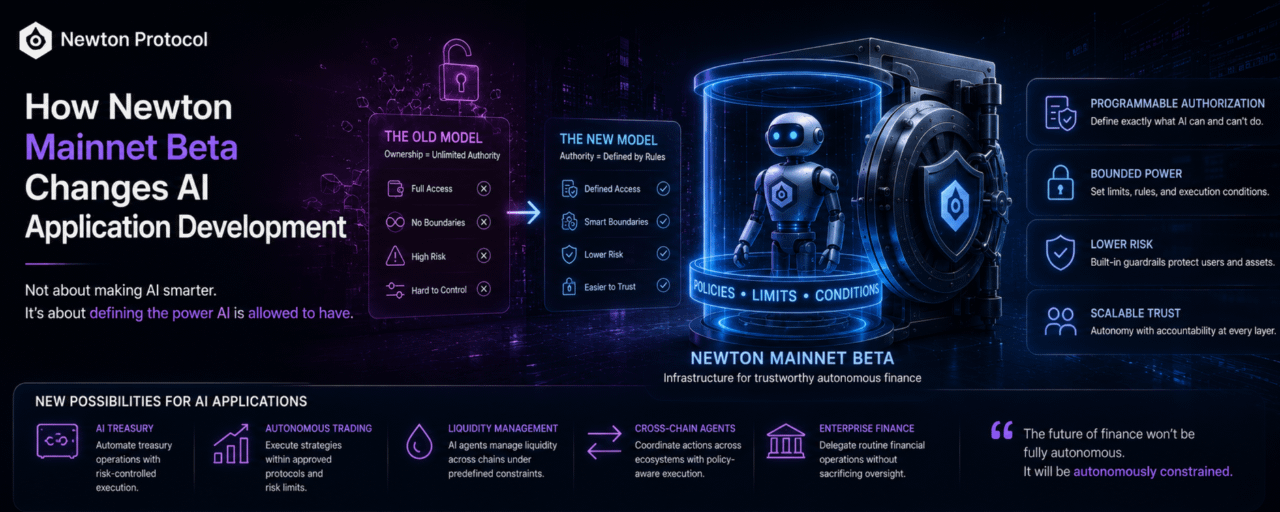
That thought kept coming back to me while I was reading about Newton Mainnet Beta.
At first glance, Newton doesn't seem radically different from other infrastructure projects. There is a new execution layer, programmable authorization, VaultKit, policy engines, and a set of tools designed for developers building AI-native applications.
On paper, those are technical features.
But the more I thought about them, the more I realized Newton may actually be proposing something much bigger.
It is challenging one of the oldest assumptions in software.
For decades, applications have been built around a relatively simple model.
Humans decide.
Software executes.
Even in crypto, that assumption remained surprisingly intact.
Smart contracts automated transactions, but humans still controlled wallets. Bots accelerated execution, but people defined the strategy. AI could recommend actions, but someone still had to approve them.
Intelligence stayed separated from authority.
Newton starts from a different premise.
It assumes that this separation won't last.
Sooner or later, AI systems will manage treasuries, coordinate liquidity, rebalance portfolios, execute payments, and interact with financial infrastructure without waiting for constant human approval.
The question is no longer whether that future is technically possible.
The question is whether today's infrastructure is prepared for it.
Because traditional blockchain architecture makes a very strong assumption.
If a wallet signs a transaction, the network accepts it.
Ownership equals authority.
For human users, that model worked remarkably well.
For autonomous systems, it becomes much harder to defend.
An AI agent can make thousands of decisions every day. It doesn't get tired. It doesn't hesitate. It doesn't wake up and rethink its assumptions after reading market sentiment.
It simply follows instructions.
And that is precisely the problem.
The danger isn't necessarily that AI will become irrational.
The danger is that AI will become extraordinarily effective at pursuing objectives that humans defined imperfectly.
A flawed strategy executed by a human creates risk.
A flawed strategy executed by autonomous software creates scale.
That's where Newton Mainnet Beta becomes interesting.
Because Newton isn't trying to build smarter agents.
It is trying to redesign the relationship between intelligence and authority.
Instead of forcing developers to choose between full autonomy and constant human oversight, Newton introduces something in between.
Programmable boundaries.
Policies.
Execution conditions.
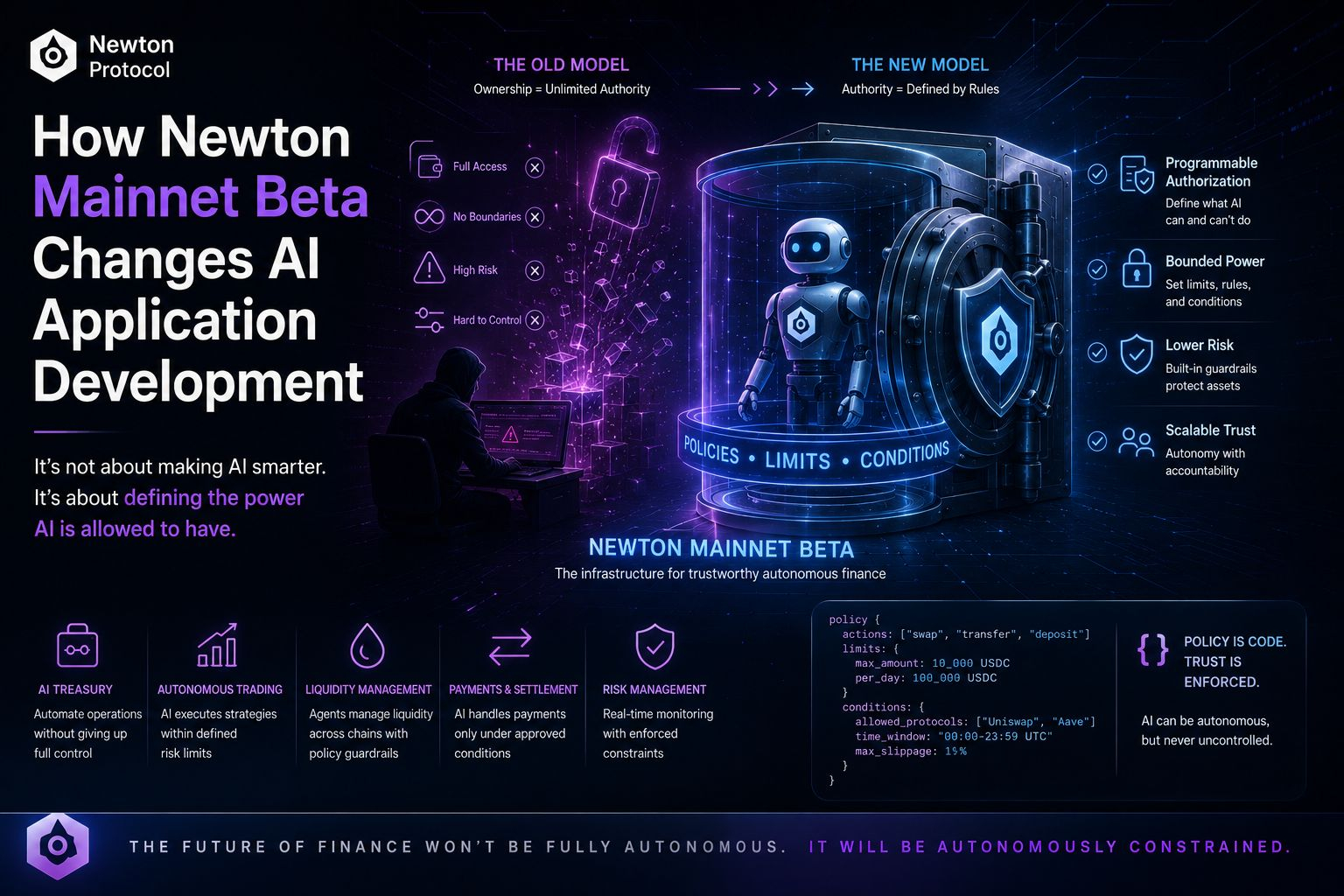
Constraints that determine not only whether an AI can act, but under what circumstances it is allowed to act.
At first, that sounds like another developer tool.
I think it changes something much deeper.
For years, developers have mostly asked:
"What can AI do?"
Newton encourages them to ask a different question:
"What should AI be allowed to do?"
That subtle shift may reshape AI application development far more than another improvement in model performance.
Imagine building an autonomous treasury manager.
Without policy-aware infrastructure, the architecture is surprisingly limited. Either the AI receives broad control over assets, or humans remain involved in every important decision.
Neither option scales particularly well.
Newton introduces a third model.
The AI can execute transactions independently, but only within predefined limits.
It can manage liquidity, but only across approved protocols.
It can allocate capital, but only inside agreed risk thresholds.
The intelligence remains autonomous.
The authority remains conditional.
And that distinction opens an entirely new design space.
Developers are no longer building applications that merely automate tasks.
They are beginning to design systems that distribute power between humans and machines.
That, in my opinion, is the real significance of Mainnet Beta.
Not the code.
Not the tooling.
Not even the architecture itself.
Mainnet Beta is the first serious test of whether developers actually want to build applications around this new philosophy.
Because history is full of technically elegant systems that solved problems nobody felt urgently enough.
Newton still faces that risk.
Developers may decide that existing wallets and smart contracts are already sufficient.
Users may continue to prioritize simplicity over stronger guarantees.
The market may conclude that today's AI simply doesn't need another layer of control.
All of those outcomes remain possible.
But if autonomous systems continue expanding their role in finance, I suspect developers will eventually stop measuring AI progress purely by intelligence.
They will begin measuring something else.
How much authority society is willing to delegate to software.
And perhaps that is the deeper experiment taking place inside Newton Mainnet Beta.
Not an experiment in artificial intelligence.
An experiment in the rules humans create before they are willing to trust intelligence at all.
@NewtonProtocol $NEWT #newt
