
I always believed blockchain's biggest strength was its ability to settle transactions without trusting a central party. But after digging into the Newton Protocol whitepaper, I found myself questioning something I had never really considered. We spend years optimizing how fast transactions execute, yet we rarely ask whether they should execute at all.
That missing question might be the next evolution of onchain infrastructure.
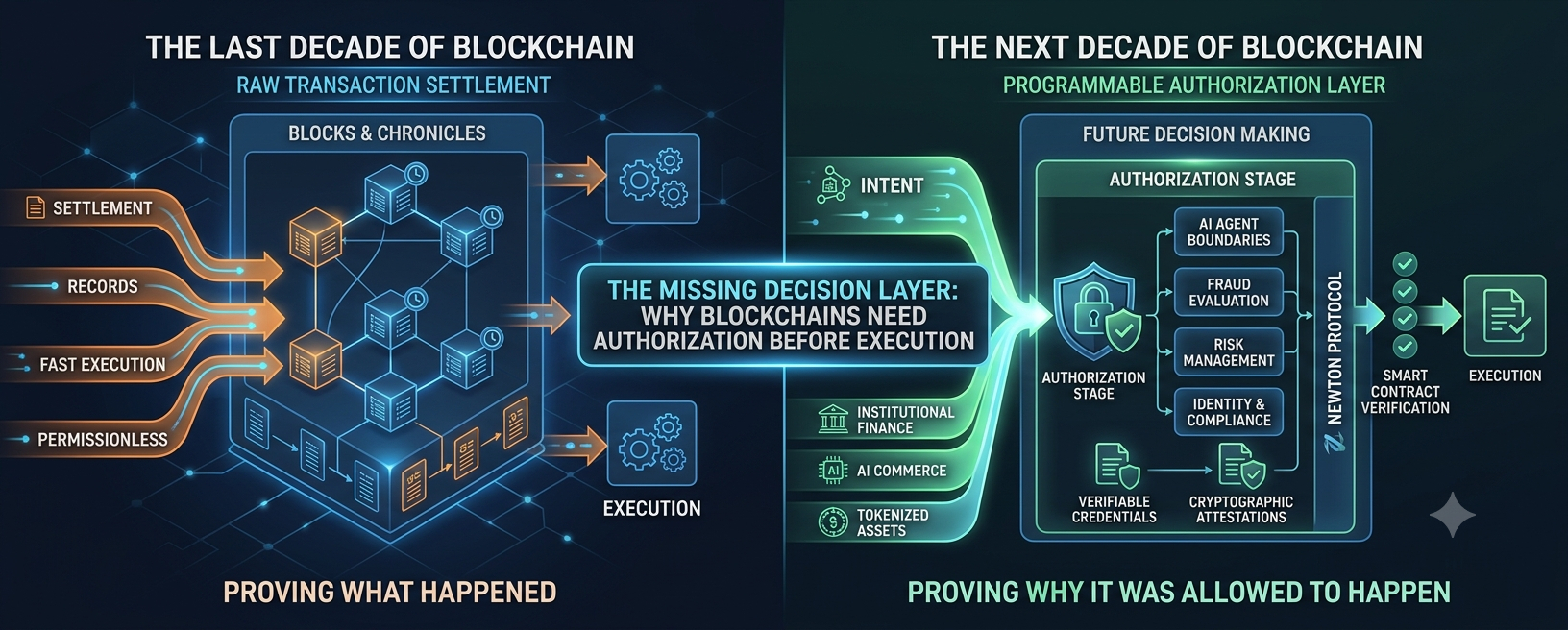
Today's blockchains are exceptional settlement engines. Once a valid transaction reaches the network, execution is almost inevitable. Traditional finance works differently. Every payment passes through an authorization stage where identity, fraud, limits, and risk are evaluated before money moves. Blockchain largely removed that layer in pursuit of permissionless execution. Now that stablecoins, tokenized assets, institutions, and AI agents are operating onchain at scale, that design choice is becoming increasingly difficult to ignore.
What genuinely caught my attention about Newton Protocol is that it doesn't try to replace blockchains or wallets. Instead, it inserts a verifiable decision layer between transaction intent and execution. Policies become programmable, decentralized operators independently evaluate those policies, and smart contracts verify cryptographic attestations before accepting a transaction. That transforms compliance from something applications can bypass into something applications can actually prove.
The AI angle made this idea even more compelling for me. Autonomous agents don't hesitate. They execute exactly as instructed, often at machine speed. That's incredibly powerful—but also dangerous if authorization isn't built into the workflow. Speed isn't the real challenge anymore. The challenge is making sure intelligent systems stay inside clearly defined boundaries without slowing them down. A programmable authorization layer feels less like compliance and more like essential infrastructure for agentic finance.
Another detail I appreciated is the privacy-first approach. Instead of exposing sensitive identity information onchain, Newton relies on verifiable credentials and cryptographic proofs so applications can verify requirements while users retain control of their personal data. To me, that's a far more sustainable direction than forcing developers to choose between privacy and regulatory expectations.
The biggest insight I walked away with is surprisingly simple. Settlement records the past. Authorization shapes the future. If the last decade of blockchain was about proving what happened, the next decade may be about proving why it was allowed to happen. That isn't just another infrastructure upgrade—it could become the foundation that makes institutional finance, AI commerce, and large-scale onchain adoption genuinely trustworthy.