
I've watched crypto reward mediocre technology with massive adoption.
I've also watched brilliant engineering quietly disappear because almost nobody built on it.
After enough market cycles, you stop asking which protocol has the better architecture.
You start asking a much less glamorous question.
Who will developers actually choose to build with?
That was the first thought that came to mind while I was reading about Newton Mainnet Beta.
At first, I saw it as another milestone.
Every infrastructure project eventually reaches one.
Mainnet launches.
SDK releases.
Developer tooling.
Roadmaps move forward.
Crypto has become so accustomed to these announcements that they almost blend together.
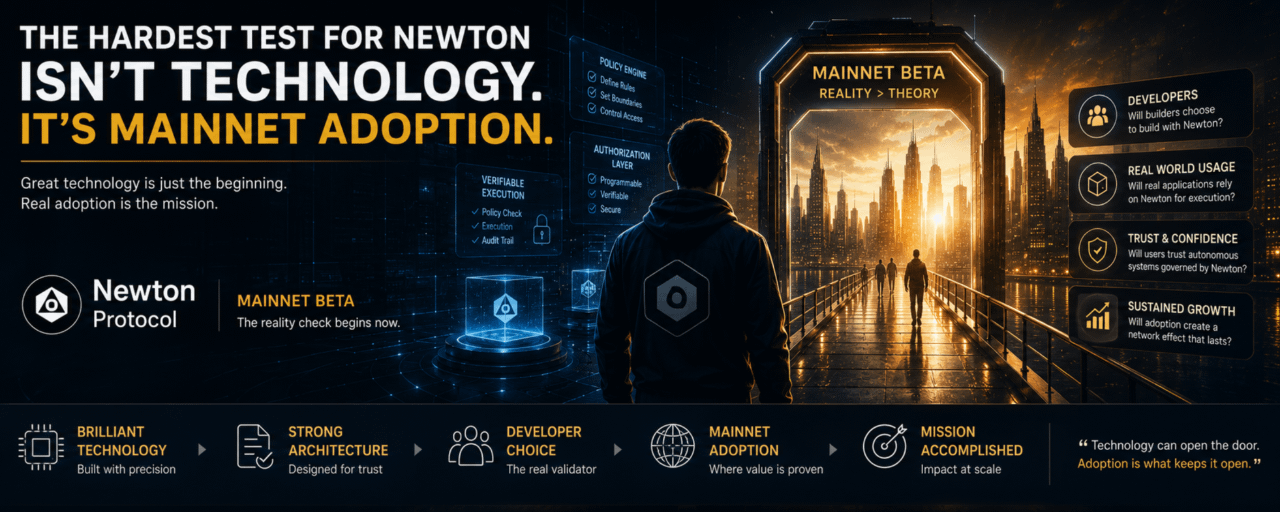
But the more I thought about it, the more I realized Mainnet Beta represents something very different.
It's the moment when architecture stops competing with whitepapers...
...and starts competing with reality.
That feels like a much harder challenge.
On paper, Newton's architecture is compelling.
Programmable authorization.
Policy-based execution.
Verifiable AI actions.
Infrastructure designed around the assumption that autonomous systems shouldn't simply be intelligent, they should also operate inside clearly defined boundaries.
It's a logical vision.
Especially if AI agents eventually begin managing treasuries, coordinating liquidity, executing trades, and interacting with assets worth millions of dollars.
But architecture has an unfair disadvantage.
It only proves what can be built.
Markets decide what will be built.
Those are rarely the same thing.
That's why I don't think Mainnet Beta is simply validating Newton's technology.
It's validating Newton's assumptions.
Imagine you're building an AI-native financial application today.
You already have access to powerful language models.
You already have wallets.
You already have oracles.
You already have smart contracts.
Now someone asks you to integrate an entirely new authorization layer.
Your first question probably isn't,
"Is this architecture elegant?"
It's something much more practical.
"Will this make my product significantly better without making it significantly harder to build?"
That's the question every infrastructure project eventually faces.
Developers don't adopt technology because it's intellectually interesting.
They adopt it because it removes friction that already exists.
If solving one problem introduces three new ones, even brilliant engineering can struggle to gain traction.
Crypto has repeated this lesson for more than a decade.
Some protocols solved problems that users never felt.
Others solved important problems through workflows that were simply too complex.
Neither survived as well as their creators hoped.
Being technically correct has never guaranteed adoption.
That doesn't mean Newton will face the same outcome.
It simply means Newton isn't exempt from the same market dynamics.
One thing that may work in its favor is timing.
A few years ago, programmable authorization probably felt unnecessary.
Most blockchain users still approved every meaningful transaction themselves.
Most DeFi interactions remained relatively straightforward.
Today's landscape looks very different.
AI agents are beginning to manage portfolios.
Treasury automation is becoming more sophisticated.
Cross-chain execution is becoming increasingly common.
Software is gradually moving from assisting decisions...
...to making them.
That changes the conversation.
The question is no longer whether autonomous systems can execute transactions.
It's whether we're comfortable giving them the authority to do so.
That's a completely different problem.
And perhaps that's exactly the environment Newton has been preparing for.
Still, relevance doesn't automatically become adoption.
That's an important distinction.
Markets often agree that a problem exists while disagreeing about which solution deserves to become the standard.
That's why I think Mainnet Beta matters more than most people realize.
Not because it's the finish line.
Because it's the first meaningful reality check.
Whitepapers rarely fail.
Architecture diagrams rarely fail.
Conference presentations rarely fail.
Mainnets fail.
Not because the technology suddenly stops working.
Because technology finally meets developers.
It meets users.
It meets edge cases nobody anticipated.
It meets competing priorities.
It meets products that have deadlines, limited engineering resources, and difficult trade-offs.
That's where infrastructure either becomes indispensable...
...or remains an interesting idea.
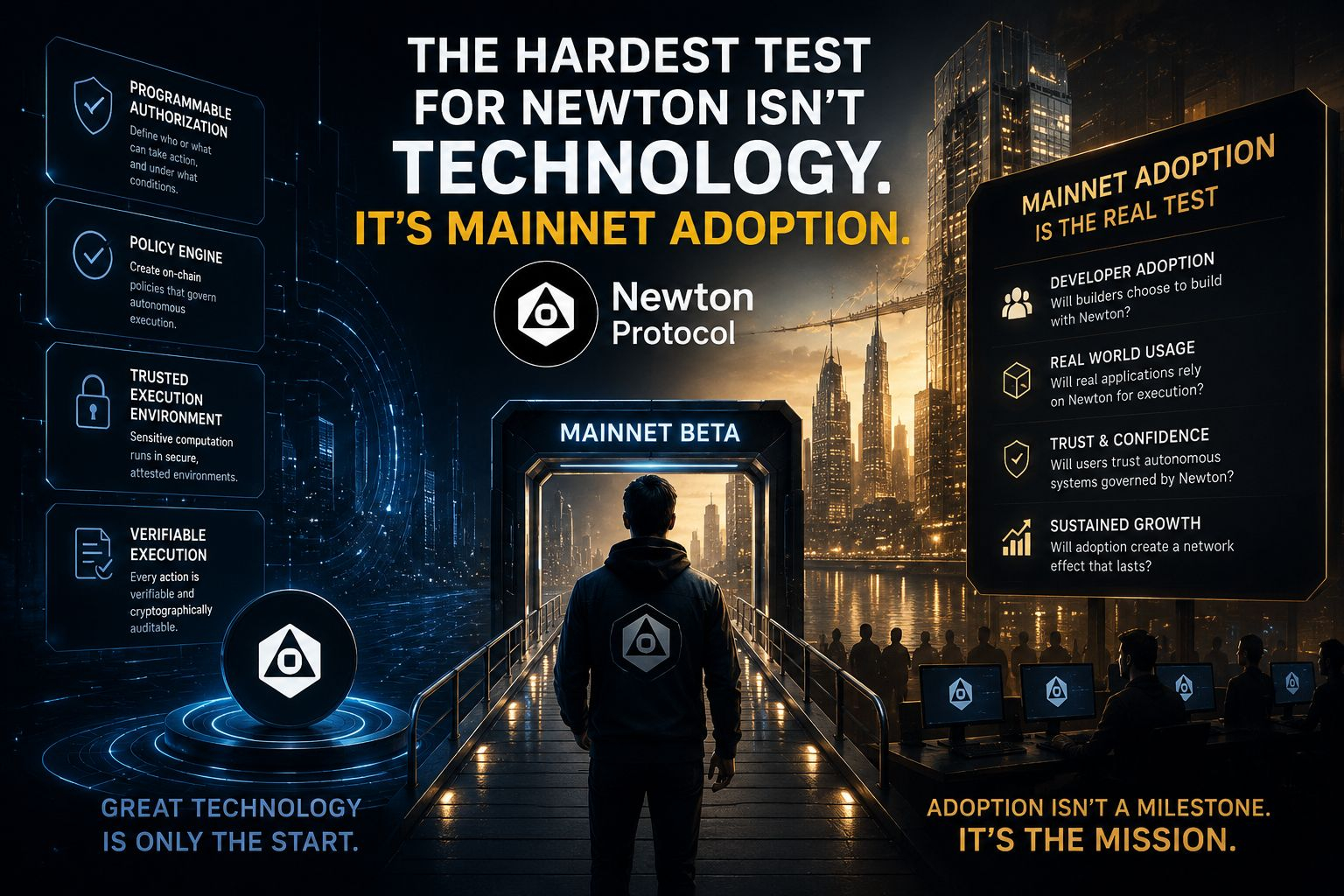
One aspect of Newton that I keep coming back to is that it isn't trying to build the smartest AI.
Instead, it's trying to build an environment where intelligent systems can operate within predefined rules before they touch meaningful value.
That's a subtle shift.
But I think it's an important one.
History suggests that infrastructure rarely succeeds because people become excited about infrastructure itself.
Nobody adopted HTTPS because encryption sounded fascinating.
Nobody embraced cloud computing because they wanted more infrastructure to manage.
People adopted those technologies because they quietly removed uncertainty.
Eventually, they stopped thinking about them altogether.
If Newton succeeds, I don't think developers will wake up excited about programmable authorization.
I think they'll simply begin expecting it.
The same way modern applications quietly expect encryption, authentication, and permissions to exist in the background.
Of course, there's another possibility.
Maybe developers decide existing smart contract patterns are already sufficient.
Maybe AI applications remain simpler than many of us currently imagine.
Maybe the additional governance layer introduces complexity that most teams aren't willing to accept.
Those possibilities deserve to be taken seriously.
Crypto has always been good at building for futures that arrive later than expected.
That's exactly why Mainnet Beta feels so important.
Not because it proves Newton's architecture works.
The documentation already explains how it's designed to work.
Mainnet Beta answers a far more difficult question.
Will real builders decide those ideas are worth integrating into real products?
Because every infrastructure project eventually reaches the same moment.
Technology stops competing with other technologies.
It starts competing for developer attention.
And attention has always been the scarcest resource in this industry.
Maybe building programmable authorization was never Newton's hardest challenge.
Maybe that was the easy part.
The difficult part begins now.
Convincing developers that policy-aware execution should become as ordinary as digital signatures.
Convincing users to trust infrastructure they rarely notice.
Because history has an interesting habit.
The technologies that change everything rarely stay in the spotlight.
Eventually, they become so dependable that people forget they were ever innovations in the first place.
If Newton ever reaches that point, Mainnet Beta won't be remembered as the moment the technology launched.
It will be remembered as the moment the market decided the technology was finally worth building on.
#newt $NEWT @NewtonProtocol