#newt $NEWT @NewtonProtocol
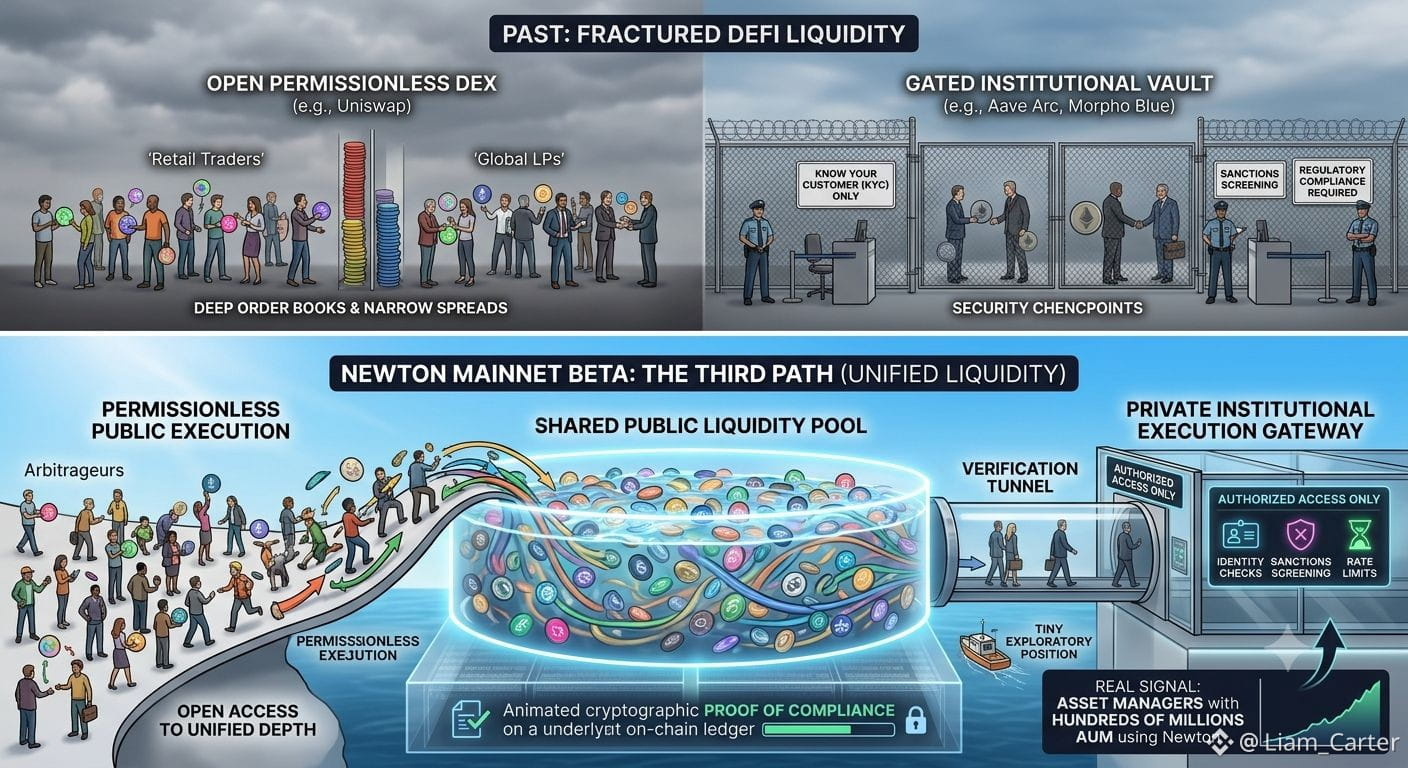
After much reflection, I’ve concluded that Newton Mainnet Beta’s “public liquidity + private execution” model represents a genuine third path for institutional DeFi—one I once thought impossible. For years, the conversation seemed trapped between permissionless chaos and gated liquidity silos. Permissioned environments like Aave Arc and Morpho Blue’s institutional vaults proved that firms willingly pay a premium for identity checks, sanctions screening, and clear regulatory boundaries. But these walled gardens fracture liquidity: they lock out retail, arbitrageurs, and global LPs, leaving shallow depth and wider spreads. Institutions moved on-chain to escape precisely those inefficiencies, yet three years of talk haven’t translated into real scale because liquidity remained balkanized. The core promise of DeFi—deep, unified liquidity—was broken.
Newton’s architecture keeps a single, shared liquidity pool. The execution layer, however, is privatized for institutions: before settlement, a verification process runs identity checks, sanctions screening, and rate limits, and only approved trades settle, with a cryptographic proof recorded on-chain. Retail participants continue permissionlessly on the same pool. So there’s one source of liquidity but two distinct execution pathways—compliant and open.
I’ve taken a tiny exploratory position just to track the infrastructure closely. The real signal I’m waiting for is asset managers with hundreds of millions to billions in AUM actively using Newton as an authorized gateway into public DeFi, with on-chain evidence. Without that, serious capital stays on the sidelines. I searched for other protocols that have successfully implemented this hybrid model at scale and proven it works, but found very little. If you’ve seen one that has truly verified it in practice, I’d genuinely like to compare notes.
$LAB
After much reflection, I’ve concluded that Newton Mainnet Beta’s “public liquidity + private execution” model represents a genuine third path for institutional DeFi—one I once thought impossible. For years, the conversation seemed trapped between permissionless chaos and gated liquidity silos. Permissioned environments like Aave Arc and Morpho Blue’s institutional vaults proved that firms willingly pay a premium for identity checks, sanctions screening, and clear regulatory boundaries. But these walled gardens fracture liquidity: they lock out retail, arbitrageurs, and global LPs, leaving shallow depth and wider spreads. Institutions moved on-chain to escape precisely those inefficiencies, yet three years of talk haven’t translated into real scale because liquidity remained balkanized. The core promise of DeFi—deep, unified liquidity—was broken.
Newton’s architecture keeps a single, shared liquidity pool. The execution layer, however, is privatized for institutions: before settlement, a verification process runs identity checks, sanctions screening, and rate limits, and only approved trades settle, with a cryptographic proof recorded on-chain. Retail participants continue permissionlessly on the same pool. So there’s one source of liquidity but two distinct execution pathways—compliant and open.
I’ve taken a tiny exploratory position just to track the infrastructure closely. The real signal I’m waiting for is asset managers with hundreds of millions to billions in AUM actively using Newton as an authorized gateway into public DeFi, with on-chain evidence. Without that, serious capital stays on the sidelines. I searched for other protocols that have successfully implemented this hybrid model at scale and proven it works, but found very little. If you’ve seen one that has truly verified it in practice, I’d genuinely like to compare notes.
$LAB