
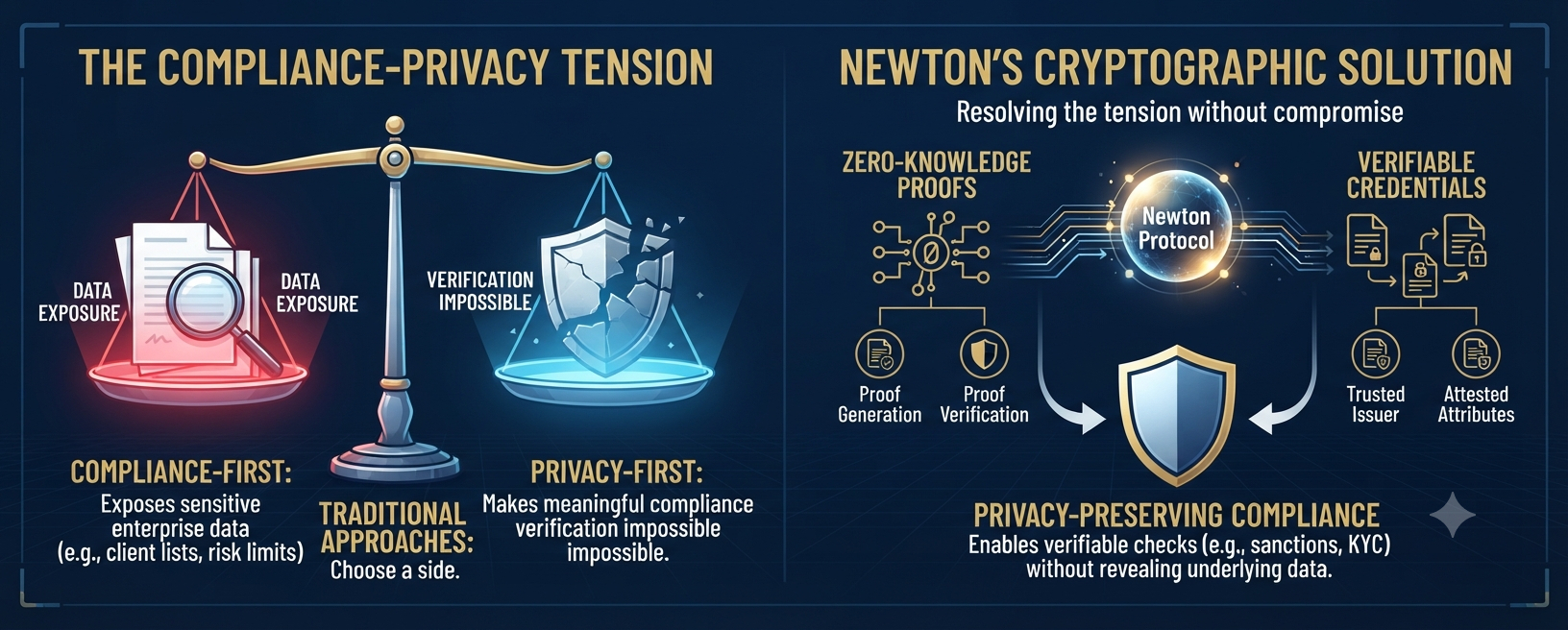
The combination of compliance requirements and privacy requirements creates a tension that most enterprise blockchain projects resolve in favor of one at the expense of the other. Compliance-first approaches expose more data than enterprise clients can accept. Privacy-first approaches make meaningful compliance verification impossible. Newton's design is attempting to resolve that tension through cryptographic techniques rather than by choosing a side.
The specific techniques involved — zero-knowledge proofs and verifiable credentials — are mature enough to be practically deployable but still complex enough that implementation quality varies significantly across projects. Understanding what Newton is actually doing with these techniques, rather than just that it uses them, matters for evaluating whether the privacy-compliance integration is credible.
Zero-knowledge proofs allow one party to prove to another that a statement is true without revealing the information underlying the statement. In Newton's context, this means a transaction can prove that it passes a sanctions check without revealing the identity of the counterparty to anyone monitoring the blockchain. The check happened, the result was clean, and the proof is verifiable — but the data that drove the check remains private.
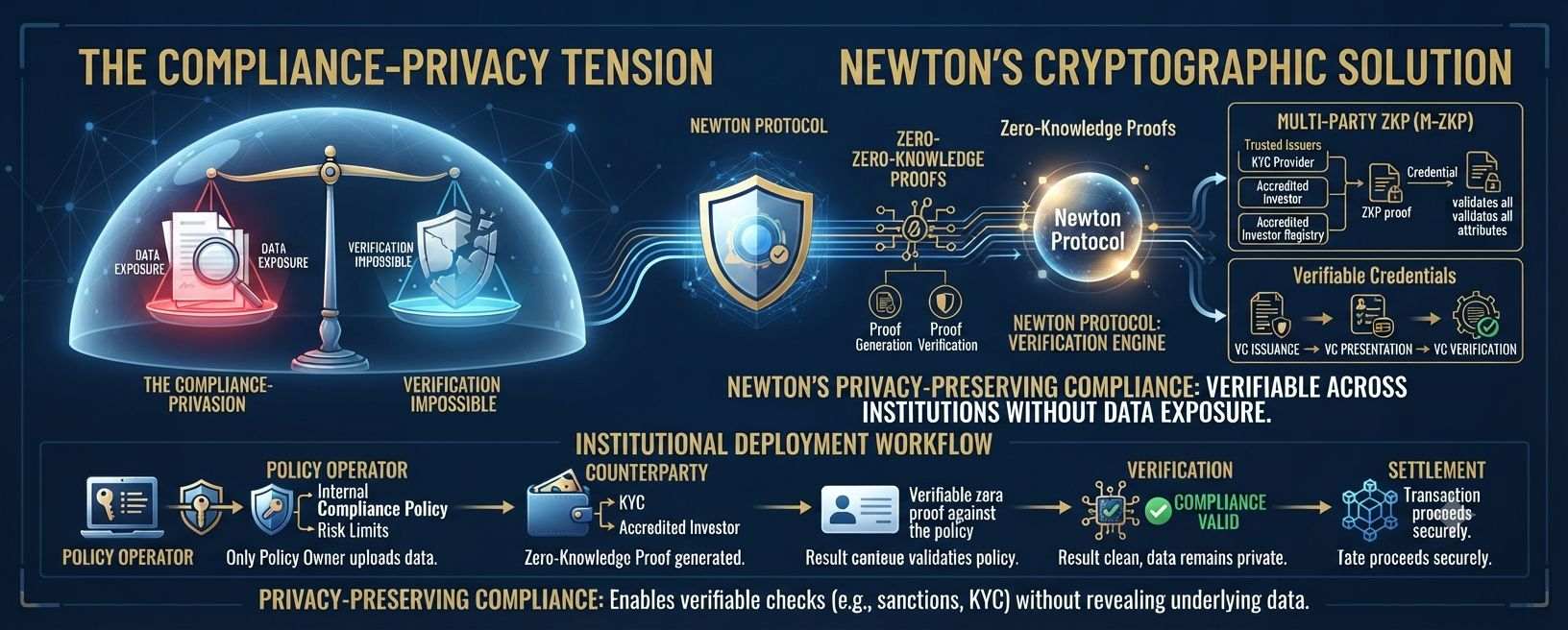
Verifiable credentials are a related mechanism for identity verification. A credential issued by a trusted identity provider attests to specific attributes of the credential holder — that they are accredited investors, that they are located in a permitted jurisdiction, that they have passed KYC verification. The credential can be presented as proof of those attributes without revealing the underlying documentation. Newton's integration with identity providers like Persona and Veriff is designed to work through this credential model.
The technical challenge is that zero-knowledge proofs have significant computational requirements, and the complexity of the compliance logic being verified affects how expensive those proofs are to generate and verify. Simple binary checks — is this address on a sanctions list, yes or no — are relatively efficient. Complex multi-factor compliance evaluations involving multiple data sources and conditional logic are more expensive. Whether Newton's implementation handles the full complexity of institutional compliance requirements efficiently enough for real-time transaction authorization is an important practical question.
The encrypted secrets model adds another dimension. Newton says policy operators cannot read plaintext sensitive data, and only the policy owner can upload or update it. This is important for enterprises that cannot expose their internal compliance policies, client lists, or risk limits to the operators enforcing those policies. The implementation of this model — specifically how key management works and what trust assumptions it requires — deserves careful examination by any institution considering deploying on Newton.
The privacy architecture is technically sophisticated and well-suited to the institutional compliance use case. Whether the implementation is robust enough to satisfy the security requirements of regulated financial institutions is something that independent security review and deployment experience will ultimately determine.#newt $NEWT @NewtonProtocol