
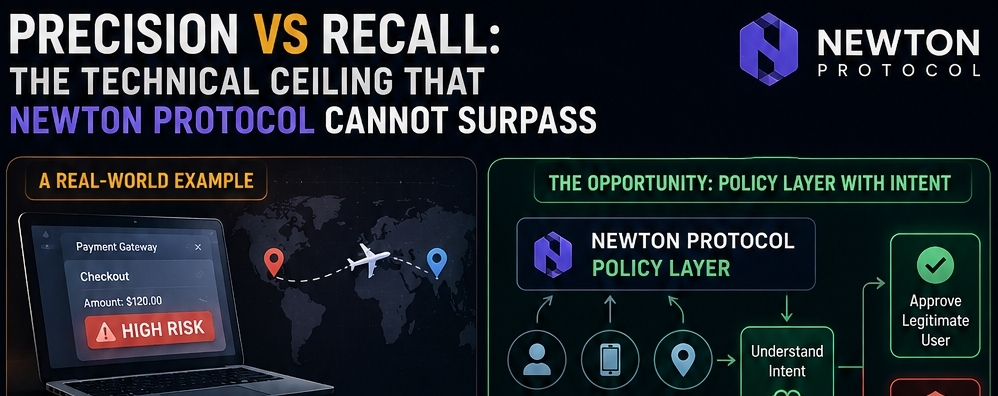
I once used an international payment gateway and had a transaction flagged as “high risk” simply because I checked out from an IP address in a different country than the one where my card was registered despite the fact that I was only traveling for work. The fraud detection model could not distinguish legitimate travel behavior from an actual account takeover because it only saw statistical deviation, not the real context behind the activity.
This is an inherent limitation of every rule-based or model-based authorization system: false positives and false negatives are always in tension. Set the threshold too tightly and legitimate users get blocked; set it too loosely and genuine fraud slips through.
The policy layer that @NewtonProtocol places in front of execution could improve this challenge if its logic goes beyond statistical anomalies and incorporates intent understanding the context behind a transaction rather than merely measuring how far it deviates from a baseline.
That said, inferring true intent is an extraordinarily difficult problem, far more complex than tuning a handful of metrics. Even the most advanced fraud detection systems used by major fintech companies still operate under the same trade off between precision and recall. No model has completely eliminated false positives without increasing false negatives somewhere else. No matter how flexible its policy engine becomes, Newton Protocol faces the same technical ceiling; there is no formula that removes this trade-off entirely.
A more practical focus for Newton, therefore, is not the pursuit of perfect accuracy, but the optimization of remediation the process of resolving false positives quickly and with minimal friction. Since false positives can never be fully eradicated, what truly matters is how long users must wait and how much effort they expend to prove that they were flagged incorrectly.
In that sense, $NEWT should be evaluated not only by the average accuracy of its authorization engine, but also by the speed, transparency, and cost efficiency of its remediation process.