
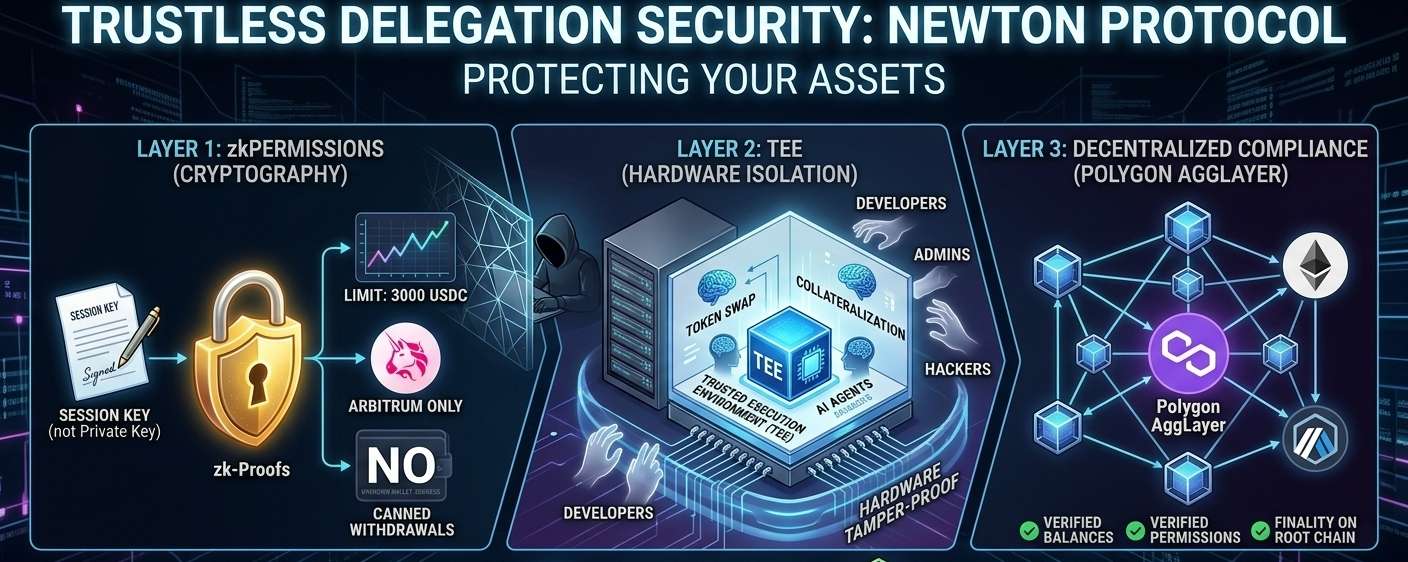

🛡️ "Trustless Delegation" Security Model
The security of Newton Protocol is built on a core principle: You do not need to trust the honesty of the project or the AI Agent. Instead, the system leverages advanced mathematics (cryptography) and secure hardware to enforce strict rule compliance.
Here are the 3 core security layers that safeguard your assets:
1. zkPermissions: Smart Spending Limits (Cryptography)
Eliminating the root cause of Private Key exposure. Traditional automated bots require users to input their private keys—meaning if the bot is compromised, you lose everything. Newton completely changes the game:
Separation of Power: You never hand over your Private Key. Instead, you only sign a Session Key bound by a strict set of rules that you define.
Customizable Rulebooks: You have absolute control to specify constraints, such as:
"The AI can only use a maximum of 3,000 USDC, is restricted to Uniswap on the Arbitrum network, and is strictly prohibited from withdrawing funds to any unknown wallet.""The AI can only use a maximum of 3,000 USDC, is restricted to Uniswap on the Arbitrum network, and is strictly prohibited from withdrawing funds to any unknown wallet."
Immutable Enforcement: This rulebook is hardcoded into cryptographic proofs (zk-Proofs). Even if the AI Agent malfunctions or Newton's servers are breached, hackers cannot alter these rules to steal your funds.
2. TEE: Isolated Execution Environment (Hardware)
When the AI Agent processes commands and calculates strategies (e.g., token swaps, collateralization), all data processing is moved into a TEE (Trusted Execution Environment).
Hardware Black Box: A TEE is a completely isolated secure enclave embedded directly inside the hardware processor (such as Intel SGX).
Zero Tampering: Once data is inside the TEE, no one—including Newton Protocol developers, server administrators, or root-access hackers—can view or modify the executing commands.
The Result: This guarantees that the AI Agent executes transactions honestly, with zero risk of wallet address swapping or token amount manipulation during trades.
3. Polygon CDK & AggLayer: Decentralized Compliance (Infrastructure)
Newton completely eliminates the risk of DDoS attacks and Single Points of Failure (SPoF) by rejecting centralized transaction processing.
The protocol leverages Polygon's AggLayer architecture to validate cross-chain transactions in a fully decentralized manner.
Every balance state, permission level, and transaction must be cross-verified across a network of nodes before being finalized on the underlying blockchain.
📌 In a Nutshell: The Principle of "Least Privilege"
💡 The Analogy: Think of the AI Agent as a delivery courier you hire. You lock the package, grant them access only to the delivery address, and specify the exact quantity. They cannot open the package or take a detour to steal your assets.