
❤️


Veröffentlichen

Sarah corner
·
--
I started reading about OpenGradient because of the AI narrative.
A few articles later I was reading about verification instead.
I honestly wasn't expecting that.
Most AI conversations still revolve around the same things. Better models. Faster responses. Bigger capabilities.
Verification barely gets mentioned.
While reading, one question kept coming back.
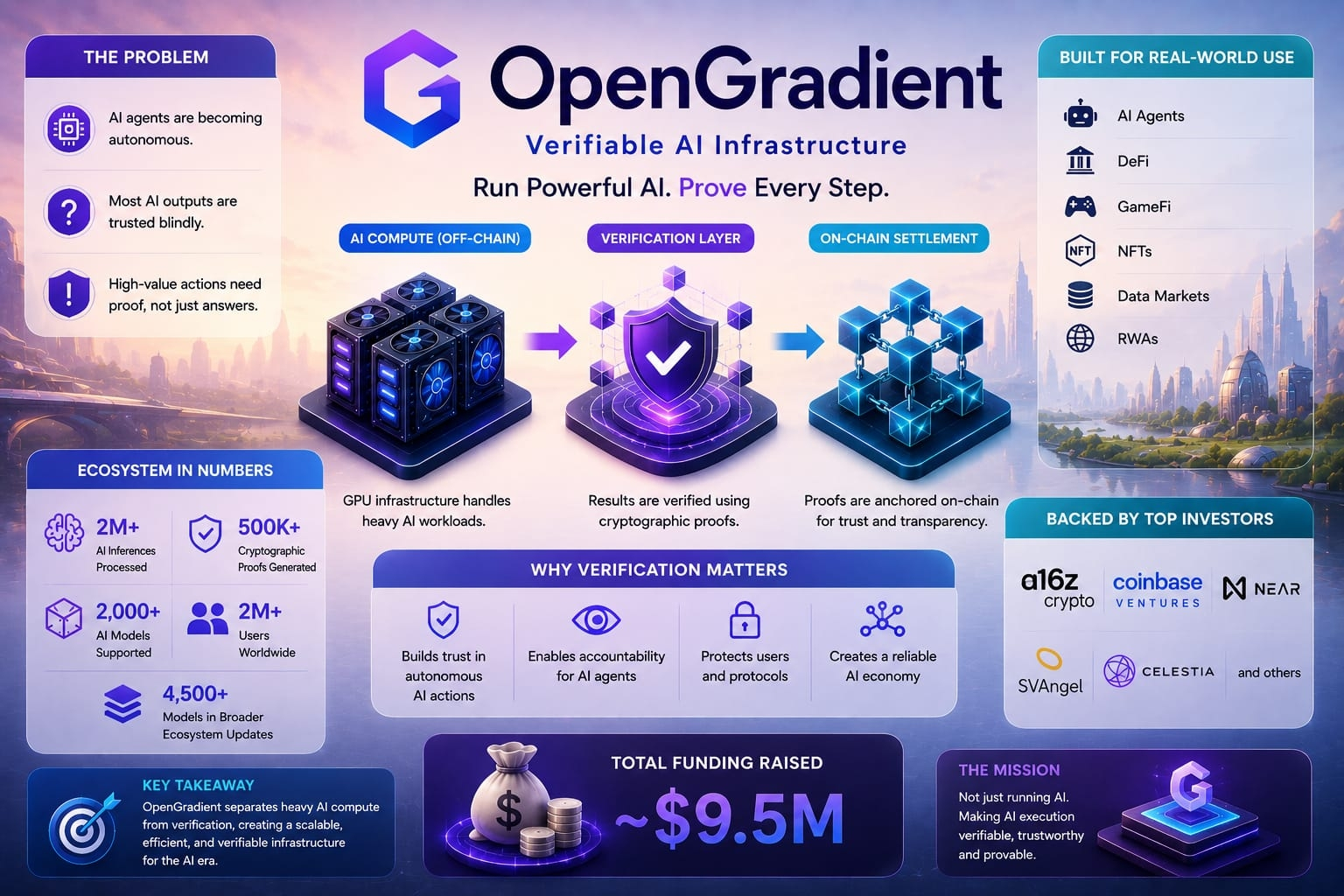
If an AI agent starts moving funds, interacting with DeFi protocols or making decisions on its own, how do you actually know it did what it says it did?
That's the problem OpenGradient seems to be working on.
The idea isn't just to run AI. It's to make AI execution something that can actually be verified.
I checked a few of the recent ecosystem updates as well. The network has already processed more than 2 million AI inferences, generated 500,000+ cryptographic proofs, supports 2,000+ AI models (with broader ecosystem updates mentioning 4,500+ models) and has reached 2 million+ users.
There's also around $9.5 million in funding with backing connected to a16z crypto, Coinbase Ventures, SV Angel, NEAR, Celestia and other investors.
Those numbers don't automatically mean the project succeeds.
They do tell me people are building, testing and using the infrastructure.
That's probably the part of OpenGradient I find most interesting.
#opg $OPG @OpenGradient
Haftungsausschluss: Enthält Meinungen von Drittanbietern. Keine Beratung. Binance AI wird ohne Gewähr bereitgestellt. Siehe AGB.