
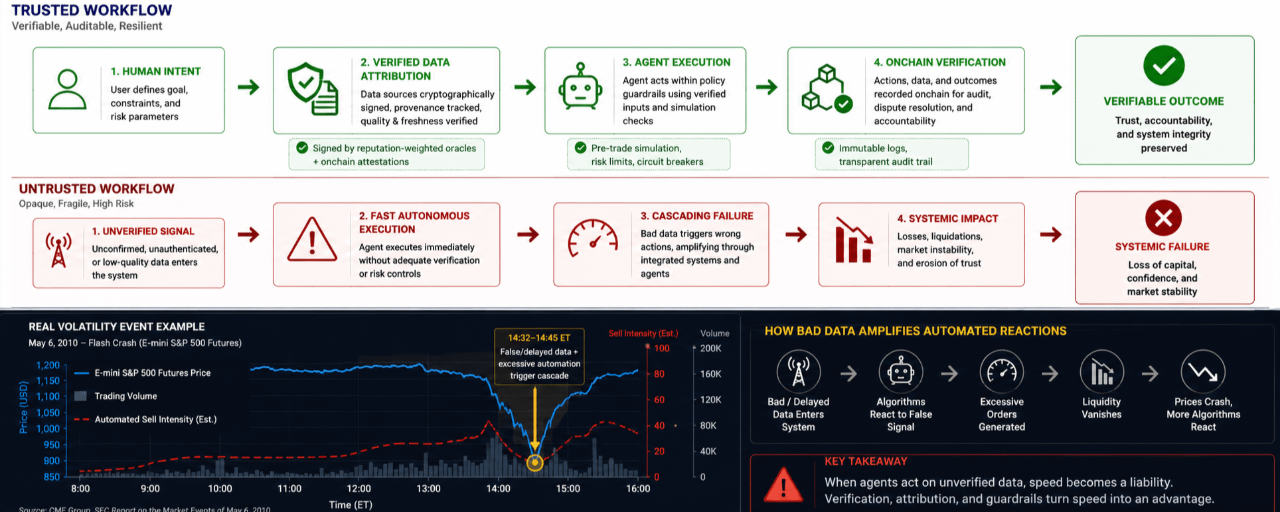

I keep thinking about what happens when verification can’t keep up with execution.
Most people still think speed is the problem. It isn’t.
Most AI discussions in crypto still revolve around speed.
Faster agents. Faster execution. Faster reactions.
But speed has a hidden cost most systems don’t talk about: signal degradation under acceleration.
And after watching the last few volatility cascades across the market, I’m starting to think speed might be the least impressive thing about AI infrastructure.
Because bad information moving at machine speed doesn’t create efficiency.
It creates faster failure.
That’s the part of the DeFAI conversation I think the market still underestimates.
A lot of AI-agent narratives today assume the hard problem is execution. It isn’t. We already have systems capable of routing trades, scanning liquidity, monitoring wallets, and reacting to onchain events faster than humans ever could.
The real bottleneck is trust in the data feeding those systems.
And honestly… the implications start looking very different once you think about what happens during stress conditions.
When volatility spikes, humans break in predictable ways. Fear takes over. Conviction disappears. People close positions too early, revenge trade, or freeze completely while the market moves against them.
I’ve seen it happen during liquidation cascades where traders spent more time second-guessing themselves than actually managing risk.
Agents don’t experience that… at least not in the way we describe it. I’m not even sure that framing is correct.
They don’t panic during a 15% candle. They don’t lose sleep after a bad entry. They don’t hesitate because Twitter sentiment flipped bearish for six hours.
That’s the opportunity AI introduces into markets.
But it’s also the danger.
Because once autonomous systems begin reacting to the same corrupted signals simultaneously, mistakes stop being isolated decisions and start becoming synchronized market behavior.
And synchronized systems fail differently than humans do.
Liquidity disappears together, and feedback loops reinforce instead of stabilizing.
And crypto already knows what bad data under pressure looks like.
We’ve watched oracle failures distort protocols during volatility. We’ve watched fake signals trigger mass reactions. We’ve watched liquidity disappear while automated systems kept executing as if conditions were still normal.
This is where I might be overgeneralizing, but—The uncomfortable truth is this:
Reaction cycles start compressing faster than markets can validate whether the underlying signal was trustworthy in the first place.
Markets become unstable when reaction speed exceeds validation capacity.
Once execution latency falls below verification latency, markets stop interpreting information and start reflexively amplifying whatever signal arrives first.
That’s why I think OpenLedger’s positioning matters more than a lot of the market currently realizes.
The interesting part isn’t “AI agents onchain.” Everyone says that now.
The more important layer is how OpenLedger structures the workflow underneath the agent itself.
Instead of treating AI outputs as isolated black boxes, the model leans into something crypto desperately needs if autonomous systems are going to scale responsibly: attribution, traceability, and verifiable sourcing across the workflow pipeline.
That shifts the problem from execution speed to execution accountability.
Although even that framing might be incomplete—execution and accountability might not actually be separable under extreme stress.
Because once agents start participating deeper in financial systems, the question stops being:
“Can the model execute?”
And becomes:
“Can anyone verify why it executed?”
That distinction becomes extremely important once markets stop giving systems the luxury of stable conditions.
A fast system looks impressive in stable conditions. Almost everything does.
The real test happens when liquidity thins, signals conflict, and multiple automated systems begin competing against the same shrinking exits.
Because under stress, markets stop behaving like pricing systems and start behaving like reflexive feedback loops.
That’s where trust infrastructure becomes more valuable than raw throughput.
And I think the market is slowly beginning to understand that the next AI race in crypto probably won’t be won purely by intelligence.
The first phase of AI narratives rewarded autonomy and speed. The next phase probably rewards systems that can survive adversarial market conditions.
Early AI narratives rewarded systems that could act autonomously. Mature markets eventually reward systems that remain trustworthy during stress.
Execution isn’t the hard part anymore.
Trusting the signal is.
Though even framing it that cleanly might be wrong. I keep going back and forth on that.
Once speculative AI narratives mature, the market stops rewarding systems that react the fastest…
And starts rewarding the systems that remain trustworthy after everyone else begins failing under stress.
That’s the part most speculative AI narratives skip because it’s less exciting than “fully autonomous finance.” But from what I’ve seen, reliability under pressure is usually what separates infrastructure from hype cycles.
OpenLedger’s broader thesis seems aligned with that reality.
Not replacing human judgment entirely.
Not pretending agents are magically risk-free.
But structuring AI workflows so humans still define objectives, boundaries, and trust assumptions — while machines handle execution consistency at scale.
That human-machine division feels important to me.
Humans are still better at defining intent, evaluating regime shifts, and deciding acceptable risk.
Machines are better at staying consistent once rules are set.
The mistake is assuming one side can completely replace the other.
I don’t think that’s where this goes… but I also can’t fully argue why it wouldn’t.
I think the future AI economy ends up rewarding systems that can prove reliability, attribution, and execution integrity during stress — not just systems that move the fastest during calm periods.
That’s how financial infrastructure actually evolves.
Nobody cares how fast a bridge was built if it collapses under pressure.
I’m not fully convinced this is even an AI problem anymore—it might just be a market structure problem exposed by AI.
Unless the next failure mode isn’t execution or verification—but consensus itself becoming the manipulated layer.

#OpenLedger $OPEN @OpenLedger