
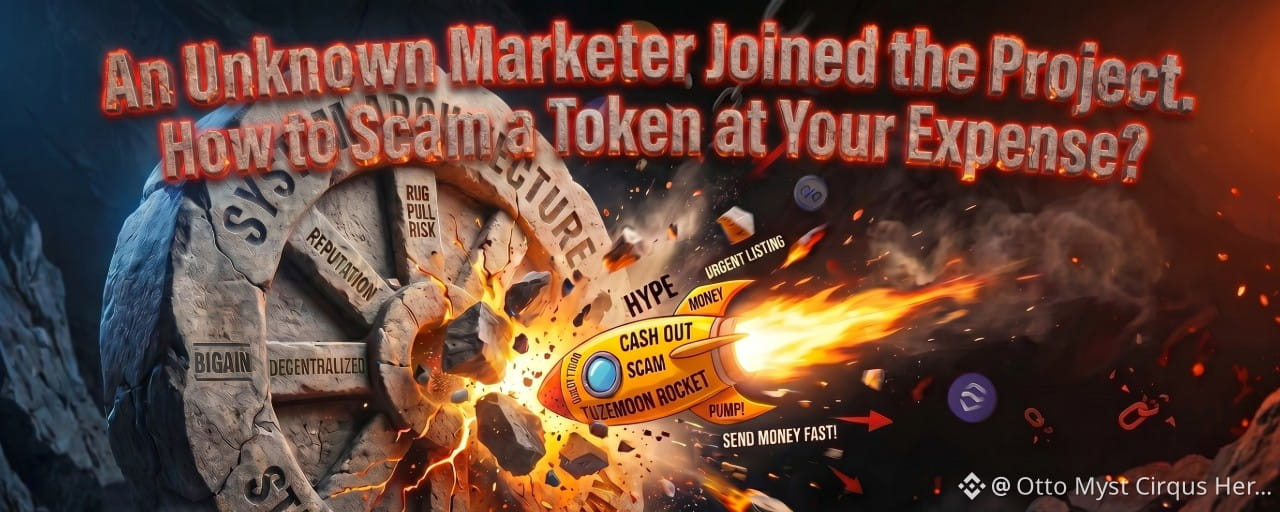

Web3 is a strange and fascinating place. Here, you can spend weeks engaging in deep philosophical dialogues about freedom, decentralization, and the future of digital communities, only to wake up one night and find someone trying to turn your project into just another short-term memecoin driven by automated bots and an "urgent listing."
I recently went through this exact scenario. Fortunately, cold, analytical reasoning kicked in just in time. Perhaps sharing this experience will save someone else from making a very foolish, and more importantly, irreversible mistake.
How It All Begins: The Illusion of Speed
The script is a classic: a new person enters the project. They usually introduce themselves as a marketer, growth specialist, or an "expert in rapid launches." They are highly confident, speak fast, throw around buzzwords, and promise that coveted momentum—the sudden impulse that will instantly push the project to the top. Their vocabulary constantly revolves around words like visibility, community, listing, and hype.
At an early stage, when you are slowly building a complex architecture brick by brick, this high-energy push sounds appealing. Especially if the project currently lacks a major budget, the audience is trickling in slowly, and you are eager to see some real action. Hundreds of founders have fallen for this mental trap.
The First Warning Sign: A Deficit of Concreteness
Once the primary fog of beautiful promises cleared, I started asking simple, grounded questions:
Who are you? Share your public profile or LinkedIn.
What Web3 use cases have you launched before? Where is your verifiable digital footprint?
How exactly do you envision the revenue distribution among participants?
What is the mathematics behind the tokenomics, and how will contributions be evaluated technically?
Instead of precise answers, I received what the industry commonly refers to as "hot air." Beautifully vague phrasing, abstract reflections on mutual trust, and a persistent, aggressive return to a single thought: "We need to issue and list the token as fast as possible before people lose interest."
This is a critical marker to remember once and for all. Mature, systems-minded specialists always begin by discussing risks, underlying infrastructure, smart contracts, legal frameworks, and security models. Speculators always begin with the listing.
Under-the-Hood Subversion
A couple of days later, it became apparent that this person had wasted no time. Operating on the logic of "it's better to ask for forgiveness than permission," he deployed the infrastructure completely on his own.
He set up Telegram groups, integrated anti-spam bots, and configured a Buy Bot—a tool designed to flash green circles into the chat with every transaction, faking high-volume market activity. Furthermore, he had already listed the project on a trending voting platform.
Most importantly, he deployed the token itself. He simply took the project’s name, logo, and visual style. The blockchain is designed such that anyone can spend a couple of dollars and two minutes to deploy an ERC-20 token on networks like Base or Solana, naming it after your company, your order, or your mother. It takes less time than brewing a cup of coffee.
But when I cross-referenced the contract addresses, everything fell into place. The official contract of our core infrastructure (located on the Zora network) and the contract this marketer created on Base for a "quick pump" were two completely different, entirely unrelated entities:
Official Core Contract (Zora): 0x6886cd19e1d926d26ff7bd687be0889e6398f6b1
Marketing Clone Contract (Base): 0x989987ce59c46ec5e819ae89fa688dc216065fc2
The project was being steered entirely in bypass of its creator.
The Mechanics of an Express Scam
This entire operation follows a rudimentary five-step blueprint that sustains 90% of the low-tier cryptocurrency market:
Creating a Shell Token. Total cost—a few dollars in network gas fees.
Faking Activity. Bots are flooded into Telegram chats, trending algorithms are triggered, and an illusion of organic momentum is engineered.
The Micro-Funding Request. The marketer approaches the founder and states: "Everything is set, the contract is live, the chats are buzzing. We urgently need to buy a premium listing on an aggregator (like Top100listing). It costs just 0.02 ETH (around $70). We have to act fast before the hype dies!"
The Trapping Feed. If the founder pays those $70, the token lands on a "Hot Pairs" or "Trending" board for a few hours. Random day-traders and algorithmic sniper bots spot the polished branding, notice the artificial price spike, and throw in small amounts ($10–$20) hoping to flip the asset in five minutes. The price chart green-bars upward.
The Final Act. Because the token lacks an actual pre-seeded liquidity pool, a real product, or a long-term dedicated audience, the algorithmic hype burns out in 2 to 3 hours. Trading volume vanishes, and the price drops to absolute zero. The marketer extracts a few hundred dollars in quick profit, deletes his Telegram account, and dissolves back into the web.
The Most Dangerous Part: The Reputational Blow
The most terrifying part of this scheme is not the loss of seventy dollars spent on a shady listing. Nor is it the loss of a few days spent on empty conversations.
The true danger lies in the total annihilation of your name. If a token that turns into worthless dust within a few hours is tied to your official website, your face, your honest name, and your brand, the audience will not hunt down an anonymous Telegram marketer. People will not remember his random username. They will remember you. The stigma of being a "rug pull" or "scam" creator sticks instantly, permanently locking the doors to any serious venture integration in the future. The anon vanishes. Your brand does not.
Code vs. Hype: How to Tell a Builder from a Liquidator
This experience helped me formulate a very sharp distinction between the mindsets of people who approach your venture:
The Systems-Minded Person (Architect/Engineer): Thinks in terms of infrastructure, sustainability, security, and long-term reputation. They talk about trust systems, value distribution mechanisms, robust tokenomics, and how to protect early participants from dilution.
The Hype-Marketer (Speed Operator): Thinks exclusively in terms of external metrics. They care only about momentum, trending, visibility, and an immediate launch. For them, a project is just a sales funnel that needs to be rotated as fast as possible.
In the Web3 industry, marketers with a launch-first approach are not necessarily malicious criminals. They are simply a specific class of operators used to working with short-lived memecoins. They can be highly useful, but much later—once the project possesses a functional product, verified code, and a formed culture. Letting them near the wheel during the foundational phase is fatal.
The Core Conclusion
A token is a powerful magnifier. But it can only magnify what you already have under the hood.