
XRP Token Analysis — Is Ripple’s Cryptocurrency Still a Game-Changer?
Introduction
In the fast-evolving world of cryptocurrencies, $XRP stands out as one of the most discussed and debated digital assets. Originally launched in 2012 by the founders of Ripple Labs, XRP was designed to solve one of the biggest problems in finance — slow and expensive cross-border payments. Over a decade later, $XRP remains a key player in the digital asset ecosystem, with both strong supporters and determined critics.
This article explores XRP’s fundamentals, tokenomics, market performance, risks, and long-term potential — providing a complete analytical overview of the token in 2025.
1. The Vision Behind XRP
Unlike most cryptocurrencies built for decentralized applications or speculation, XRP was designed for utility — specifically for fast, low-cost global transactions. The XRP Ledger (XRPL) enables transactions to settle in just 3 to 5 seconds, with minimal fees, regardless of the sender’s or receiver’s location.
Ripple Labs, the company closely associated with XRP, envisions a world where financial institutions can use XRP as a bridge currency to transfer value efficiently between different fiat currencies. This approach significantly reduces the need for pre-funded accounts and lowers transaction costs compared to traditional systems like SWIFT.
2. Tokenomics and Supply
XRP operates on a pre-mined supply model of 100 billion tokens — a design that contrasts with mined assets like Bitcoin. Of these:
80 billion XRP were allocated to Ripple Labs,
20 billion XRP went to the project’s founders and early contributors.
Ripple later placed about 55 billion XRP in escrow accounts to ensure transparent monthly releases (up to 1 billion per month). This mechanism prevents uncontrolled dumping of tokens into the market and adds predictability to XRP’s circulation.
Additionally, every transaction on the XRPL burns a tiny fraction of XRP, introducing a mild deflationary pressure over time. Though small, this mechanism slowly reduces the total supply.
3. Core Strengths and Advantages
Real-World Utility: XRP has a defined purpose — cross-border payment facilitation — unlike many speculative crypto assets.
Speed and Cost: Transactions settle in seconds with minimal fees, making it far superior to traditional systems for global transfers.
Institutional Partnerships: Ripple has secured partnerships with numerous financial institutions, including banks exploring XRPL for settlement and liquidity.
Regulatory Progress: After years of legal uncertainty, Ripple has achieved increasing regulatory clarity, especially following key developments in its case against the U.S. SEC.
4. Market Performance and Current Landscape
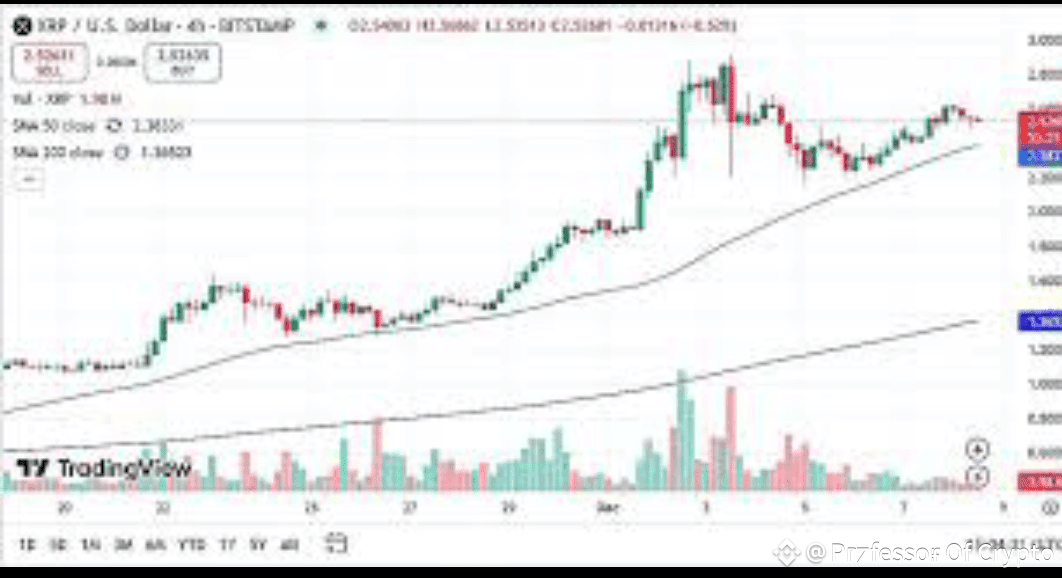
As of late 2025, XRP trades around $2.50 to $3.00, showing resilience amid broader crypto volatility. Recent months saw surges driven by institutional adoption and positive legal clarity.
For example, Ripple’s collaboration with BBVA under the European MiCA framework and increasing institutional inflows pushed XRP beyond the $3 mark earlier this year. Technical analysts have highlighted critical support levels near $2.90–$3.00 and resistance between $3.13–$3.50 — suggesting potential for upward momentum if institutional activity continues to rise.
5. Key Risks and Concerns
While XRP’s potential is promising, investors should also consider its major risks:
Regulatory Uncertainty: Although Ripple has made progress, global regulations remain uneven, and new rulings could impact adoption.
Centralization Risk: A significant portion of XRP supply remains under Ripple’s control. Market participants have raised concerns about the potential influence of large holders.
Adoption Pace: Real-world use by banks and institutions must scale substantially for XRP’s price to reflect its utility potential.
Competition: Emerging blockchains and stablecoins offering similar or faster settlement options could challenge XRP’s dominance.
Market Volatility: Like all cryptocurrencies, XRP is subject to large price swings influenced by global sentiment and liquidity cycles.
6. Outlook and Price Scenarios
Analysts remain divided on XRP’s long-term trajectory:
Bullish Scenario: If XRP becomes a core bridge asset in the global payments ecosystem, optimistic targets range between $10–$20 within the next few years.
Moderate Scenario: With steady adoption and growing institutional usage, XRP could maintain gradual growth in the $3–$5 range.
Bearish Scenario: If adoption lags or regulatory headwinds intensify, prices could stagnate or decline below current levels.
Regardless of the scenario, XRP’s success will largely depend on real-world utility, network adoption, and macroeconomic sentiment toward digital assets.
7. Conclusion
XRP has survived over a decade of evolution in the crypto market — enduring legal challenges, market crashes, and shifts in investor sentiment. Unlike many tokens driven purely by hype, XRP is anchored by a tangible use case: to revolutionize international money transfers.
Its future depends on how effectively Ripple and the XRP Ledger can translate that vision into widespread institutional use. If banks and payment providers continue to adopt XRP for cross-border settlements, the token’s utility — and potentially its value — could see substantial growth.
However, investors should remember that volatility and uncertainty remain high. XRP represents both a bold innovation and a high-risk opportunity in the evolving digital economy.
Disclaimer:
This article is for educational and informational purposes only. It does not constitute financial or investment advice. Cryptocurrency investments carry risk, and readers should conduct their own research before making any financial decisions.