
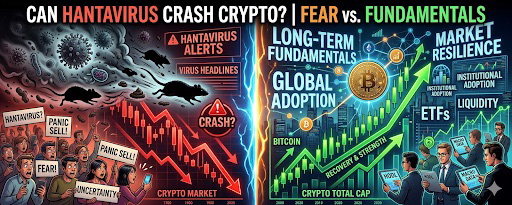

Hantavirus has started appearing in headlines again, and whenever a virus-related story trends globally, the crypto market reacts emotionally before it reacts logically. But the big question is:
Can Hantavirus actually crash the crypto market?
The short answer is: very unlikely — unless it evolves into a major global health emergency.
Here’s the deeper reality behind the fear, the psychology, and the market impact.
What Is Hantavirus?
Hantavirus is a rare viral disease transmitted primarily through contact with infected rodents, especially rats and mice. Unlike highly contagious respiratory outbreaks such as COVID-19, Hantavirus does not typically spread easily from person to person in most cases.
Because of this, health experts usually monitor it carefully, but it is not currently viewed as a pandemic-level threat to the global economy.
That distinction matters a lot for financial markets.
Why Crypto Reacts To Fear Faster Than Stocks
The crypto market is extremely emotional and highly sensitive to uncertainty.
Unlike traditional markets that close during weekends or after hours, crypto trades 24/7. That means fear spreads instantly.
When investors see headlines involving:
Viruses
Wars
Economic instability
Bank collapses
Government regulations
…many traders immediately reduce risk.
This creates:
Panic selling
Liquidations
Volatility spikes
Fake breakdowns
Emotional exits
Even a rumor can trigger sharp corrections in crypto.
So if Hantavirus dominates media cycles aggressively, crypto could temporarily dip due to fear sentiment alone.
But sentiment crashes are different from structural crashes.
Could It Cause A Full Market Crash?
For Hantavirus to truly crash crypto markets, several extreme conditions would need to happen simultaneously:
1. Global Spread Escalation
The virus would need to spread internationally at an alarming rate.
2. Economic Shutdowns
Governments would need to impose restrictions similar to the COVID era.
3. Financial Panic
Traditional markets would need to experience broad risk-off behavior.
4. Liquidity Crisis
Investors would need to rapidly pull money from speculative assets like crypto.
At the moment, none of these conditions exist.
What History Teaches Us
During the early COVID crash in March 2020:
Bitcoin collapsed sharply alongside stocks.
Fear dominated all markets.
Investors rushed into cash.
But something important happened afterward:
Crypto eventually became one of the strongest recovering assets in the world.
Massive liquidity injections, stimulus spending, and increased digital adoption pushed Bitcoin into a historic bull cycle.
This is why experienced investors distinguish between:
Short-term panic
Long-term fundamentals
The Bigger Threat To Crypto Isn’t Hantavirus
Right now, the market is more influenced by:
Interest rates
Federal Reserve policy
ETF inflows
Global liquidity
Institutional adoption
Bitcoin halving cycles
Regulation
These factors move crypto far more than isolated health headlines.
A virus story may create temporary fear candles, but sustained bear markets usually come from macroeconomic tightening and liquidity problems.
How Traders Usually Overreact
Retail traders often make the same mistake during fear-driven headlines:
They:
Sell support levels emotionally
Exit positions during volatility
Chase news instead of structure
Confuse temporary panic with long-term collapse
Meanwhile, experienced investors usually:
Watch liquidity
Monitor market structure
Accumulate during fear
Avoid emotional decisions
This psychological gap is why panic headlines often create opportunities instead of disasters.
What Could Happen Short Term
If media coverage intensifies, we could see:
Increased volatility
Sudden BTC pullbacks
Altcoin weakness
Fear-driven liquidations
Especially in leveraged markets..
But unless the situation becomes globally systemic, the probability of a long-lasting crypto collapse remains low.
Final Perspective
Hantavirus alone is unlikely to crash the crypto market.
What it can do is trigger temporary fear, volatility, and emotional reactions — especially among short-term traders.
Crypto markets move heavily on sentiment, but long-term direction is usually determined by:
liquidity,
adoption,
macroeconomics,
and investor confidence.
In markets, fear spreads faster than facts.
That’s why smart investors focus less on headlines and more on whether the underlying fundamentals are truly changing.