
Some ecosystems grow, spend, cool off, and then start the same cycle again as if nothing was learned.
Pixels is trying to avoid that reset.
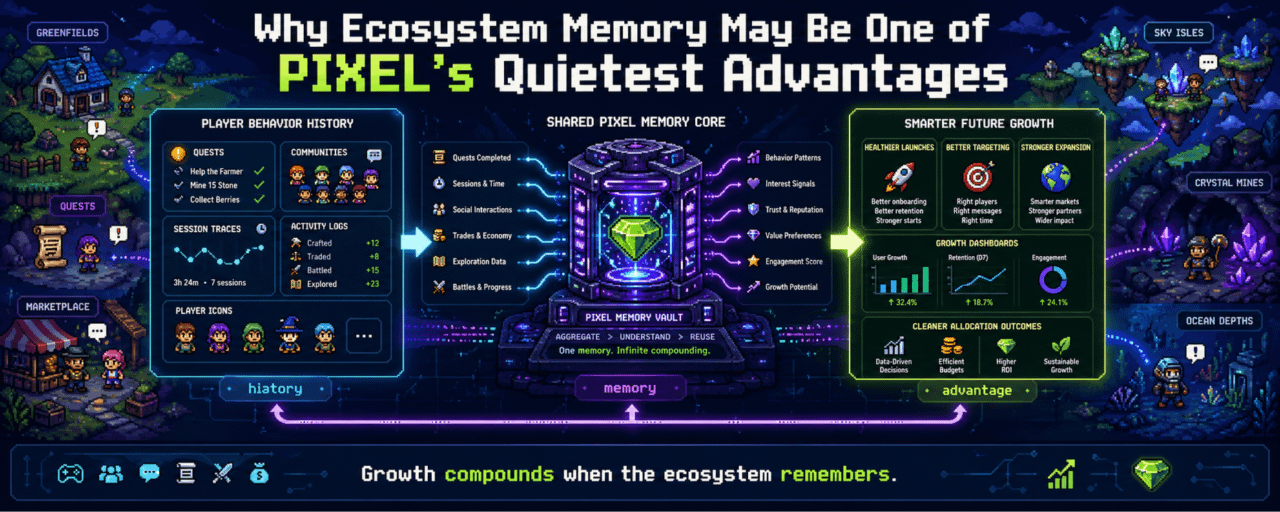
The whitepaper’s flywheel is not just a growth loop. It is also a memory loop. Pixels describes a circular economy where $PIXEL staking → UA credits → player spend → revenue share → staker rewards → richer data → smarter targeting → more games → back to staking, with the explicit goal of pushing Return on Reward Spend above 1 and keeping it there.
That matters because a loop like that does more than recycle capital.
It recycles information.
According to the flywheel section, every purchase, quest, trade, or withdrawal is logged through the Pixels Events API, creating a first-party dataset that spans LTV curves, fraud scores, session depth, and churn vectors across games. The same page says models retrain nightly and re-weight reward budgets toward the cohorts and moments in the funnel that improve retention, ARPDAU, and RORS.
Once you read that carefully, the interesting part of the PIXEL thesis is not only that rewards exist.
It is that the system is designed to remember what those rewards actually did.
Which users stayed?
Which users spent?
Which incentives created better behavior instead of short-term extraction?
Which games generated the strongest signals for the next cycle?
That is a very different model from blind reward spending. It is much closer to a system that turns past behavior into reusable allocation intelligence. That interpretation is an inference, but it follows directly from the flywheel’s data-and-targeting architecture.
This also helps explain why the revised vision puts so much emphasis on precision.
Pixels says 2024 exposed token inflation, sell pressure, and mis-targeted rewards, and the response was a pivot toward data-backed incentives, higher-quality DAU, and a more measurable growth platform. The docs even frame the long-term ambition as building a decentralized AppsFlyer or AppLovin for Web3 and Web2 games.
That kind of ambition only works if the ecosystem does not forget.
A platform becomes smarter only when each cycle leaves something behind that the next cycle can use. In Pixels’ case, that “something” is not just player count. It is behavioral memory: the stored record of what players did, what converted, what retained, what leaked, and what made the economics stronger. This is partly an inference, but it is strongly supported by the documented use of first-party event data and nightly model retraining.
The main site makes that broader reading easier too.
Pixels is presented not just as a single game, but as a free-to-play social ecosystem where users play with friends, build communities, and where the platform aims to let users build games that integrate digital collectibles. That matters because memory becomes more powerful when it is shared across a broader network rather than locked inside one isolated title.
That is why ecosystem memory may end up being a real moat.
Not in the dramatic sense of a flashy feature.
In the quieter sense that each new game, each new player cohort, and each new reward cycle may leave the platform with better pattern recognition than it had before. The flywheel page explicitly says each launch enlarges the addressable audience, adds fresh behavioral data, and restarts the loop at a higher base.
If that continues to work, then PIXEL’s edge is not only token design.
It is not only staking.
It is not only rewards.
It is the possibility that growth becomes cumulative because the system remembers enough to waste less on the next attempt. That is a stronger long-term story than simple activity metrics, because activity can be rented, while usable ecosystem memory can compound. This final point is an inference from the combined design described in the whitepaper.