


Growth becomes expensive when every new game has to buy attention from scratch.
That is why the more interesting part of the PIXEL thesis may be its attempt to make strong games easier to grow over time, not just easier to subsidize for a moment. In the litepaper, Pixels frames its model around three connected pillars — Fun First, Smart Reward Targeting, and the Publishing Flywheel — and that combination matters because it links game quality directly to acquisition efficiency.
The logic is straightforward, but stronger than it first appears.
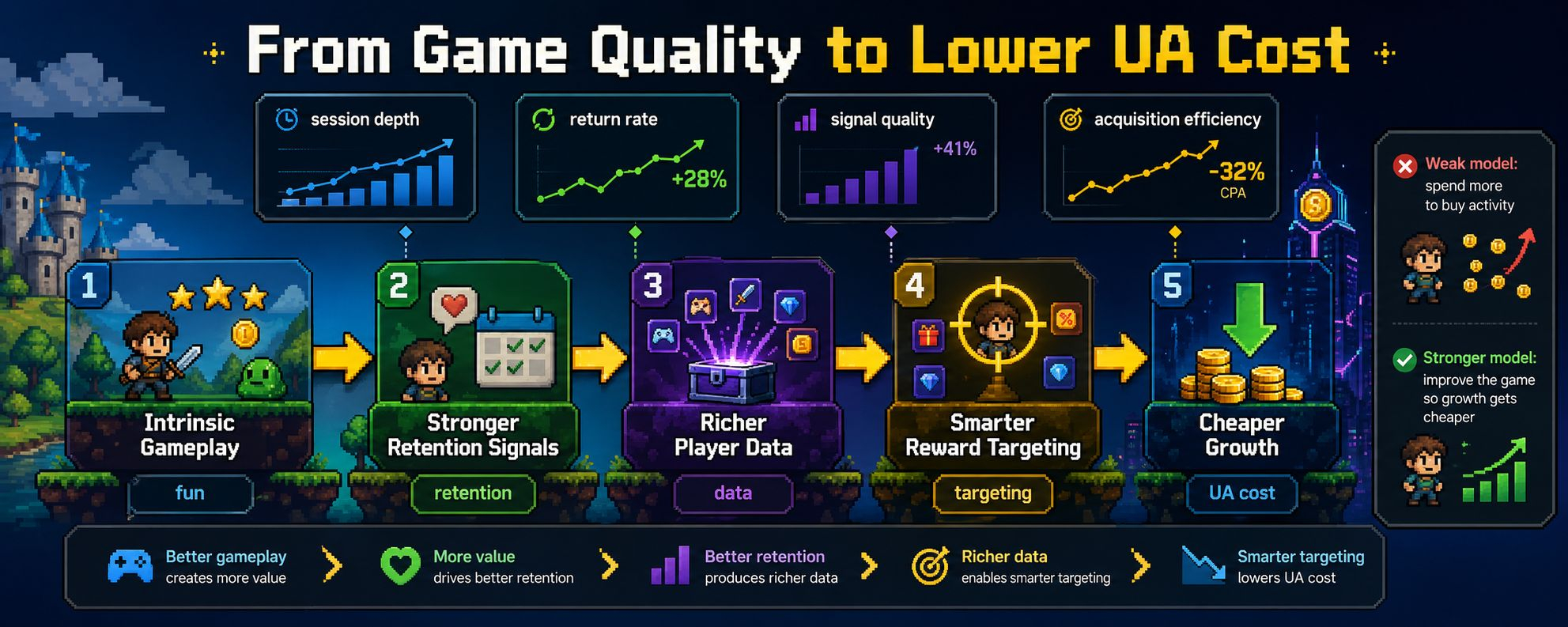
Better games tend to create better player behavior. Better behavior creates better data. Better data improves targeting. Better targeting lowers user acquisition cost for the next wave of growth. The litepaper describes this directly inside the publishing flywheel: better games generate richer data, richer data helps match the right users more precisely, and that lowers UA cost while making the whole system more attractive for future games.
That is a very different model from the usual reward-heavy growth story.
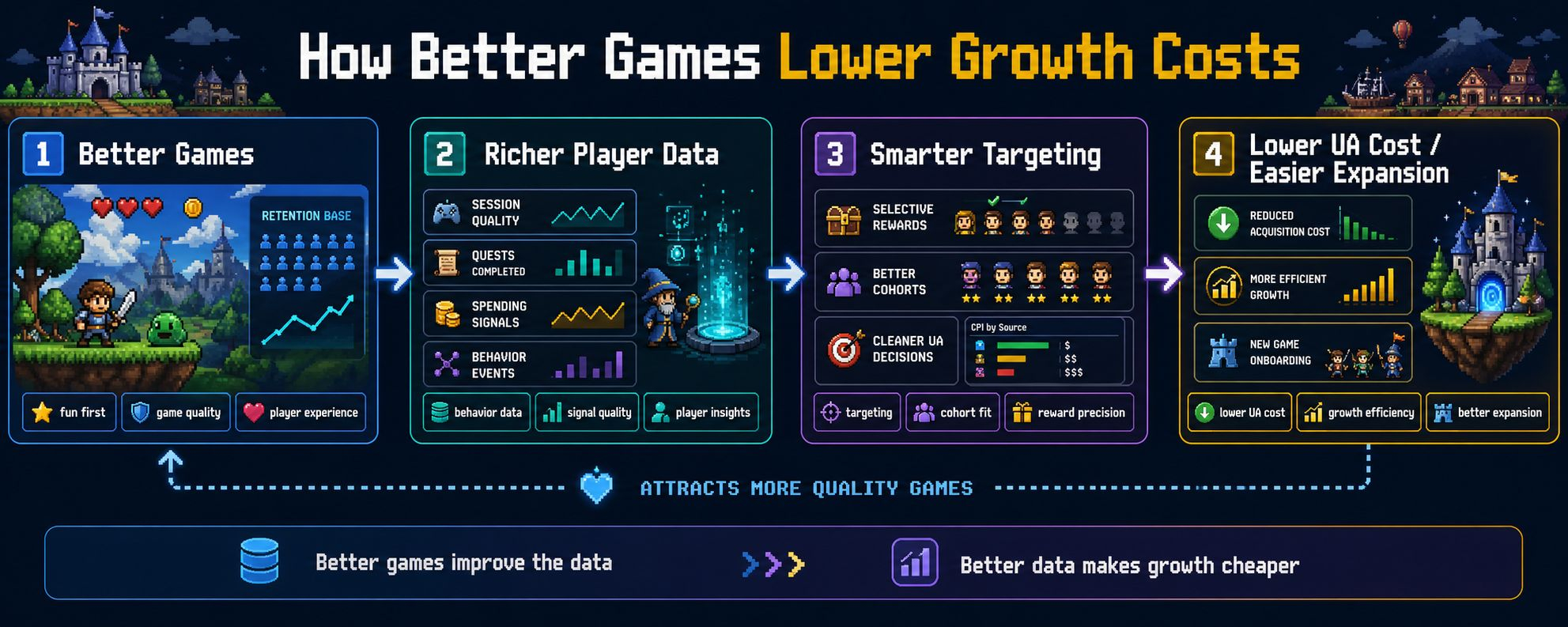
A weaker system tries to solve the problem by spending more. More rewards, more campaigns, more paid activity. But that approach often treats growth like a recurring expense instead of a compounding advantage. Pixels is pointing in another direction: game quality is not just a product issue, it is an acquisition advantage. If the game is stronger, the targeting system gets better. If the targeting system gets better, the next unit of growth should cost less.
This is also why Fun First matters so much in the broader thesis.
If a game has no intrinsic pull, the data it generates is weaker. Session quality is weaker. Retention is weaker. Reward targeting has less useful signal to work with. But if the underlying experience is actually good, then the system gets cleaner inputs: who stays, who spends, what activities matter, what cohorts convert, and where incentives should go next. In that sense, fun is not separate from growth — it is one of the things that makes growth more measurable and more efficient.
The same is true of targeting.
The litepaper’s reward layer is not framed as simple broad distribution. It is framed as Smart Reward Targeting, where rewards should support actions that create long-term value rather than just surface activity. Once that is combined with richer player data, the growth engine becomes more selective. The system is no longer only asking how to get more users. It is asking how to find the right users for the right games at lower cost.
That shift matters because it changes the economic role of PIXEL itself.
Instead of functioning only as a game token or reward asset, PIXEL starts to look more like a coordination layer for publishing and growth. Better games feed the system better data. Better data sharpens targeting. Better targeting improves expansion economics. And healthier expansion makes the ecosystem more attractive to additional games. That is why the publishing flywheel is such an important part of the story: it turns game quality into distribution leverage.
The main site supports that broader reading as well.
Pixels is presented not just as a tokenized economy, but as a free-to-play social ecosystem built around games, communities, and shared play. That makes the project easier to understand as an expanding game network, not only as a single title with emissions attached to it. Once you read it that way, lower UA cost becomes more than a marketing detail — it becomes part of how the whole ecosystem scales.
So the stronger way to read this thesis may be:
not “how much can PIXEL spend to make games grow?”
but “can PIXEL make better games cheaper to grow every time the system learns?”
That is a much more serious ambition than temporary reward-driven traction.
Because the strongest growth engines are usually not the ones that spend the most.
They are the ones that get smarter as quality improves.