
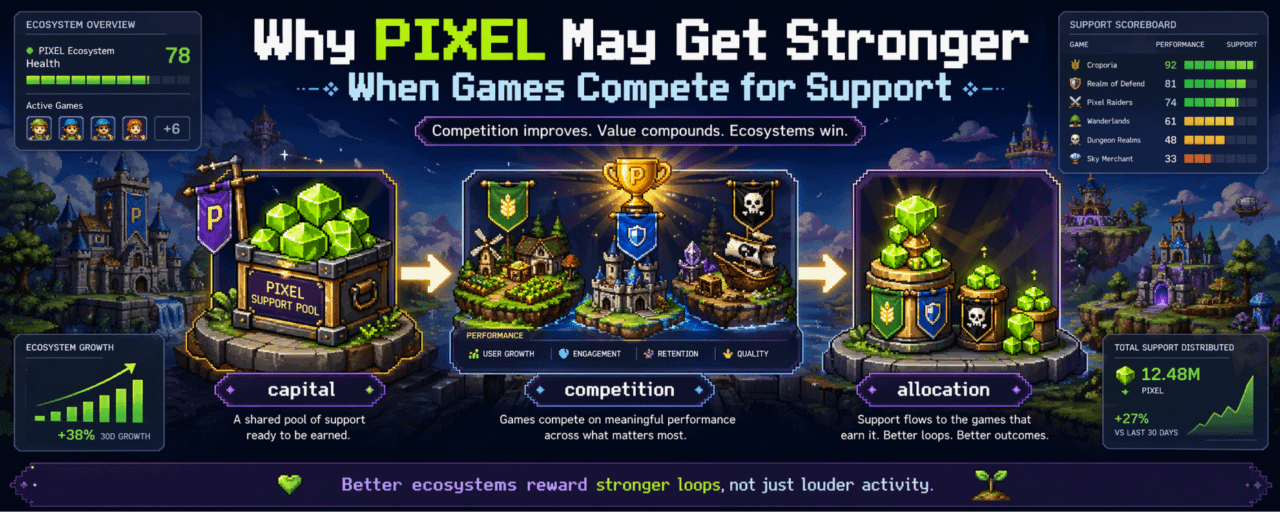

A weak ecosystem usually tries to fix weak growth with the same reflex:
increase rewards and hope activity follows.
That approach can create motion, but it rarely creates discipline.
Pixels appears to be moving toward a different model. In the staking design described in the litepaper, games are not treated as passive destinations for generic incentives. They compete for stake and ecosystem support, while players influence which games receive backing. The docs tie that competition to measurable factors like retention, net in-game spend, player quality, and effective use of ecosystem tools.
That changes the economic logic in an important way.
If support is distributed broadly, then weak and strong game loops often get funded together. The result is familiar: some rewards reinforce useful behavior, others disappear into short-term extraction, and the system has to keep paying to recreate the same activity. But if support is something games must earn, then incentives begin to function less like a subsidy and more like selective capital.
This is where competition becomes more important than bigger emissions.
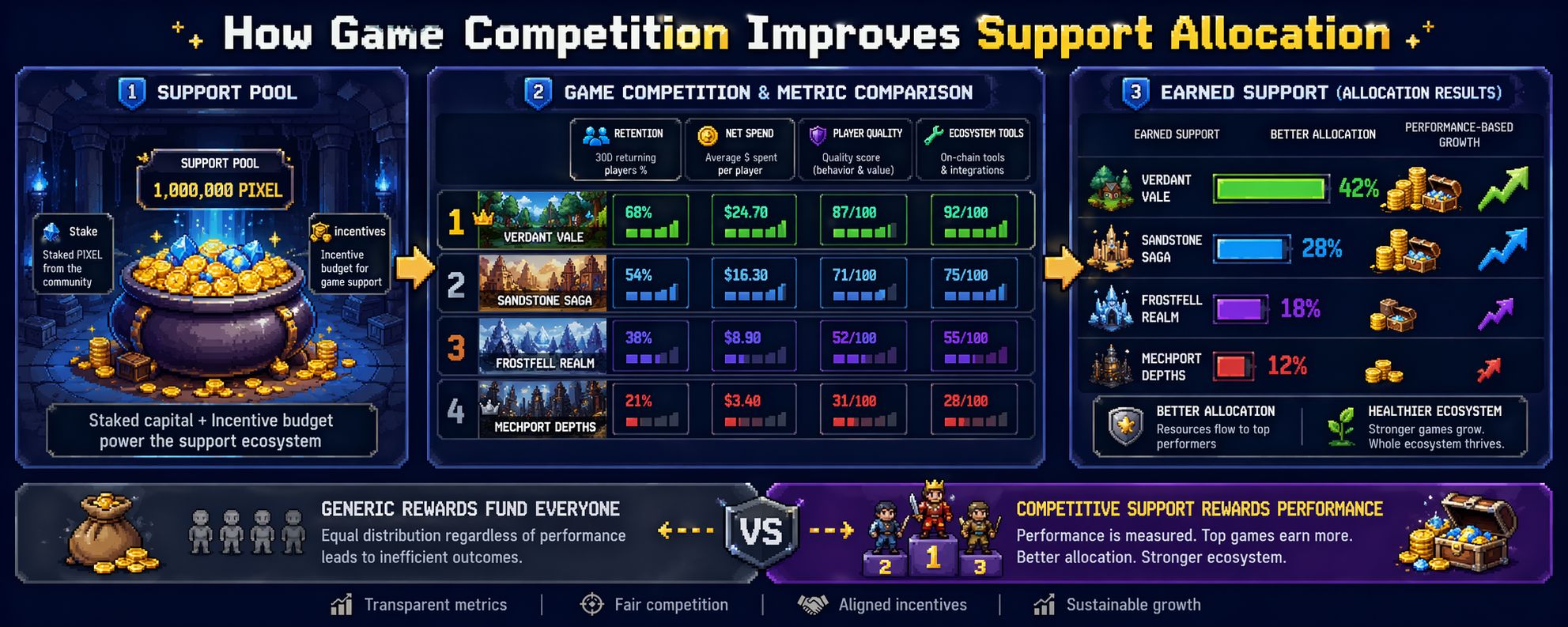
A larger reward budget can always produce more surface activity for a while. It cannot guarantee that the activity is worth financing again. Competition forces a harder standard. A game has to prove that it can keep players, convert incentives into stronger loops, and contribute something measurable back to the ecosystem. That fits the broader revised Pixels thesis, which increasingly emphasizes data-backed incentives, higher-quality DAU, and measurable return instead of broad undifferentiated reward spend.
The staking layer is what makes this especially interesting.
In a normal staking model, capital is locked and yield is collected. In the Pixels model, staking starts to look more like directional support. That support is not abstract. It flows toward games. And once games become the units competing for capital, the ecosystem starts behaving more like a live market for performance than a passive reward farm. That is partly an inference, but it follows closely from the litepaper’s framing of games as the focal units receiving stake and competing for ecosystem incentives.
That distinction matters because it improves allocation pressure.
A system with no competitive filter tends to overfund mediocrity.
A system where games compete for support has a reason to ask better questions:
Which game is actually retaining users?
Which one turns incentives into spending instead of leakage?
Which one creates better signals for future targeting?
Which one deserves more support in the next cycle?
Those questions push the ecosystem toward performance-based growth rather than reward-based inflation. That direction is consistent with the revised vision, where Pixels explicitly connects better targeting and more sustainable growth to stronger data and higher-quality users.
There is also a strategic upside here.
Once games know support is earned, they are pushed to optimize for healthier metrics instead of simply chasing raw activity. That means better retention matters. Better spending behavior matters. Better integration with ecosystem tools matters. The reward pool stops behaving like free fuel and starts behaving like scarce backing that has to be justified.
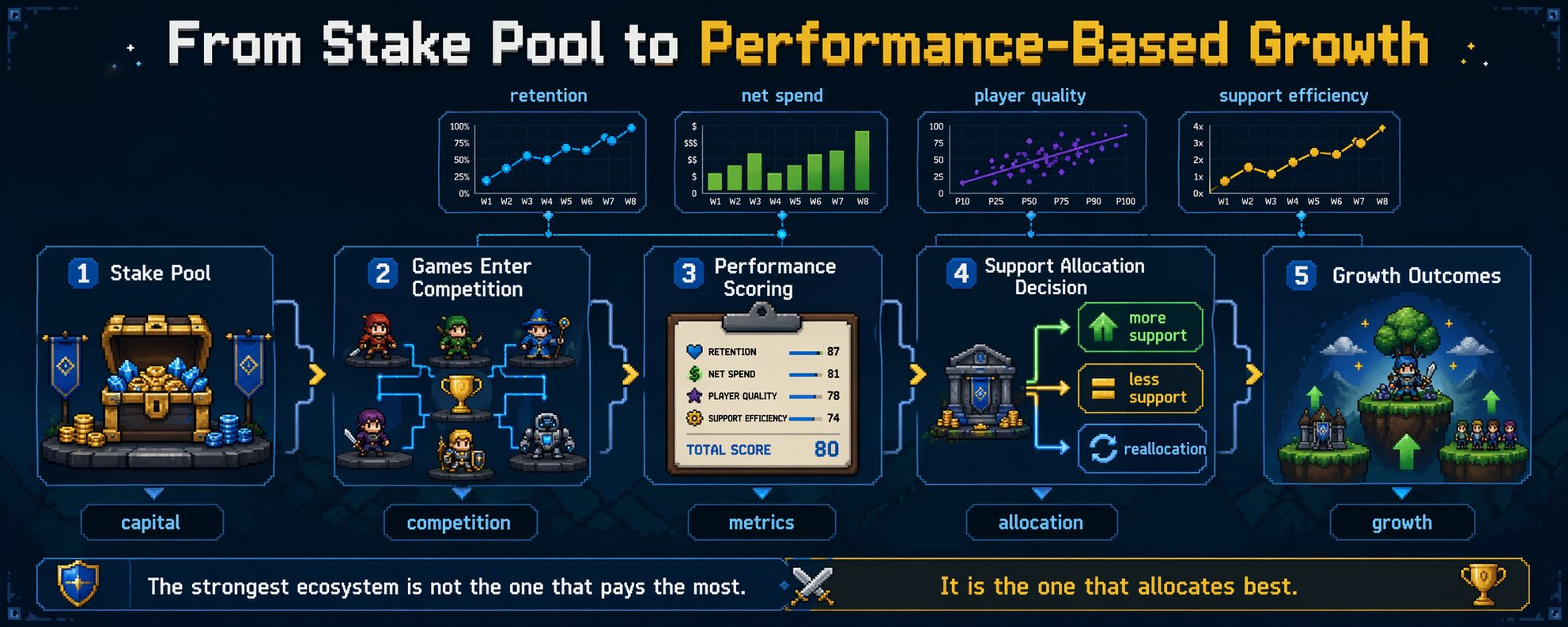
That is a stronger long-term design than simply paying more.
Because ecosystems rarely become durable by rewarding everything equally.
They become durable when capital learns to move toward the strongest loops.
In that sense, the more bullish reading of PIXEL is not “the system can always increase incentives.” It is that the system may become better at deciding where incentives belong. And if that happens, growth gets cleaner over time: less blind support, more earned support, less leakage, and better compounding across the games that can actually perform.
So the interesting part is not just that Pixels has staking.
A lot of projects have staking.
The interesting part is that staking here appears to be turning ecosystem support into something competitive, selective, and measurable.
That is usually a healthier foundation than bigger rewards alone.