
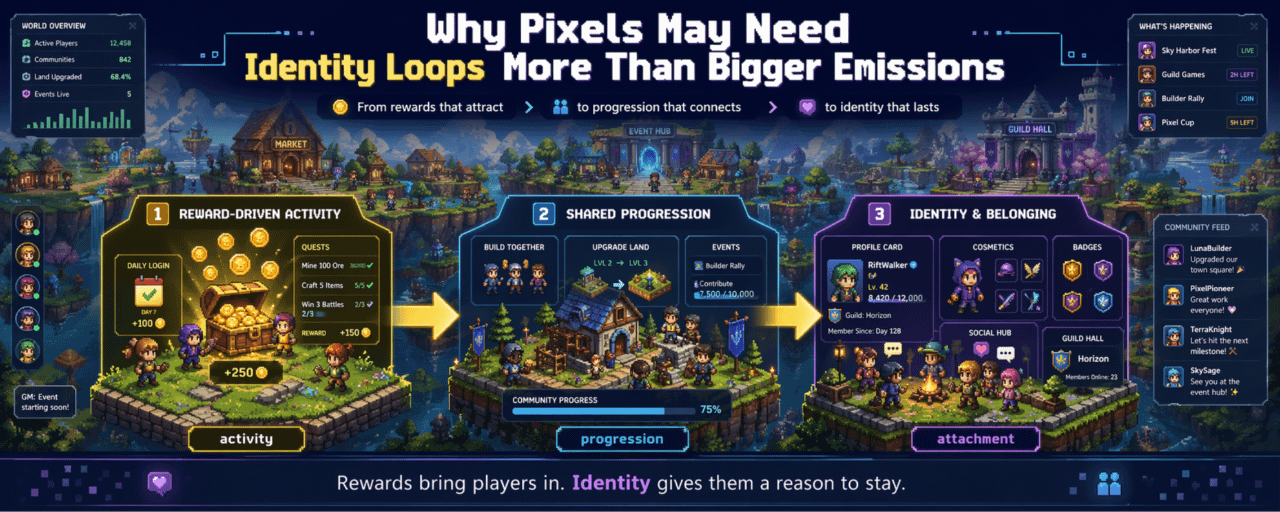
More rewards can increase activity.
That part is not especially hard.
The harder challenge is turning activity into attachment, and that is where Pixels starts to look more interesting. The main site presents the project as a social, free-to-play ecosystem, while the litepaper points toward a stronger social meta as part of its broader direction. That combination suggests future retention may depend less on simply increasing emissions and more on building reasons for players to care about who they are inside the world.
That distinction matters because reward loops and identity loops do different jobs.
A reward loop can bring players back for another session.
An identity loop gives them something to come back as.
Those are not the same kind of stickiness. Rewards can create motion, but identity creates continuity. When progression becomes visible, when social recognition becomes legible, and when players start to occupy a recognizable place in the world, retention stops depending only on payouts. It starts depending on status, memory, belonging, and social momentum. This is an inference from Pixels’ social positioning and litepaper direction rather than a direct quoted claim, but it follows closely from both sources.

That may end up being one of the more important shifts in the whole PIXEL thesis.
A pure emissions strategy can always buy short-term activity if the budget is large enough. But activity bought that way is usually fragile. It often weakens the moment rewards become less attractive, because the player’s relationship to the system is still transactional. The stronger Pixels thesis increasingly points elsewhere: toward higher-quality engagement, healthier loops, and ecosystem behavior that lasts because players are invested in the world itself, not only in the next reward cycle.
Shared progression is part of that story.
If players build together, join recurring events, improve land, complete group milestones, or participate in visible world development, then progress stops feeling purely personal. It becomes social. And once progress becomes social, leaving the ecosystem means leaving behind more than just potential earnings. It means leaving behind accumulated presence. Again, that is an inference, but it is a grounded one given Pixels’ framing as a social ecosystem and its litepaper emphasis on stronger social meta.
Identity loops deepen that effect.
In weak game economies, users remain largely interchangeable. They enter, extract, and disappear. In stronger worlds, players become easier to recognize: through cosmetics, visible progression, social roles, community presence, and recurring participation. Once that happens, the value of staying is no longer only economic. It becomes reputational and relational. That is the kind of retention rewards alone usually struggle to produce.
This also helps explain why “more emissions” is not automatically the strongest growth answer.

If the project’s long-term goal is a healthier ecosystem, then the more important question is not simply how much activity incentives can buy. It is whether the ecosystem gives players stronger reasons to remain visible, recognized, and connected after the incentives have already done their job. In that framework, bigger emissions are only one tool. Identity may be the stickier one.
That reading also fits the broader direction Pixels has been signaling elsewhere.
The project increasingly links success to higher-quality users, stronger loops, and behavior that reinforces the economy rather than simply inflating top-line activity. Social and identity systems fit that logic well, because they can strengthen return behavior without forcing the project to rely only on ever-larger reward budgets.
So the stronger long-term PIXEL narrative may not be:
how much can the system pay?
It may be:
how much can the world mean once players are already inside it?
Because rewards can start a session.
Identity is what can make that session feel worth repeating.