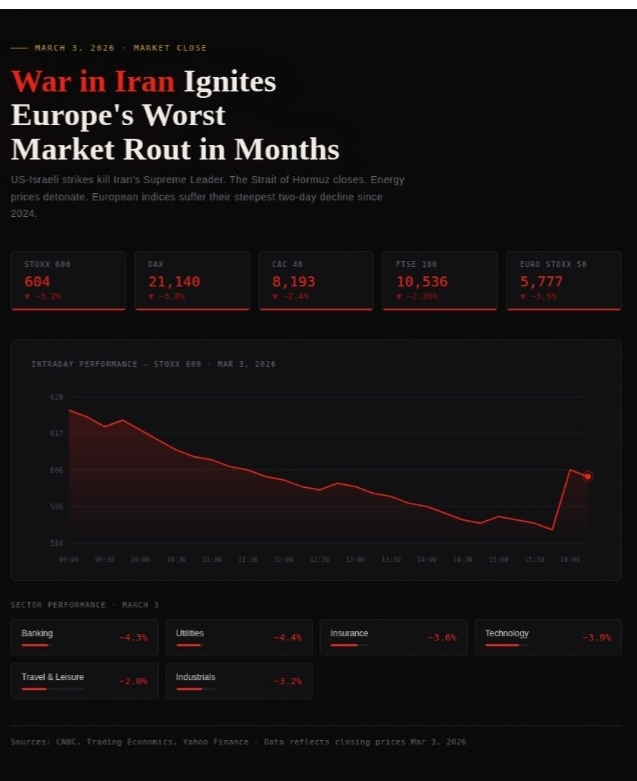
Yesterday (March 3, 2026), European markets fell sharply, and the primary cause was the escalating military conflict in the Middle East — specifically the US and Israeli strikes on Iran.
Here's a breakdown of what happened:
The Trigger: Iran War
Over the weekend, the US and Israel launched widespread attacks on Iran, killing Supreme Leader Ayatollah Ali Khamenei. Iran has since launched retaliatory strikes against US bases in the Middle East, and Iranian forces have threatened vessels crossing the Strait of Hormuz.
Energy Price Shock
European natural gas futures soared more than 40%, and crude oil prices surged more than 12%. Tanker traffic through the Strait of Hormuz — through which about a third of the world's seaborne oil exports pass — came to a standstill as ship owners took precautionary measures.
Market Damage
The pan-European Stoxx 600 ended Tuesday's session 3.2% lower, extending Monday's losses. Banking stocks fell 4.3%, insurance stocks dropped 3.6%, and utilities fell 4.4%. Germany's DAX and Italy's FTSE MIB saw the sharpest declines.
Inflation & Rate Fears
Banks led losses as the possibility of higher inflation drove traders to price in rate hikes, triggering a selloff in European bonds. The energy spike is expected to add further pressure on inflation and may prompt a more hawkish stance from the ECB.
Travel Sector Hit Hard
Travel and leisure stocks plummeted as airspace closures in the Middle East forced airlines around the globe to cancel thousands of flights.
Spain Hit Extra Hard
The Spanish market faced additional pressure after President Trump threatened to cut off all trade with Spain, after the Spanish government denied the US permission to use its bases for attacks on Iran.
In short, the combination of an active Middle East war, surging energy prices, inflation fears, and geopolitical uncertainty created a perfect storm for European equities.