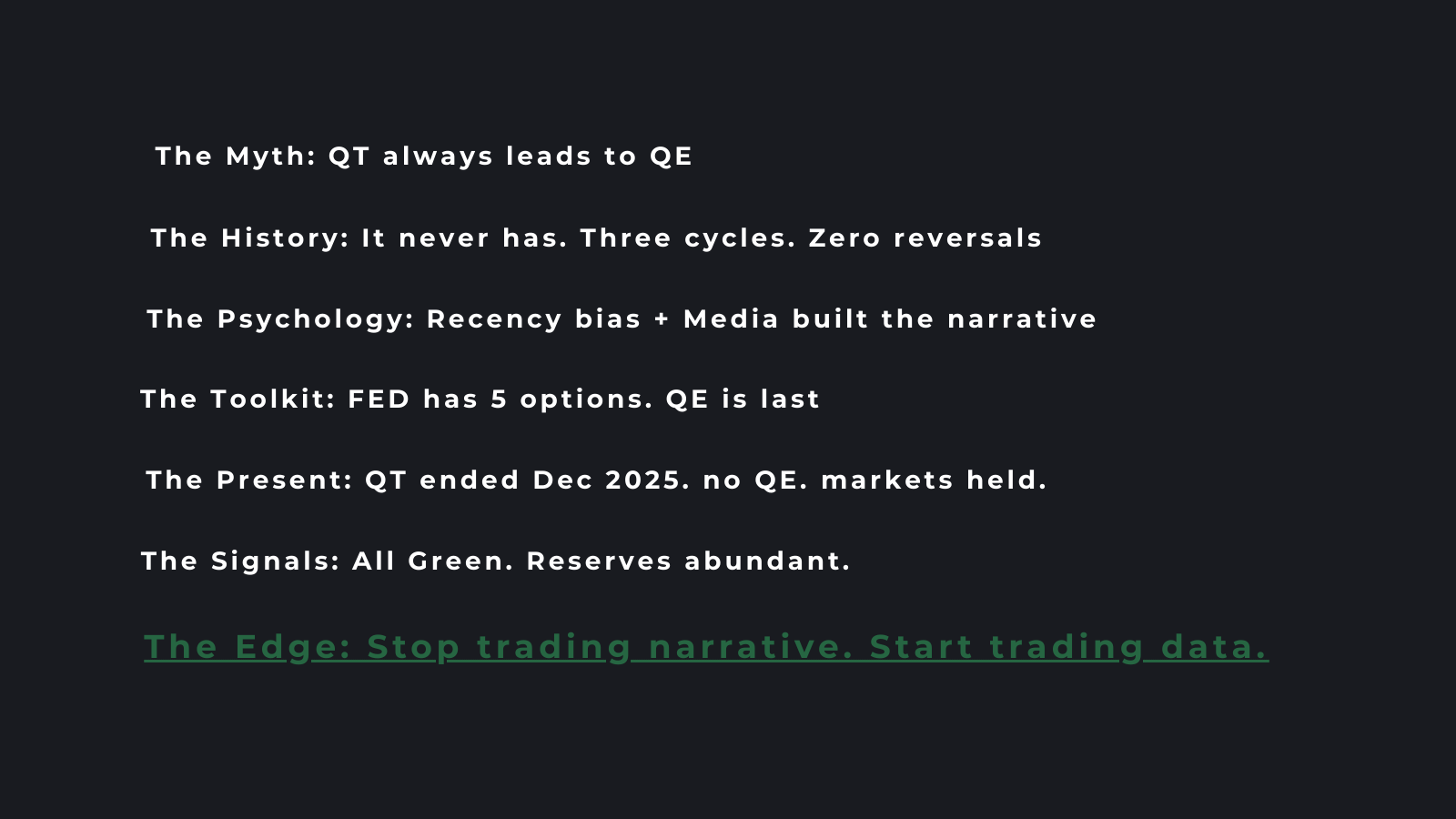
QE is NOT always the end of QT: here's the evidence markets keep getting wrong
every trader on X has the same take. QT ends. QE starts. printer goes nonstop and the cycle repeats.
it's the laziest macro narrative alive. and the fed just broke it.
december 1, 2025. QT officially done. balance sheet down from $9 trillion to $6.58 trillion. that's $2.4 trillion drained from the system.
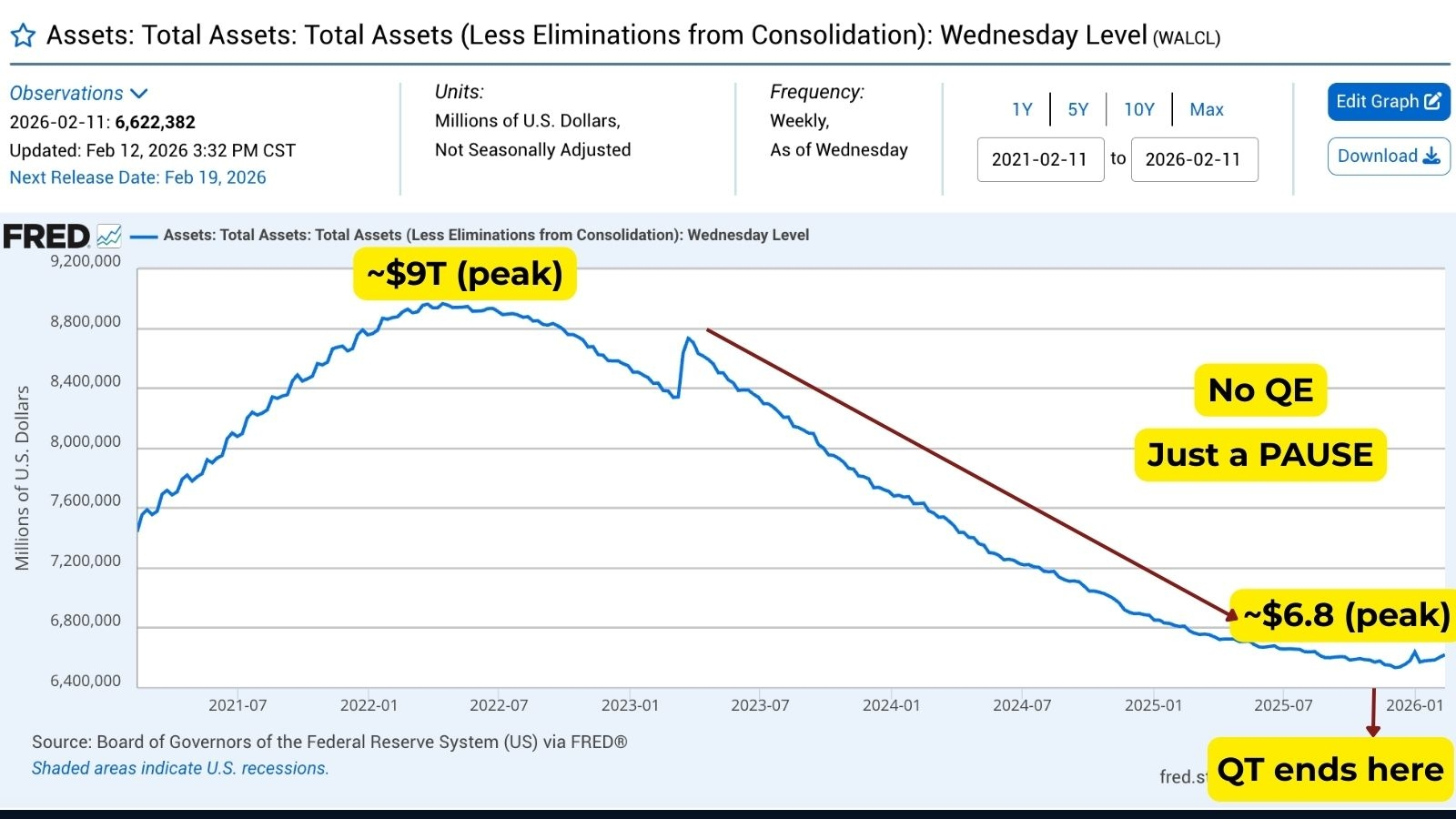
No QE - Just a PAUSE
and then... nothing.
no QE
no stimulus package
no emergency press conference
no reversal
the fed started reinvesting maturing bonds into short-term t-bills. boring but technical.
exactly how monetary policy should work when it's actually working.
meanwhile the S&P500 ran 16% during the entire QT window. no crash. no liquidity crisis. no forced pivot back to easing.
let that sit for a second.
the thing every macro account told you was impossible - QT ending without QE happened in real time.
so either the entire "QT always leads to QE" framework is wrong. or the fed got lucky.
it's not luck. and the evidence goes back further than most people bother to look. but first let's make sure we're actually talking about the same thing.
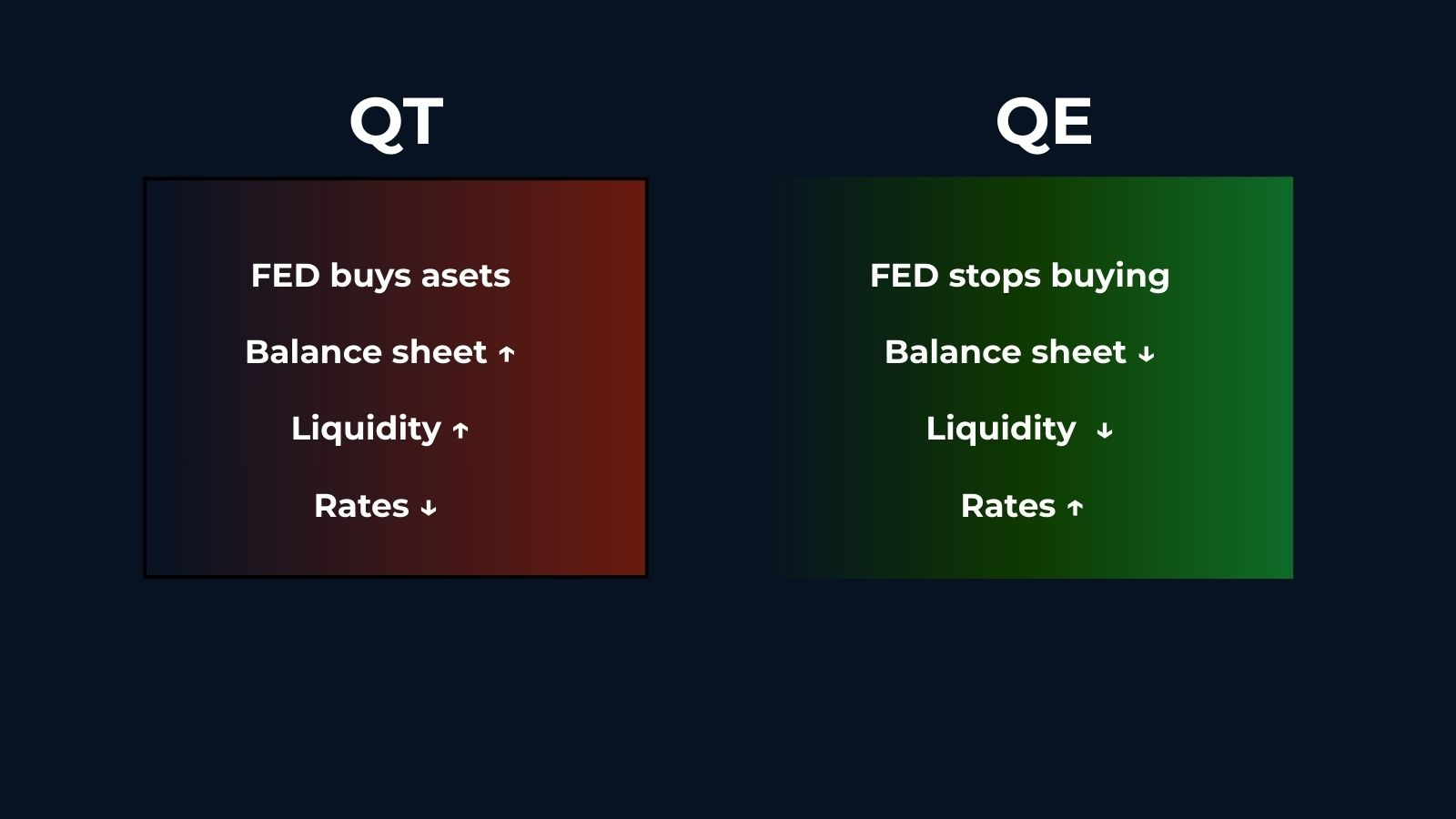
QE - quantitative easing. the fed buys assets. treasuries, mortgage-backed securities (basically bundles of home loans that trade like bonds), sometimes corporate bonds. balance sheet gets bigger. liquidity floods in. long-term rates drop. economy gets a sugar hit.
QT - quantitative tightening. the fed stops buying. lets bonds mature without replacing them. balance sheet shrinks. liquidity drains out. rates stay higher. system runs tighter.
sounds like --> easy. tight. easy. tight. back and forth forever.
that's the mental model most people run on. and it's wrong.
here's where it broke.
2013 -@benbernanke walks up to a microphone and says the fed might slow down QE. not stop it or reverse it. slow the pace a little.
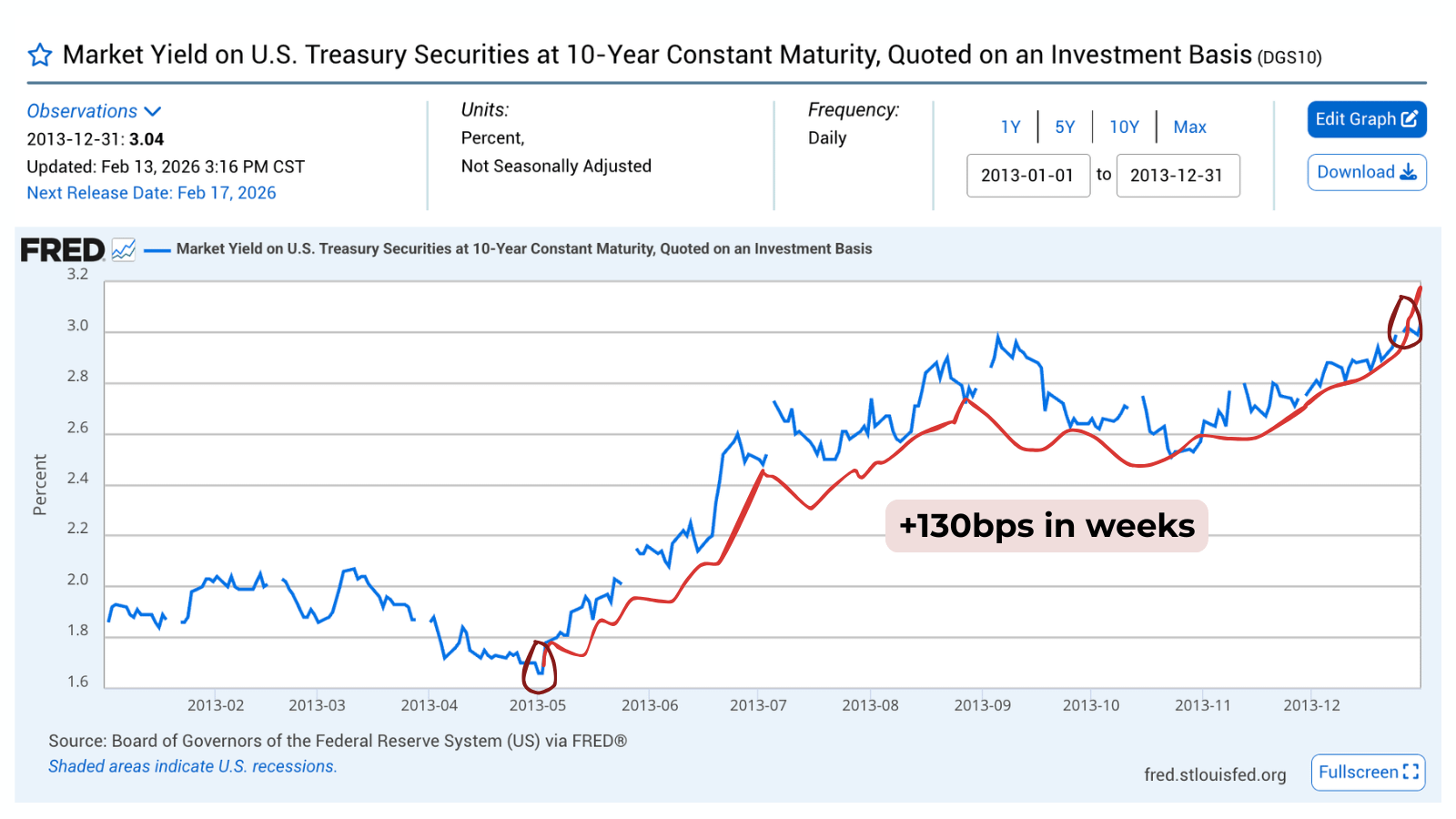
0-year yield rips 130 basis points in weeks. for context, that's a massive move - it means the interest rate on government debt shot up from about 1.6% to nearly 3% in a few months.
markets lost their minds. every headline screamed taper tantrum. the takeaway burned into a generation of traders: the fed can never tighten. they'll always blink.
twelve years later that moment still frames how people read every fed decision.
but here's what nobody talks about.
the tantrum never repeated. not once.
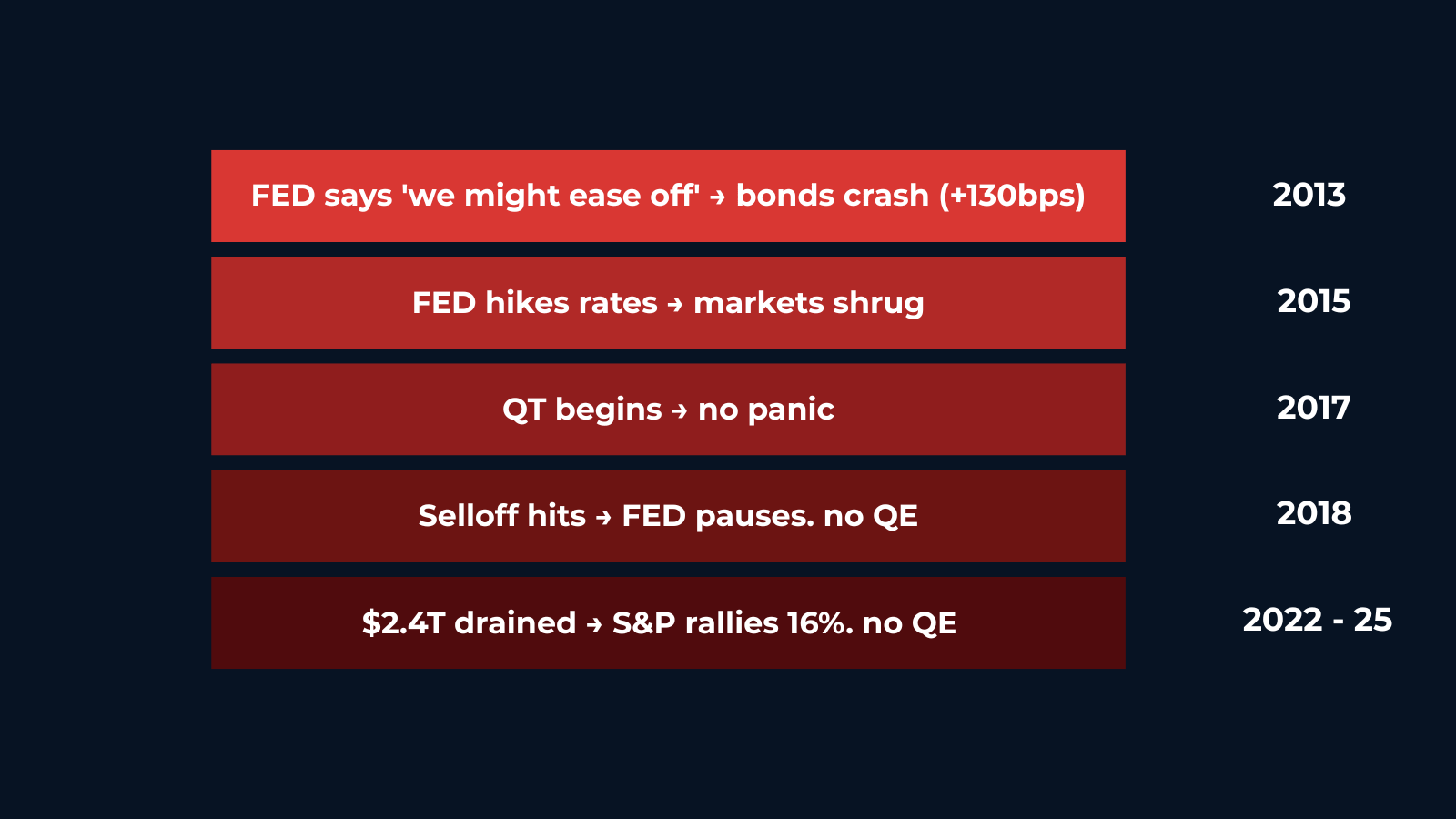
2015 - fed hikes rates. markets absorb it.
2017 - fed starts QT. economy keeps growing.
2018 - markets sell off during QT. fed doesn't launch QE. they pause and wait to let things settle.
2022 through 2025 - fed runs the most aggressive QT in history. four years. $2.4 trillion drained. S&P rallies. bonds stabilize. no forced reversal.
the one event that created the entire narrative framework never happened again.
people kept waiting for the sequel. the fed kept not delivering it.
the myth lives because the story is simple and scary. central banks always cave. always print and always reverse.
reality has a longer memory than CT.
let's look at what actually happened instead of what people say happened.
2017-2019: the first real QT cycle
october 2017. fed starts unwinding. treasury runoff at $6 billion a month. slowly ramps to $30 billion. MBS (mortgage-backed securities - those bundled home loans) runoff starts at $4 billion. climbs to $20 billion.
two years pass. growth holds. inflation stays moderate. by mid-2019 the fed is draining $50 billion a month.
then september 2019. repo market stress. the repo market is where banks lend to each other overnight using treasury bonds as collateral - think of it as the banking system's daily cash circulation. overnight funding rates spiked. banks scrambled for cash. fed stepped in and paused QT.
and here's where the narrative breaks.
everyone expected QE. full balance sheet expansion. back to the printer 😁
what actually happened: fed bought roughly $400 billion in t-bills. short-term only. reserve management. not stimulus. fed explicitly called it "technical liquidity operations." their words. not QE.
balance sheet held steady around $3.8 trillion for three years after. no expansion. no QE.
QT ended. QE didn't follow. that's the data point.
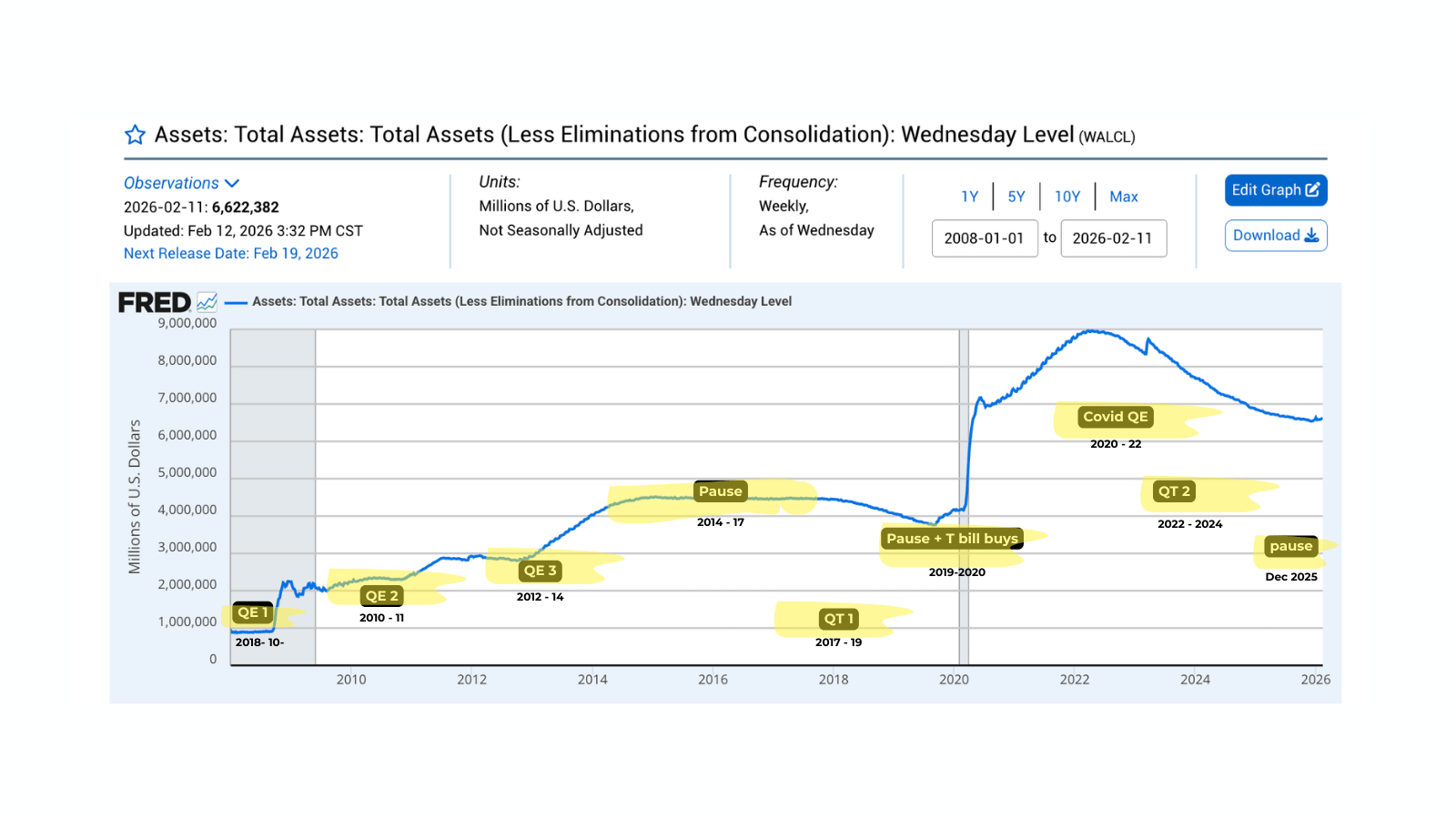
2008-2014: the QE3 era
QE3 launched september 2012. $40 billion in MBS purchases per month. open-ended. balance sheet balloons.
december 2013. taper tantrum. markets freak. (you already know this part.)
october 2014. QE3 officially ends.
now watch the timeline.
first rate hike: december 2015. fourteen months of doing nothing. sitting there.
QT doesn't start until october 2017. three full years after QE ended.
the pattern: QE → long pause → rate hikes → longer pause → then QT. slow. deliberate. nothing mechanical about it.
2020-2022: the outlier everyone treats as the rule
march 2020. pandemic hits. fed launches emergency QE. unlimited purchases. balance sheet rockets to $9 trillion.
march 2022. inflation surges past 8%. fed stops buying. QE ends.
june 2022. QT starts. two-month gap.
fastest transition in fed history. and this is the cycle burned into everyone's memory. fed started the most aggressive QT ever.
people saw this and decided it's the template.
it's not. it was a once-in-a-century pandemic response. extrapolating covid policy as the baseline for all fed behavior is like judging someone's driving by how they handled a car crash.
the pattern nobody wants to see
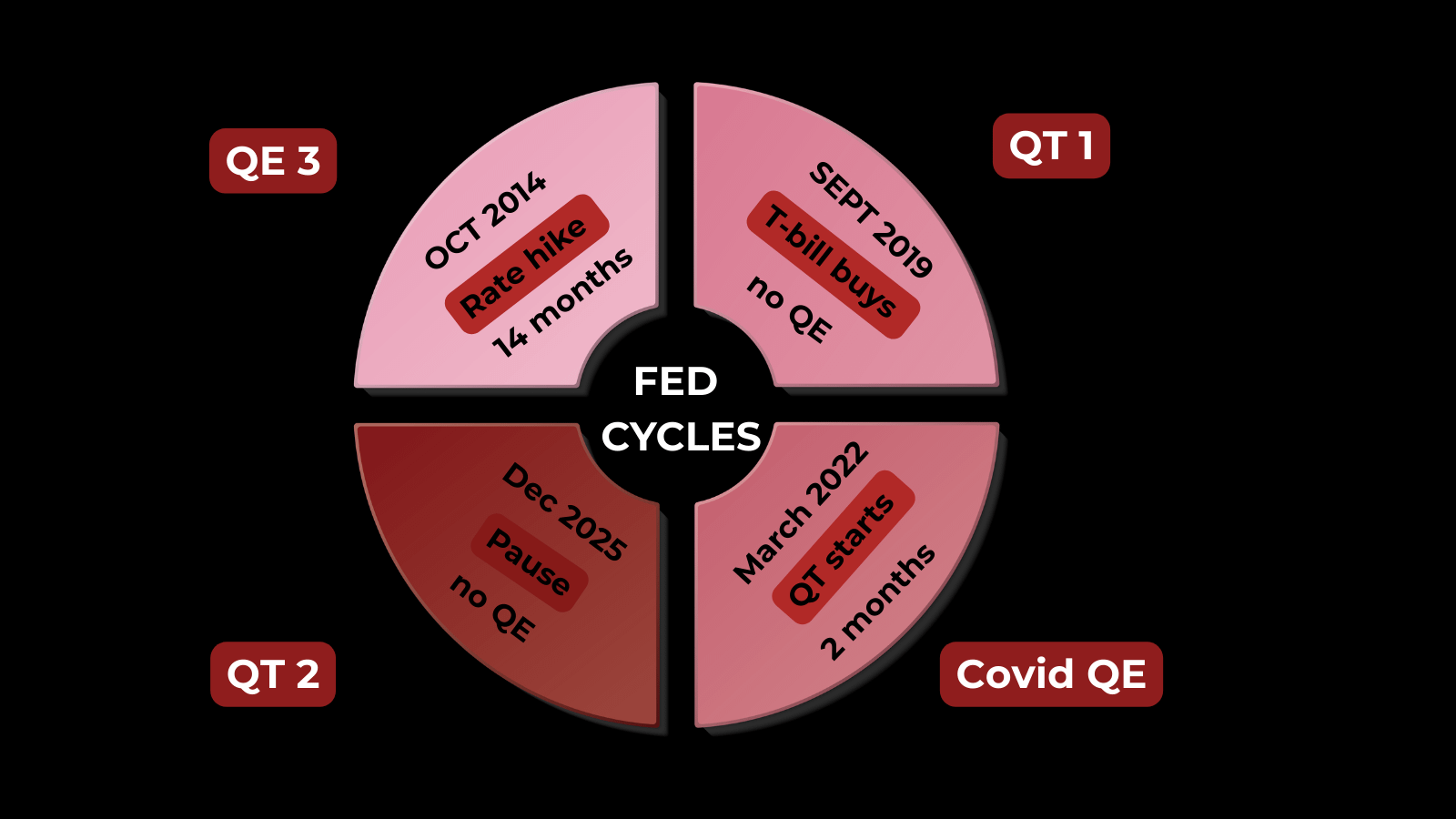
2014, QE ends → 3 year pause → QT starts
2019, QT ends → pause → t-bill purchases → no QE
2022, QE ends → 2 month gap → QT starts
2025, QT ends → pause → reinvesting t-bills → no QE
every single cycle has gaps. pauses. alternative tools. transitions. not once did QT get back to QE.
remember, your brain is trading against you
the data is right there. three cycles. zero reversals from QT to QE. pauses every time. alternative tools every time.
so why does every macro thread still say "QT always leads to QE" like it's gravity?
because your brain isn't trading the data. you re over optimistic
recency bias
2020 was the loudest QE in history. unlimited purchases. $9 trillion balance sheet. fed goes full wartime mode. then 2022 hits and QT starts fast.
that sequence - massive QE followed by aggressive QT and this is the most recent cycle. most dramatic and even emotional one.
your brain assumes the most recent example is the default. extrapolates one data point into a universal rule just like ALT CYCLE everytime btc hits a ATH 😅
"QT happened after QE. therefore QT always leads back to QE."
sample size of one. conviction of a thousand.
taper tantrum ptsd
2013 rewired an entire generation of traders.
@benbernanke
hints at slowing purchases. market melts down. media goes fulltime nuclear mode. and the lesson → the fed cannot tighten. ever. markets won't allow it.
twelve years later people still cite it. "remember 2013? just talking about tapering crashed everything."
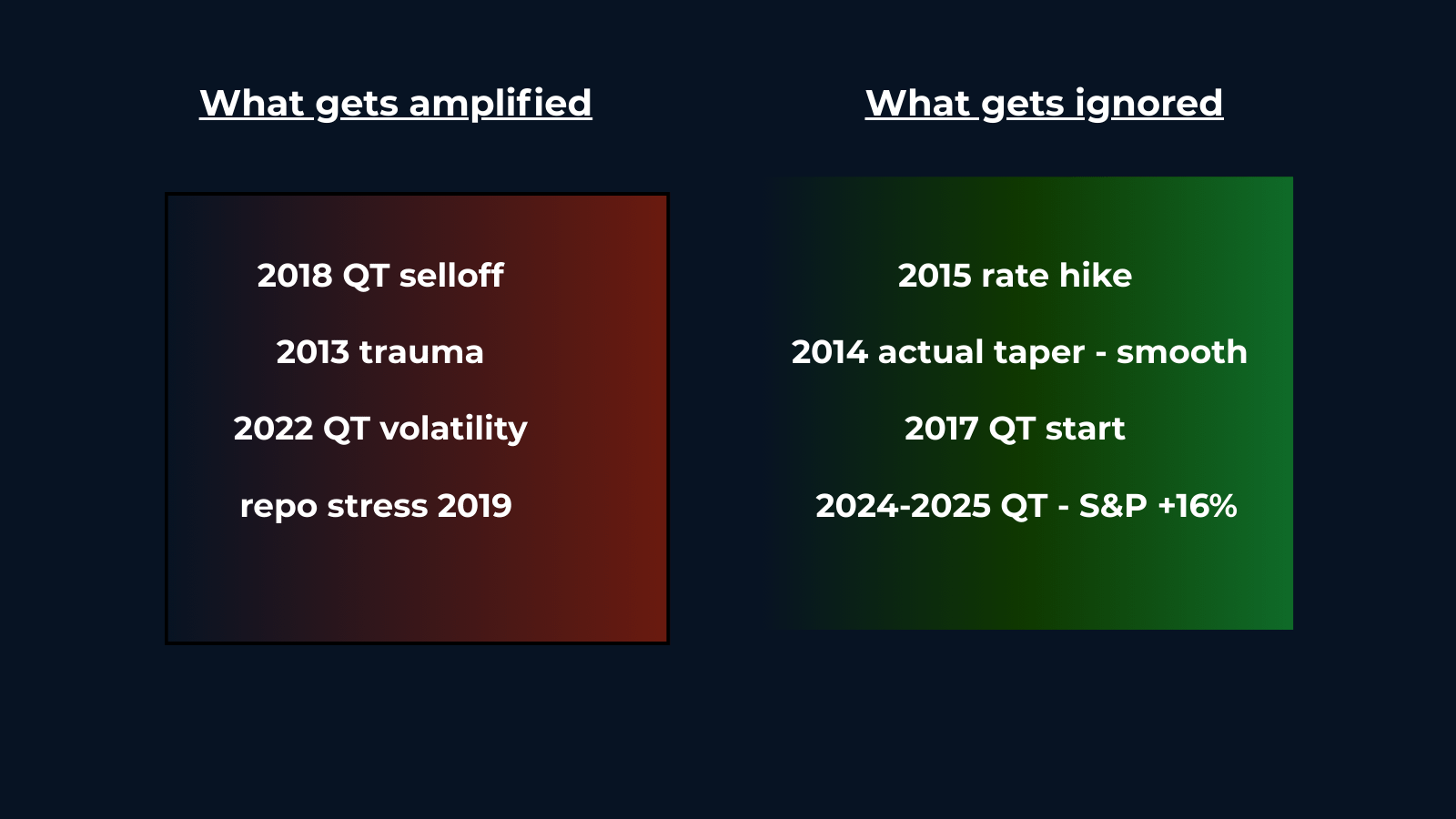
nobody mentions that markets recovered within months. nobody mentions that the actual taper in 2014 went smooth. nobody mentions that five subsequent tightening cycles went off without a repeat.
confirmation bias
2018 - markets sell off during QT. traders point and say "see? proof QT breaks things."
2022 - markets sell off during QT. "proof again."
2024-2025 - S&P500 rips 16% during QT.
nobody posts about that one
sell-offs prove the theory. rallies get a footnote. pick your favorite and call it research.
self-fulfilling positioning
if enough traders position for "QT → crisis → QE pivot," their collective positioning creates the volatility they're betting on. traders start loading up shorts and hedging everything in sight.
markets dip. headlines like this. "see? QT is breaking markets. fed has to reverse."
but the dip happened because of the positioning. not because QT mechanically destroys liquidity. the trade creates its own evidence.
media incentive structure
"fed pauses balance sheet. nothing dramatic happens." - zero clicks.
"fed forced back to QE as markets crumble under QT pressure." - engagement machine.
news outlets don't get paid for accuracy. they get paid for attention. scary fed narratives get attention. boring fed competence doesn't.
multiply that across thousands of articles over twelve years and you get a population of traders who genuinely believe something the data contradicts
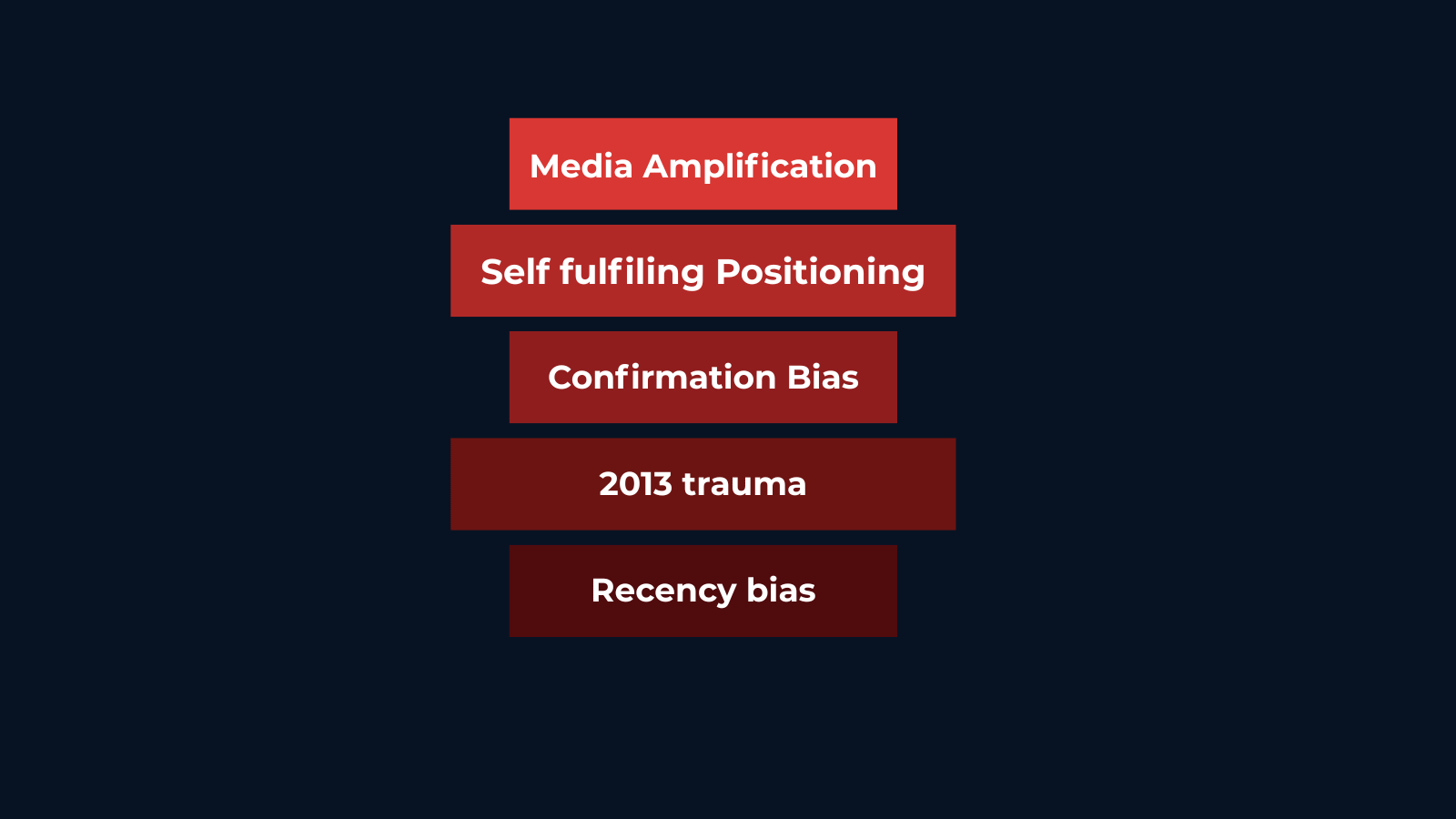
five biases stacked on top of each other. recency. trauma. confirmation. reflexivity. media amplification.
each one alone is manageable. together they build a narrative fortress that feels like truth.
but feelings aren't data.
the fed has options. they've always had options. and they're using them right now.
the fed's toolkit nobody talks about
here's what actually kills the "QE is inevitable" argument.
the fed doesn't have two options. they have at least five. and QE is the last one on the list.
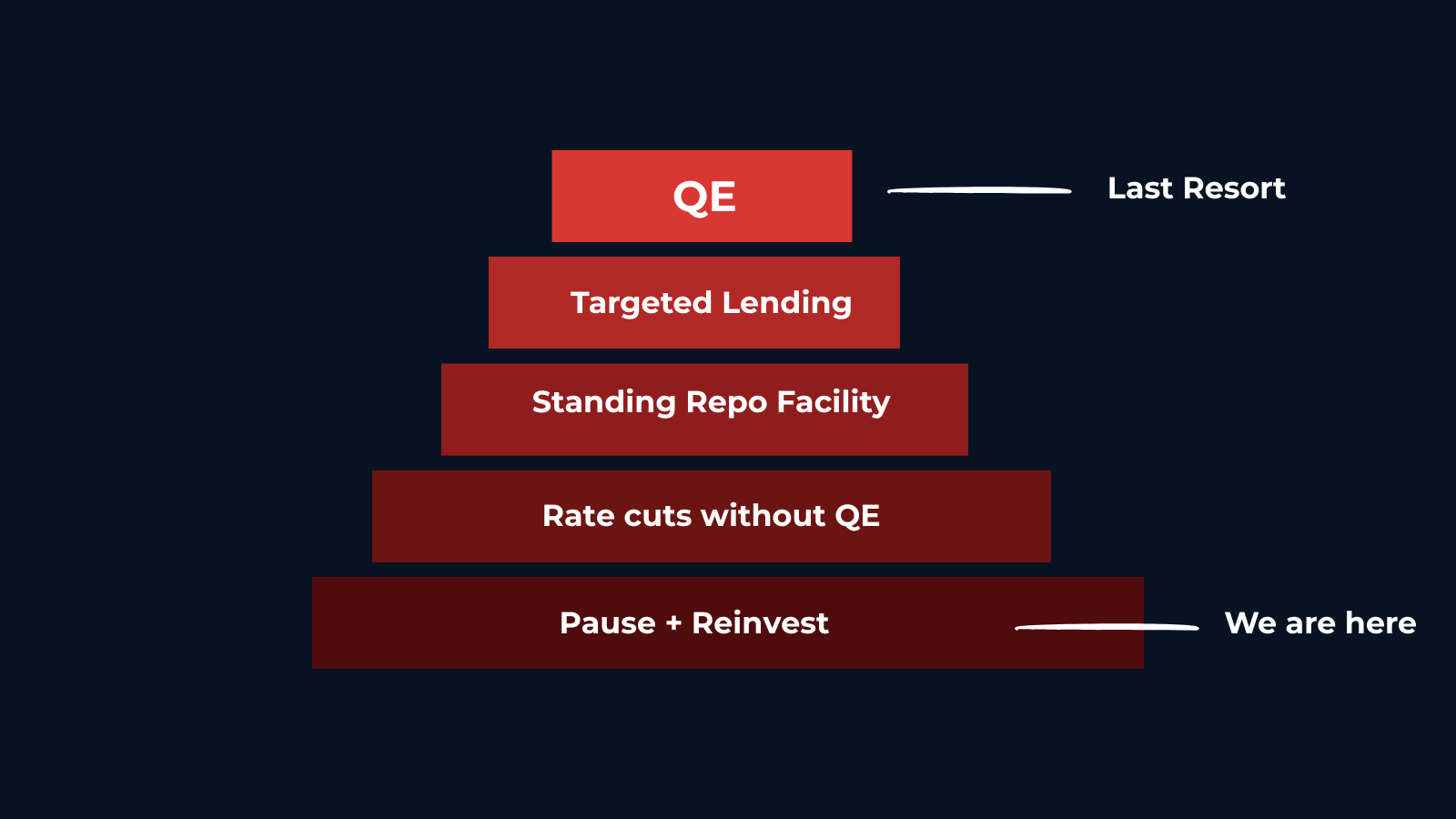
option 1: pause
this is what's happening right now. QT stops. fed holds the balance sheet steady. reinvests maturing bonds into short-term t-bills. either expansion or contraction.
it worked in 2019. fed paused QT. bought some t-bills for plumbing. held the balance sheet at $3.8 trillion. no QE. markets stabilized.
it's working now. balance sheet sitting at $6.58 trillion. stable and boring. exactly the point.
people hear "pause" and think "pivot is next." that's not what this is.
option 2: cut rates without QE
this is the one people constantly confuse.
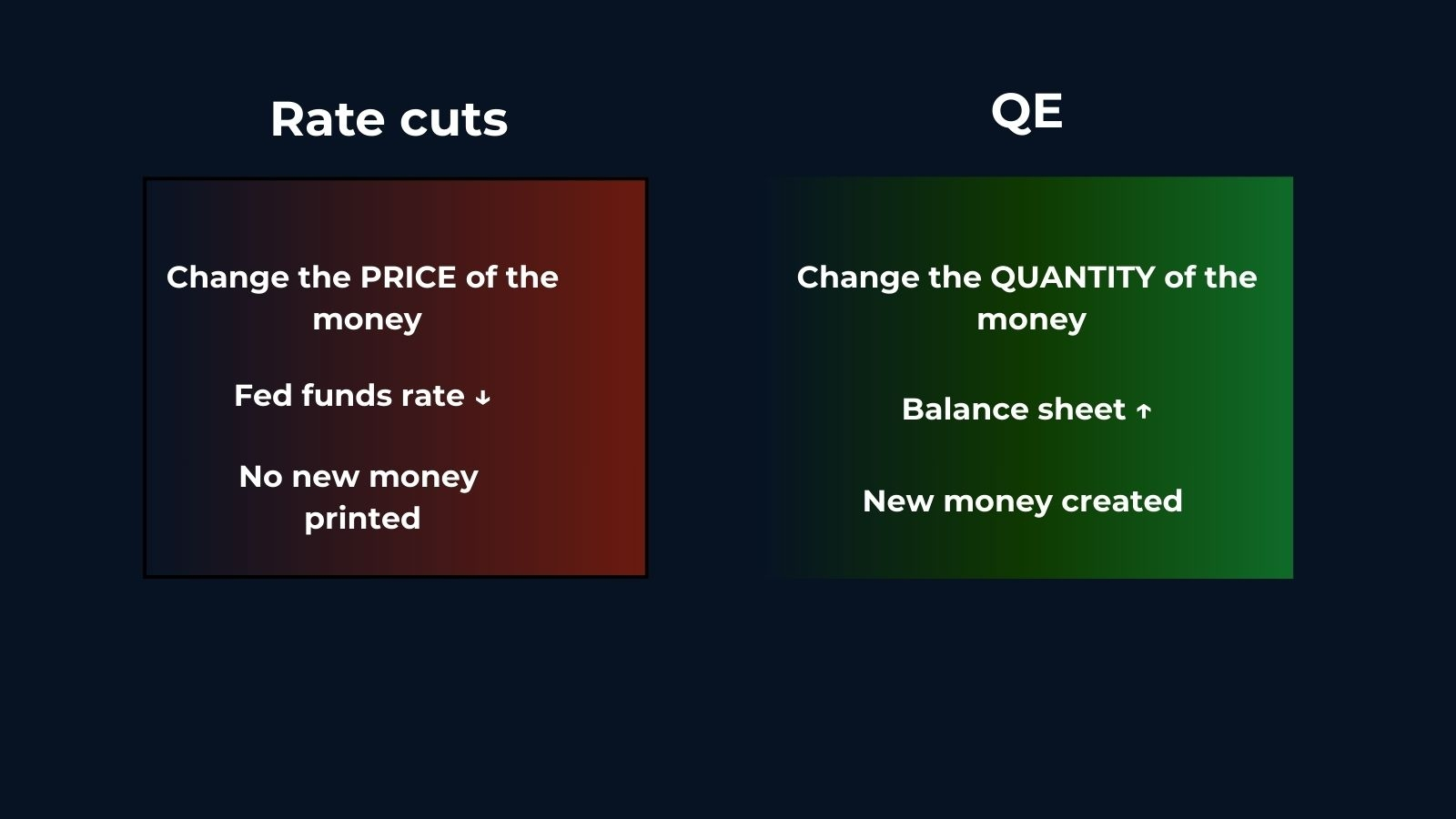
rate cuts and QE are different tools. rate cuts change the price of borrowing. QE changes the quantity of money in the system. different levers and different mechanisms. so different outcomes.
fed cut rates to 3.5%-3.75% in late 2025. zero balance sheet expansion. no QE. economy held.
you can make money cheaper without printing more of it. most people on CT don't distinguish between the two. that's a problem.
option 3: let the government handle it
fiscal policy. congress spends money. infrastructure. stimulus checks. tax cuts. deficit spending.
none of this requires the fed to buy a single bond. economy gets stimulated through the front door instead of the back door.
post-2008 deficit spending kept demand alive while the fed was still figuring out its next move. it works but clunky and political but it works.
the point: not every easing impulse has to come from the central bank.
option 4: targeted lending
fed can lend directly to specific sectors without expanding the whole balance sheet.
corporate credit facilities. municipal bond programs. small business lending windows.
2020 proved this works. main street lending facility. municipal liquidity facility. fed extended credit to the sectors that needed it. no broad QE required.
way more precise than QE. fed can put money exactly where it's needed without flooding everything else.
option 5: the standing repo facility
this one gets almost zero attention and it might be the most important.
permanent facility where banks can borrow cash overnight by posting treasury bonds as collateral. instant liquidity. no questions.
remember what killed QT in 2019? repo market stress. funding rates spiked. banks couldn't get cash. fed had to intervene.
the standing repo facility was built specifically so that scenario never repeats. launched n july 2021. full allotment with cap and its still operational
this tool didn't exist during the 2019 repo crisis. it exists now. that changes everything about how QT ends.
repo stress used to mean "fed has to do QE." now it means "banks tap the SRF and move on with their day."
fed's current plan: maintain balance sheet around $6.5-7 trillion. let assets mature naturally. reinvest proceeds. slow steady-state growth from currency demand.
not QE. not QT. a third path that the "pendulum" crowd doesn't have a name for.
QE is option five. they're on option one. four tools sit between here and the printer.
the traders pricing in imminent QE are skipping four chapters of the playbook.
forget the history for a second. look at what's happening right now.
december 1, 2025. QT ends. not with an emergency meeting or with a press conference full of panic.
it stopped on schedule.
fed let the program run its course. balance sheet came down from $9 trillion to $6.58 trillion. $2.4 trillion drained. mission accomplished. move on.
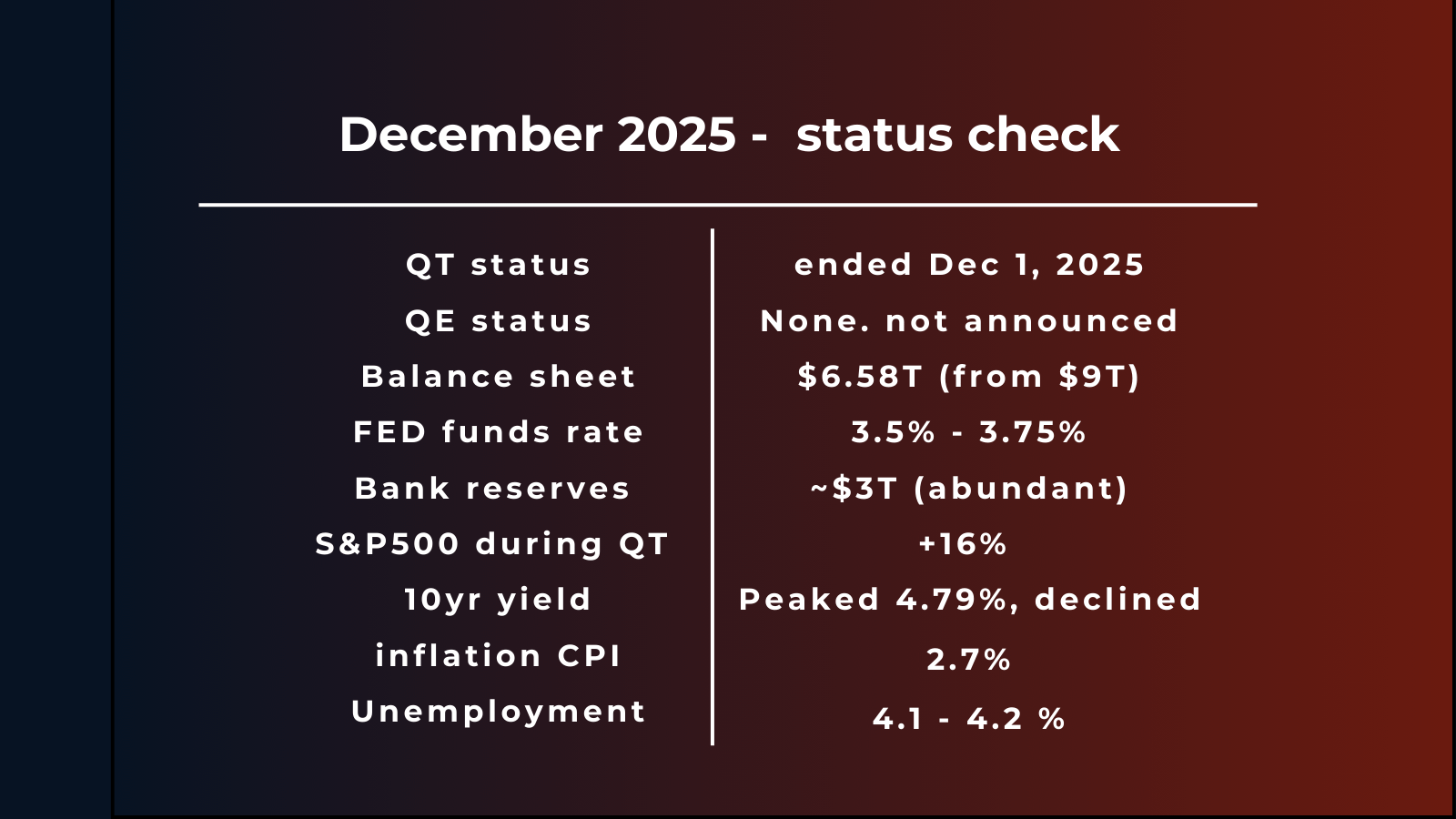
no QE announcement. no hint of QE. no emergency facilities. no "we need to act now" language from powell.
fed started reinvesting maturing bonds into short-term t-bills. building a liquidity buffer. keeping the plumbing clean.
fed funds rate sitting at 3.5%-3.75% after cuts in late 2025. stable. not emergency-level low.
bank reserves at roughly $3 trillion. fed's own word for that level: "abundant." not stressed or scarce. just abundant.
now look at markets during the entire QT window.
S&P500 up approximately 16%. not despite QT. during QT. while $2.4 trillion was being pulled from the system.
10-year treasury yield peaked at 4.79% in january 2025. came back down by year-end. no runaway rate spiral and no bond market collapse.
inflation running around 2.7% heading into 2026. above the 2% target but trending in the right direction. not spiraling or collapsing.
unemployment at 4.1-4.2%. softening from where it was but nowhere near crisis territory. labor market cooling.
add it all up.
QT ran for four years. balance sheet dropped $2.4 trillion. markets rallied. bonds stabilized. economy held together. unemployment didn't spike. inflation didn't reignite. no crisis materialized.
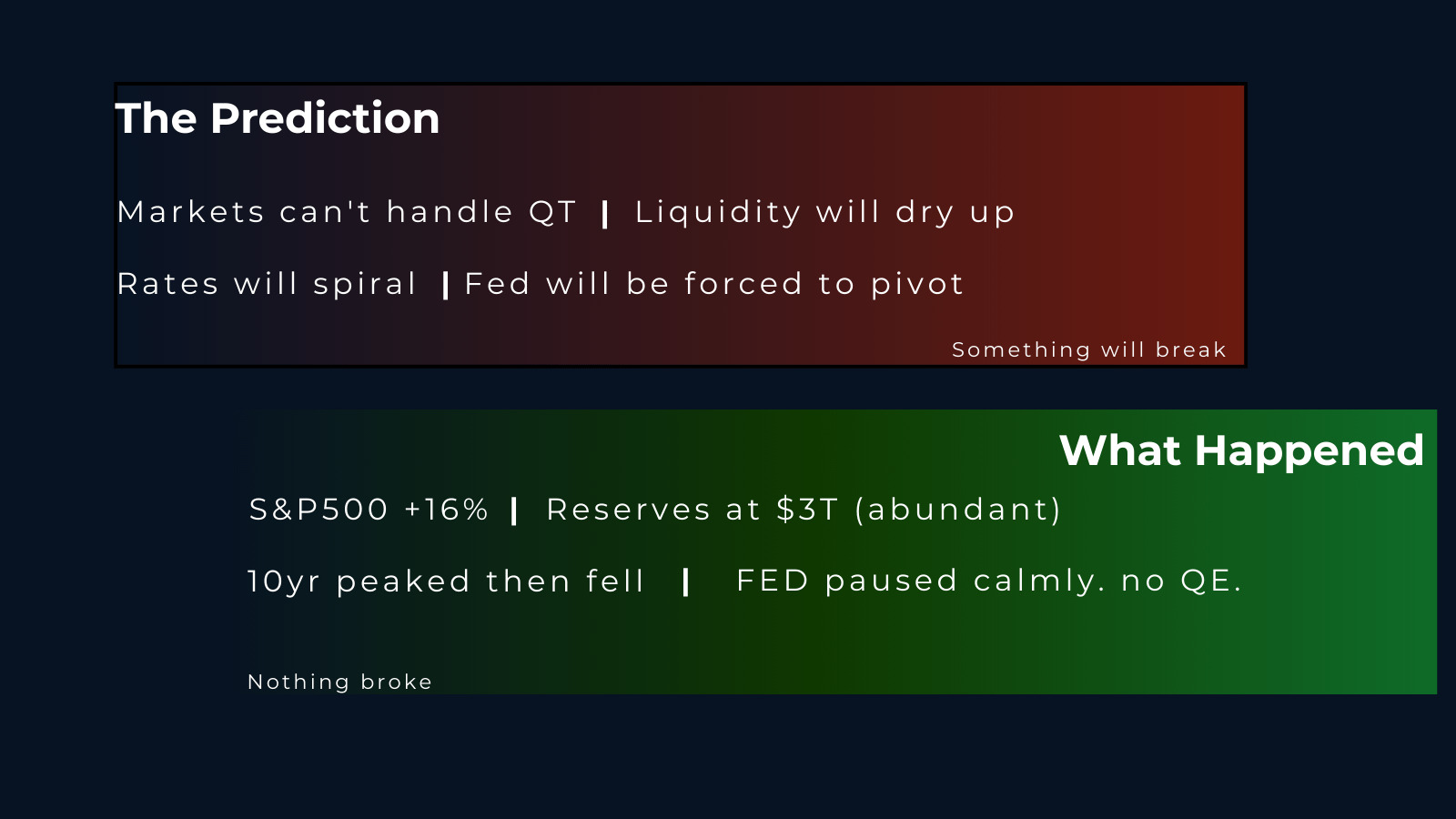
this is the outcome that the "QT always leads to QE" framework said was impossible. they said markets would force the fed's hand. they said liquidity would dry up. they said something would break.
nothing broke.
the fed picked option one from the toolkit. pause and reinvest. and it's working.
stop watching for QE. watch these instead.
most traders are staring at the wrong screen.
they're refreshing fed headlines waiting for the words "quantitative easing." scanning every powell speech for hints of a pivot. positioning portfolios around a scenario that isn't coming.
meanwhile the actual signals are sitting right there. in the data. free to look at. mostly ignored.
here's what matters.
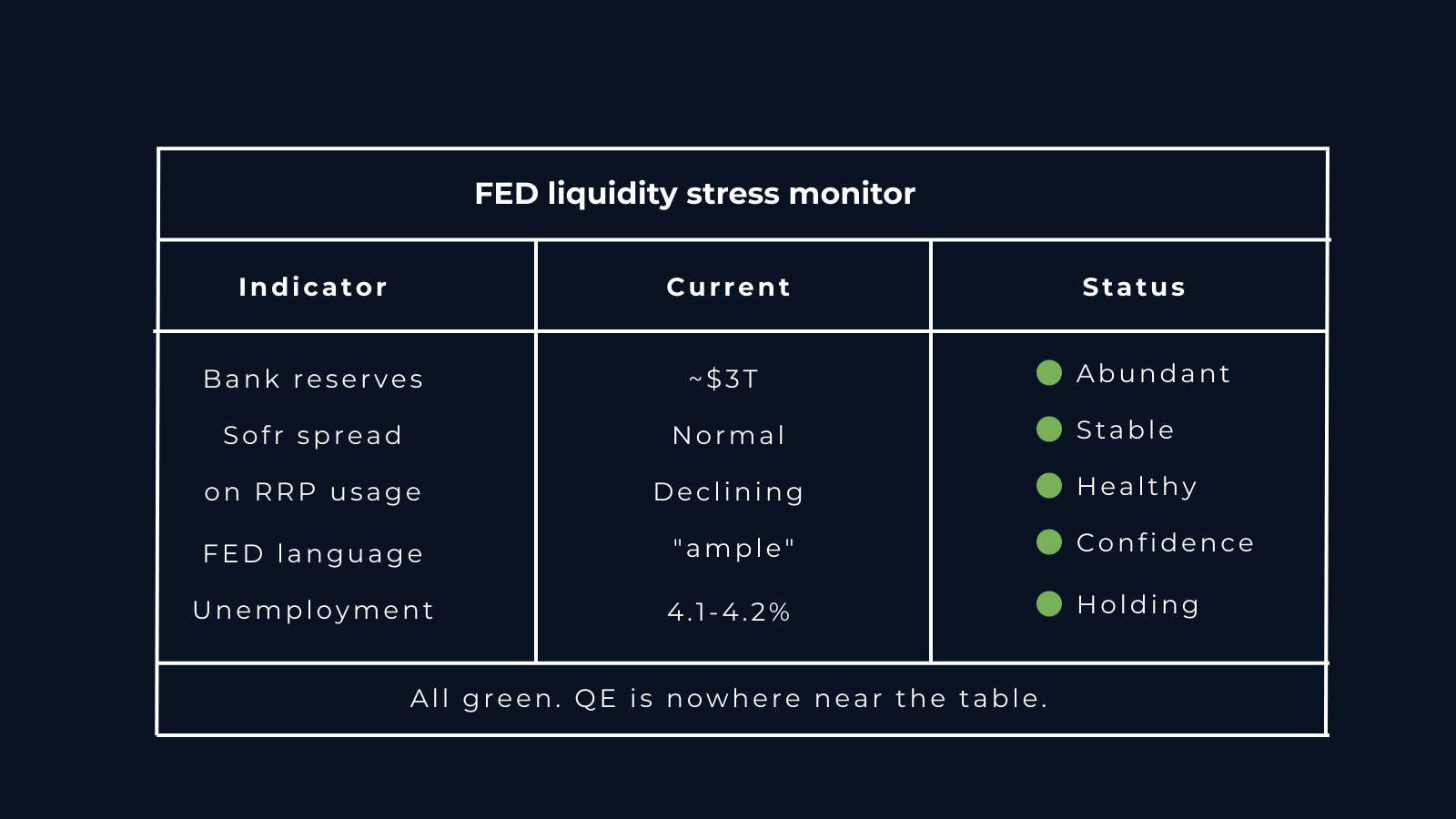
bank reserves
the number that tells you whether the system has enough cash to function.
right now: roughly $3 trillion. fed calls that "abundant." that's the green zone. system is flush. banks aren't scrambling.
stress zone: watch for reserves dropping toward $2.5 trillion. that's where the fed starts getting uncomfortable. where liquidity conversations shift from "we're fine" to "we're monitoring closely."
if reserves stay above $2.5 trillion the fed has zero reason to even consider QE.
SOFR and repo rates
SOFR is secured overnight financing rate. this is the heartbeat of overnight funding. where banks lend to each other using treasuries as collateral.
normal: SOFR trades tight to the fed funds rate. boring, stable and healthy.
stress signal: SOFR spikes more than 9 basis points above fed funds. that's the canary. that's what happened in september 2019 when repo markets froze.
the standing repo facility exists now specifically to catch these spikes before they become crises. but still worth watching. if SOFR starts jumping consistently something is off.
right now: normal. plumbing is clean.
overnight reverse repo (ON RRP)
this one's counterintuitive. ON RRP is where banks park excess cash with the fed overnight. when it's high there's too much cash in the system. when it declines that cash is flowing into the real economy.
healthy: gradual decline. money moving into productive use.
warning: approaches zero. that means the excess liquidity buffer is gone. system is running lean.
right now: declining at a normal pace. buffer still exists.
fed language
forget what the fed does for a second. listen to how they talk.
"ample reserves" = relaxed. steady as she goes.
"monitoring liquidity conditions" = getting attentive. something on the radar.
"concerns about market functioning" = action is coming.
latest FOMC messaging: firmly in "ample reserves" territory. no stress language.
the shift from "ample" to anything else is the real signal. that's when positioning matters.
economic triggers
the data that would actually force the fed's hand.
unemployment crossing above 4.5% - labor market breaking. fed has to respond.
CPI dropping to or below 2%-— inflation solved. fed has room to ease aggressively.
payrolls collapsing . consecutive weak prints.
right now: unemployment 4.1-4.2%. CPI 2.7%. payrolls softening but not falling apart. none of these triggers are firing.
QE doesn't come back because one indicator blinks yellow.
QE comes back when multiple indicators flash red at the same time. reserves dropping. SOFR spiking. ON RRP at zero. fed language shifting. unemployment surging. all at once.
one bad jobs report isn't enough. one repo hiccup isn't enough. the fed has shown over and over that they'll exhaust every tool before reaching for the printer.
the traders still refreshing headlines for "QE" are fighting the last war.
the ones watching these five signals will see the next move coming before the headlines write themselves.
let's land this.
three things.
QT does not automatically lead to QE. never has. the historical record is clear. every cycle had pauses. alternative tools. different conditions. the mechanical pendulum theory has zero evidence behind it and twelve years of evidence against it.
the fed has five tools before QE becomes necessary. they built new ones after 2019 specifically so they'd never be forced into QE by a plumbing crisis again. standing repo facility. targeted lending. rate cuts. fiscal coordination. and the simplest one - pause.
right now they're using option one. pause and reinvest. balance sheet stable. markets stable. economy stable.
so what do you do with this.
if you're positioned for imminent QE you're either early by years or wrong entirely. the fed has given you no signal. the data has given you no signal. the indicators are all green. you're trading a narrative not a reality.
the edge right now isn't predicting when QE comes back. the edge is recognizing that it's not coming back yet while most of the market prices like it's around the corner.
that's where the opportunity sits.
don't watch the headlines. watch the reserves. watch SOFR. watch the ON RRP. watch how the fed talks. watch the labor market.
when multiple signals flip red at the same time that's when the conversation changes. not before.
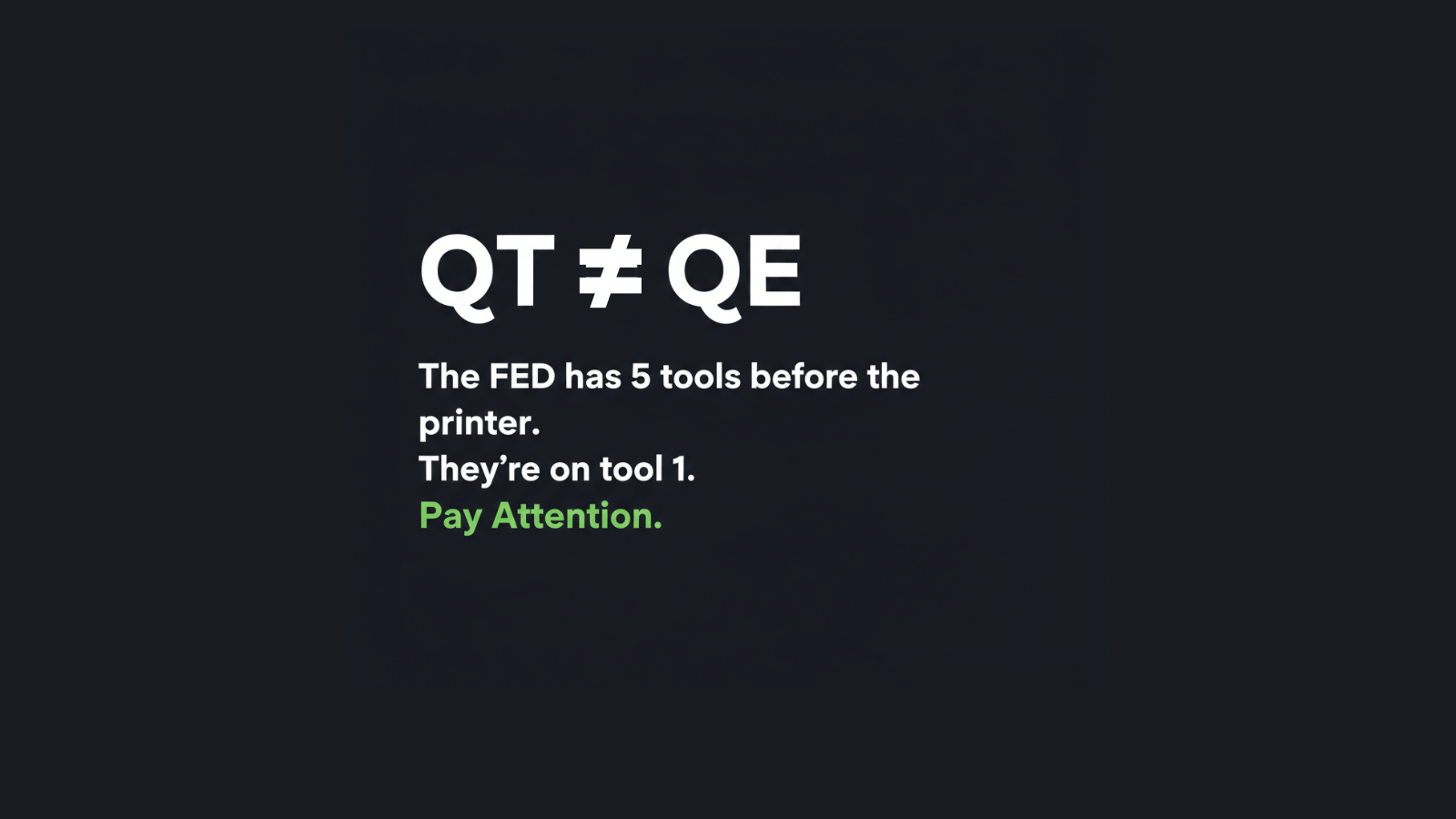
the fed's playbook has more pages than "QT then QE then repeat."
the traders who get that will be on the right side of the next move.
everyone else will still be waiting for the printer.
it's 2026. different tools. different fed and outcome.
pay attention.