
I’ve seen a lot of “fast L1” promises in crypto, but @Fogo Official feels different because the pitch isn’t hype-first — it’s performance-first, and the design choices actually match that promise. What pulled me in most is how clearly Fogo ties three things together: low-latency execution, builder-friendly UX, and community ownership—without trying to dilute the thesis into “we’re for everything.”
And now with $FOGO tokenomics, the bigger picture becomes obvious: Fogo isn’t just launching a token… it’s trying to build an economy where speed stays credible and ownership stays meaningful.
The one idea that keeps repeating: performance without compromise
Fogo’s positioning is simple: decentralization and high performance don’t have to be enemies. The network is framed around proving you can build a serious SVM Layer 1 that’s fast, scalable, and still shaped by the community—not only by private capital.
One line that captures the tone perfectly is:
“True decentralization and high performance can exist together.”
That’s not just branding. It shows up repeatedly in how the network is structured and how value flows back into the ecosystem.
Why Fogo is obsessed with execution
Most people argue chains on TPS charts. I care more about what happens under stress: volatility spikes, liquidations, mempool chaos, and real money competing for ordering.
Fogo keeps coming back to a very trader-native perspective:
Speed matters, but consistency matters more
Infrastructure quality decides user experience
Builders need permissionless deployment, but also performance parity
And I like that they’re honest about the reality: if you want serious performance, you don’t pretend everything can run equally well on random consumer setups. You architect for the workload.
The “Sessions” angle: where UX stops feeling like a tax
This is one of the most practical parts of the stack for me: Fogo Sessions are designed to remove the repetitive friction that makes on-chain apps feel clunky compared to centralized experiences.
The concept is straightforward: give users an experience where they don’t feel forced to sign and pay for every micro-action.
A line that sums up the goal:
“A seamless, gas-free experience.”
When you pair that with dApps sponsoring costs, it becomes clear Fogo wants apps to feel like products — not like “wallet gymnastics.”
$FOGO utility: three pillars that actually make sense
What I like about the token design is that it doesn’t try to invent ten different utilities just to sound “busy.” It stays centered around how the network works.
1) Network Gas
the native fuel for transactions. The important detail is that Fogo expects apps to sponsor these fees when needed, meaning the token can be used at the infra layer while apps still deliver clean UX.
2) Staking Yield
Stakers and validators earn yield for securing the network. That’s normal in crypto, but it matters because it supports a long-term security loop rather than a short-term attention loop.
3) The Flywheel
This is where the model gets interesting. The Foundation supports high-impact projects, and in return partners commit to a revenue-sharing model that routes value back toward the ecosystem.
Their framing is basically: value accrual isn’t optional—it's structural.
Community-first distribution
Most L1s lean heavily on venture capital. #fogo is explicitly presenting itself as community-first, using the Echo Raise and public allocations to push meaningful ownership toward early participants.
The “Community Ownership” category is presented as a combined bucket that includes the Echo raise, a prime sale, and the airdrop — consolidated to prioritize active contributors rather than splitting attention across too many labels.
Here’s how I interpret it: they’re trying to keep the story clean participate early, own early.
Token distribution: the numbers that matter
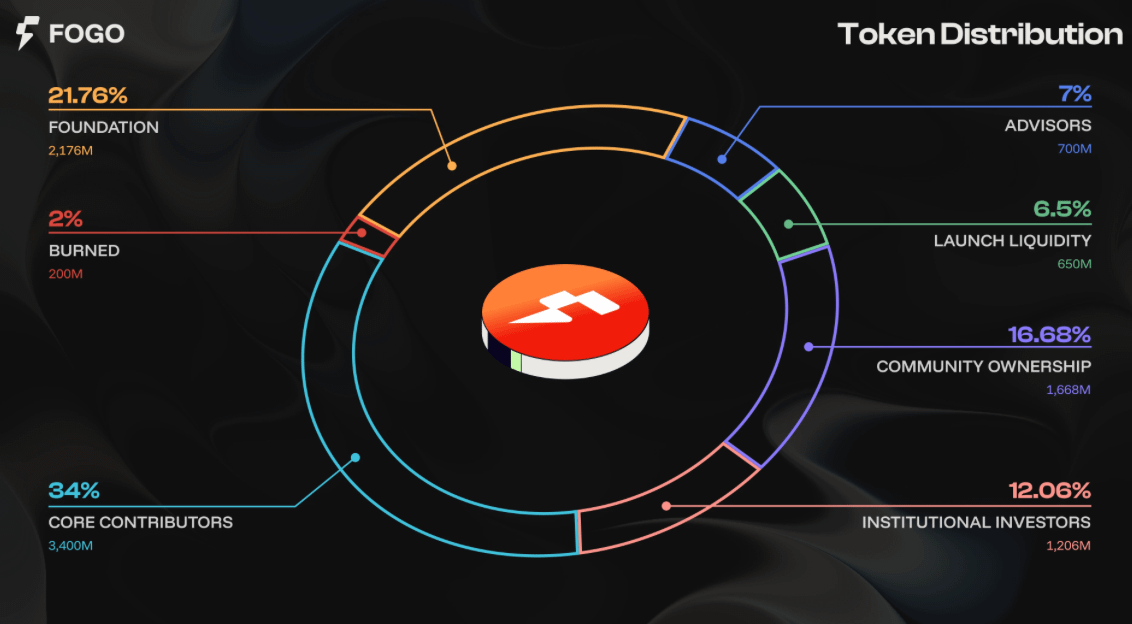
I’m going to lay this out clearly because tokenomics only becomes useful when it’s readable.
Community Ownership — 16.68%
This includes:
Echo Raises — 8.68% (locked at TGE; unlock over 4 years from 26 Sep 2025, with a 12-month cliff)
Binance Prime Sale — 2% (fully unlocked)
Community Airdrop — 6% (fully unlocked)
Plus community distribution planning:Jan 15th distribution — 1.5% (at public mainnet launch)
Future Rewards — 4.5% (reserved for future campaigns)
Two raises were completed on Echo:
$8M at $100M FDV
$1.25M at $200M FDV
across around 3,200 participants.
Institutional Investors — 12.06%
Fully locked
Unlock starts from 26 Sep 2026
The logic is clear: keep investors aligned long-term and reduce early sell pressure.
Core Contributors — 34%
Fully locked
Unlock over 4 years from 26 Sep 2025 with a 12-month cliff
This is the “build runway” allocation — big, but time-aligned.
Foundation — 21.76%
Fully unlocked
Used for grants, incentives, ecosystem programs
This is basically the ecosystem engine.
Advisors — 7%
Fully locked
Unlock over 4 years from 26 Sep 2025 with a 12-month cliff
Launch Liquidity — 6.5%
Fully unlocked
Intended to support third-party liquidity provisioning
Burned — 2%
Burned amount so far (explicitly stated as already burned)
The real headline: the lock structure
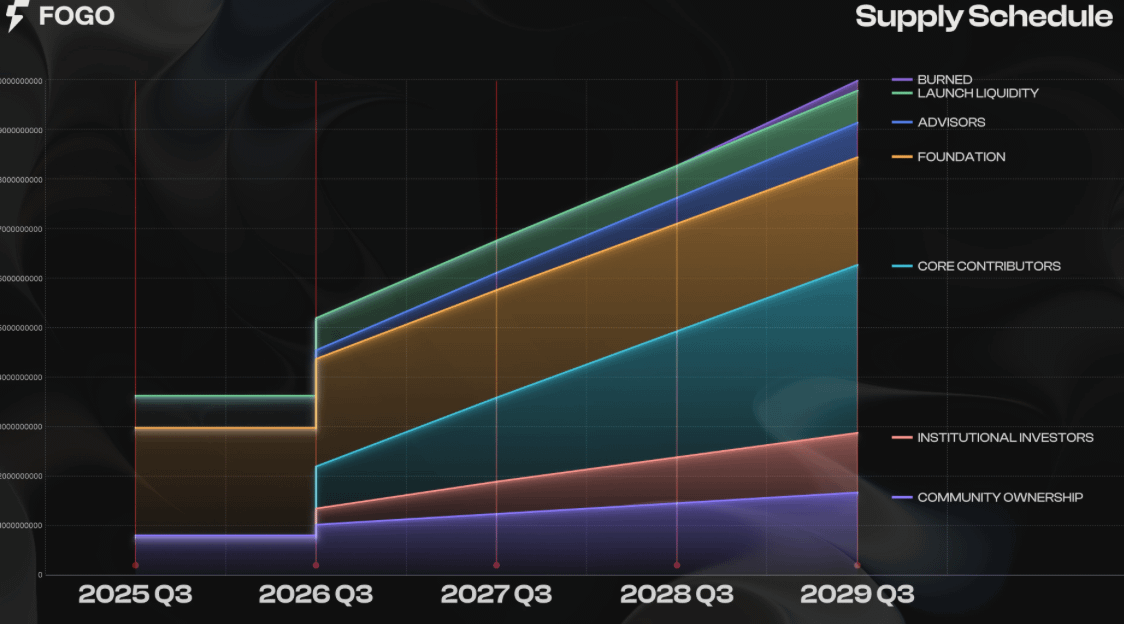
This is where tokenomics turns from “percentages” into a story.
63.74% of Genesis supply is locked at launch
Unlocking happens gradually over four years
The rest is available for foundation activity, grants, liquidity, and community programs
So instead of dumping a huge float into the market day one, they’re clearly trying to balance:
immediate ecosystem functionality
community participation rewards
long-term alignment for contributors + investors
What I personally take from this

If I had to explain Fogo in one sentence, it would be this:
Fogo is trying to build a trader-grade chain, and $FOGO designed to make that chain sustainable.
And the vibe is captured perfectly by the brand line:
“Don’t just trade here. Belong here.”
Because that’s what they’re really pushing: not just a network you use, but an ecosystem where builders are funded, users feel less friction, and ownership doesn’t get swallowed by early private allocations.
My key takeaways
Fogo’s story is latency + execution, not generic “L1 expansion.”
FOGO utility is simple and anchored in the economy (gas + staking + flywheel).
Community ownership is meaningful, not decorative, and backed by clear allocations.
Lock-heavy structure suggests long-term alignment over short-term hype.
Foundation being liquid is a deliberate choice: it enables grants, incentives, and growth.
If Fogo delivers the consistency it’s aiming for, this won’t be remembered as “another SVM chain.” It’ll be remembered as a network that took the hardest problem seriously: making on-chain execution feel reliable when the market is chaotic.