@Fogo Official , I’ve noticed something simple when I try most on-chain apps that claim to be “real-time.” You can feel the hesitation. Not huge. Just a beat. You click, and there’s that small internal question: did it register?
That tiny delay tells you more about infrastructure than any whitepaper.
Most blockchains were designed for security and decentralization first, speed second. Which makes sense. If you are settling large value transfers, you want certainty. But once you try to build a live order book or a multiplayer game on top of that structure, the cracks show. It’s like building a racing track on top of cobblestones. You can do it, technically. It just doesn’t feel right.
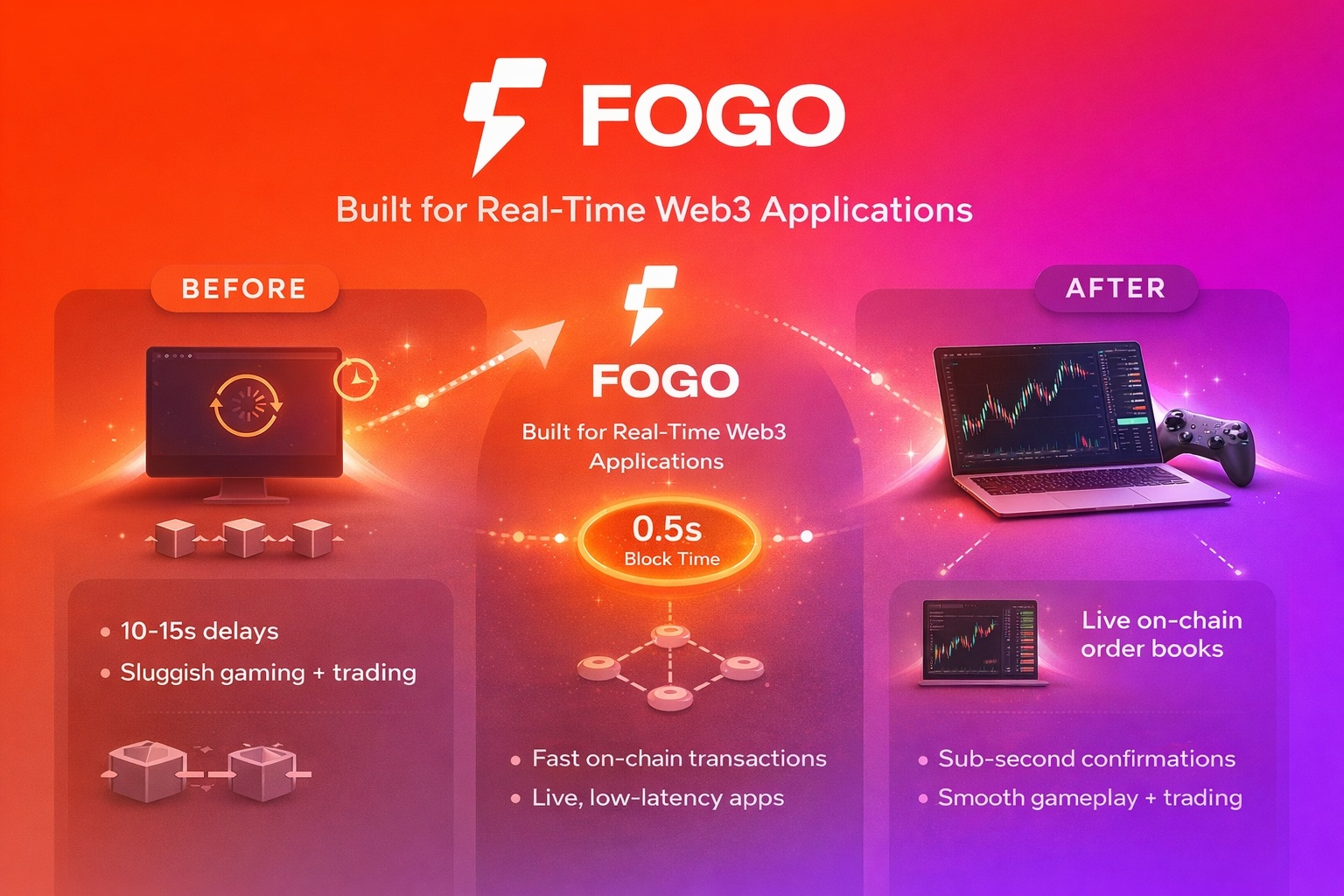
Fogo approaches this from a different angle. Instead of adapting a slower base for high-frequency use, it leans into low latency from the start. The goal isn’t abstract throughput bragging. It’s responsiveness. Sub-second block times in test environments, as reported in early 2026 documentation, are not just numbers. They change how applications behave.
Under one second confirmation sounds small. But compare that to older networks where confirmation can take 10 to 15 seconds under load. That difference is the gap between “this feels usable” and “I’ll wait.” In trading systems, that gap becomes slippage. In games, it becomes frustration.
The stock exchange analogy comes up often with Fogo, and I think it’s useful. Traditional exchanges process thousands of updates per second because order books constantly shift. Every bid, every ask, every partial fill matters. On most blockchains, those updates are too frequent to keep fully on-chain without congestion. So teams push parts off-chain. Hybrid models. Workarounds.
Fogo is experimenting with keeping more of that logic native. Tens of thousands of transactions per second in controlled benchmarks, according to late 2025 test data, were focused on small, repetitive state changes. Not token transfers once in a while. Continuous updates. That distinction matters.
Of course, benchmarks are controlled. Real networks behave differently. As of February 2026, the validator set remains in the low hundreds. That’s healthy for a young chain, but it is not global-scale decentralization yet. Performance at smaller scale is easier to sustain. The real question is what happens when activity doubles, then triples. If this holds under heavier load, the narrative changes.
Gaming is where this design becomes interesting in a less obvious way. Most on-chain games to date have adapted mechanics around network limitations. Turn-based systems. Delayed reveals. Scheduled updates. That wasn’t always creative choice. Sometimes it was necessity.
With sub-second finality, developers can design interactions that feel closer to traditional multiplayer games. Not just minting items, but reacting instantly to player inputs. If you move, the state updates. If someone attacks, the result anchors quickly. It creates a different texture. You don’t think about the chain as much. It fades into the background.
There is a structural trade-off, though. Faster block times require more coordination between validators. Higher throughput demands stronger hardware and reliable network connections. That can quietly narrow participation if requirements drift upward. Fogo’s documentation suggests efforts to keep validator specifications reasonable, but infrastructure always tightens as usage grows. That part remains open.
Another piece sits underneath all of this: deterministic ordering. For real-time trading and gaming, not only speed matters. Predictability matters. If transactions are processed quickly but ordering becomes inconsistent under congestion, confidence drops. Early technical notes emphasize consistency in execution timing, which suggests awareness of that risk. Whether that consistency survives mainnet stress is something we can’t yet fully measure.
It’s also worth noticing the broader context. Compared to the quieter period in 2024, on-chain activity volumes in early 2026 show renewed growth across multiple ecosystems. More users, more experiments with live financial products, more attempts to replicate traditional market structures on-chain. That shift increases pressure on infrastructure. Chains that were “fast enough” two years ago feel slower now.
What makes Fogo different isn’t just the speed target. It’s the alignment between design and use case. Many networks chase general-purpose versatility. Fogo seems comfortable leaning toward specific workloads: high-frequency financial interactions, dynamic state updates, and interactive applications that don’t tolerate lag.
There is risk in specialization. If developers don’t build meaningful applications that take advantage of this architecture, the advantage sits unused. Infrastructure without demand becomes a quiet footnote. And migrating liquidity and users from established ecosystems is never simple. Familiarity has weight.
Still, the logic feels grounded. Real-time systems require infrastructure that respects timing at a foundational level. Retrofitting that later is possible, but it often introduces complexity and hidden latency. Building with that assumption from day one shapes the entire stack differently.
I don’t see this as a race to replace existing chains. It feels more like a parallel lane forming. If Fogo maintains low latency as the validator count grows and applications increase, it may become the default environment for certain categories of Web3 products. Not everything. Just the ones where a fraction of a second changes behavior.
And that fraction is where experience lives. You don’t notice it when it works. You definitely notice when it doesn’t. Whether Fogo sustains that quiet responsiveness at scale is still unfolding. But the direction makes sense in a market that is slowly demanding systems that feel less like experiments and more like infrastructure people can rely on without thinking about it.