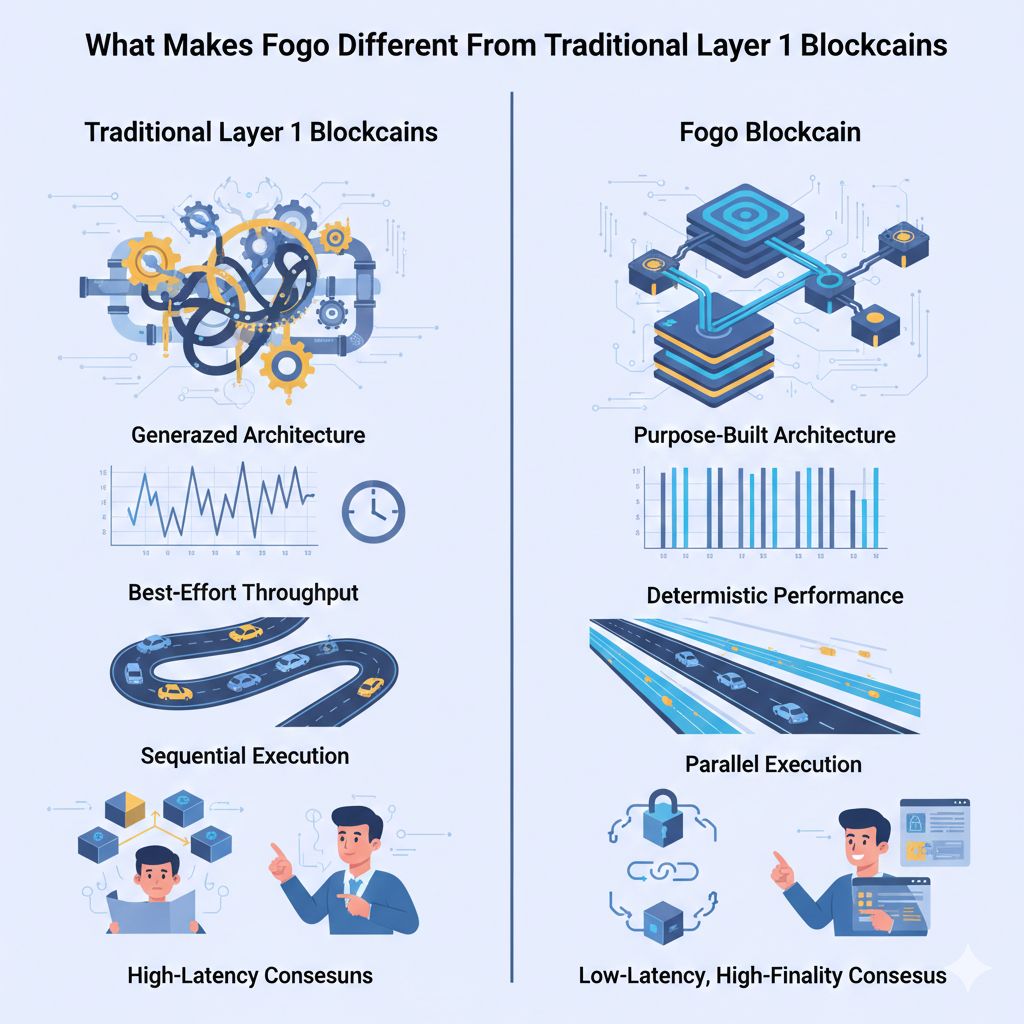
The Layer 1 blockchain landscape has grown increasingly crowded, with many networks offering incremental improvements in scalability, security, or decentralization. Yet despite years of innovation, fundamental limitations persist—particularly around performance predictability, execution efficiency, and developer experience. @Fogo Official represents a new class of Layer 1 architecture designed not as an iteration on existing models, but as a structural rethinking of how a base blockchain should operate.
This article explores what differentiates Fogo from traditional Layer 1 blockchains and why those differences matter for the next generation of decentralized applications.
1. Purpose-Built Architecture Rather Than Generalized Design
Traditional Layer 1 blockchains are largely general-purpose systems. They attempt to support every possible application type using a single architectural framework. While this approach promotes flexibility, it often results in inefficiencies—particularly when high-throughput or low-latency execution is required.
Fogo takes a purpose-built approach. Its architecture is designed around the explicit goal of delivering deterministic, high-performance execution at the base layer. Rather than retrofitting optimizations onto legacy designs, Fogo embeds performance assumptions directly into its core protocol, allowing the network to scale predictably without relying on secondary layers or fragmented execution environments.
2. Deterministic Performance Instead of Best-Effort Throughput
Most traditional Layer 1s operate on a best-effort execution model. Block times, transaction finality, and throughput fluctuate depending on network congestion, validator behavior, and fee dynamics. This unpredictability limits their suitability for real-time or high-frequency applications.
Fogo introduces deterministic performance guarantees. Execution timing, ordering, and finality are designed to be consistent and measurable. This allows developers to build applications that depend on reliable execution—such as on-chain order books, real-time games, or financial primitives that require precise timing—without resorting to off-chain workarounds.
3. Modern Execution Model Optimized for Parallelism
Many Layer 1 blockchains still rely on sequential execution models, inherited from early blockchain designs. While simple and secure, this approach creates bottlenecks as transaction volume increases.
Fogo leverages a modern execution model optimized for parallelism. Transactions that do not conflict at the state level can execute concurrently, significantly improving throughput without compromising determinism or safety. Unlike some parallel execution systems that rely on optimistic assumptions and frequent rollbacks, Fogo’s design emphasizes predictable execution paths that scale with hardware improvements.
4. Consensus Designed for Low Latency and High Finality
Traditional consensus mechanisms often trade speed for decentralization or security, leading to long confirmation times or probabilistic finality. Even newer consensus designs can struggle with latency under real-world conditions.
Fogo’s consensus mechanism is engineered for low-latency block production and rapid finality. Instead of focusing solely on theoretical fault tolerance, it emphasizes practical performance under realistic network assumptions. The result is a network that can confirm transactions quickly and reliably—an essential requirement for user-facing applications and institutional use cases.
5. Simplified Developer Experience Without Abstraction Overload
Layer 1 complexity has increasingly been pushed onto developers, who must navigate fragmented tooling, layered scaling solutions, and inconsistent execution environments.
Fogo prioritizes a cohesive developer experience. By keeping performance, scalability, and execution guarantees at the base layer, it reduces the need for developers to manage cross-layer communication, $FOGO