


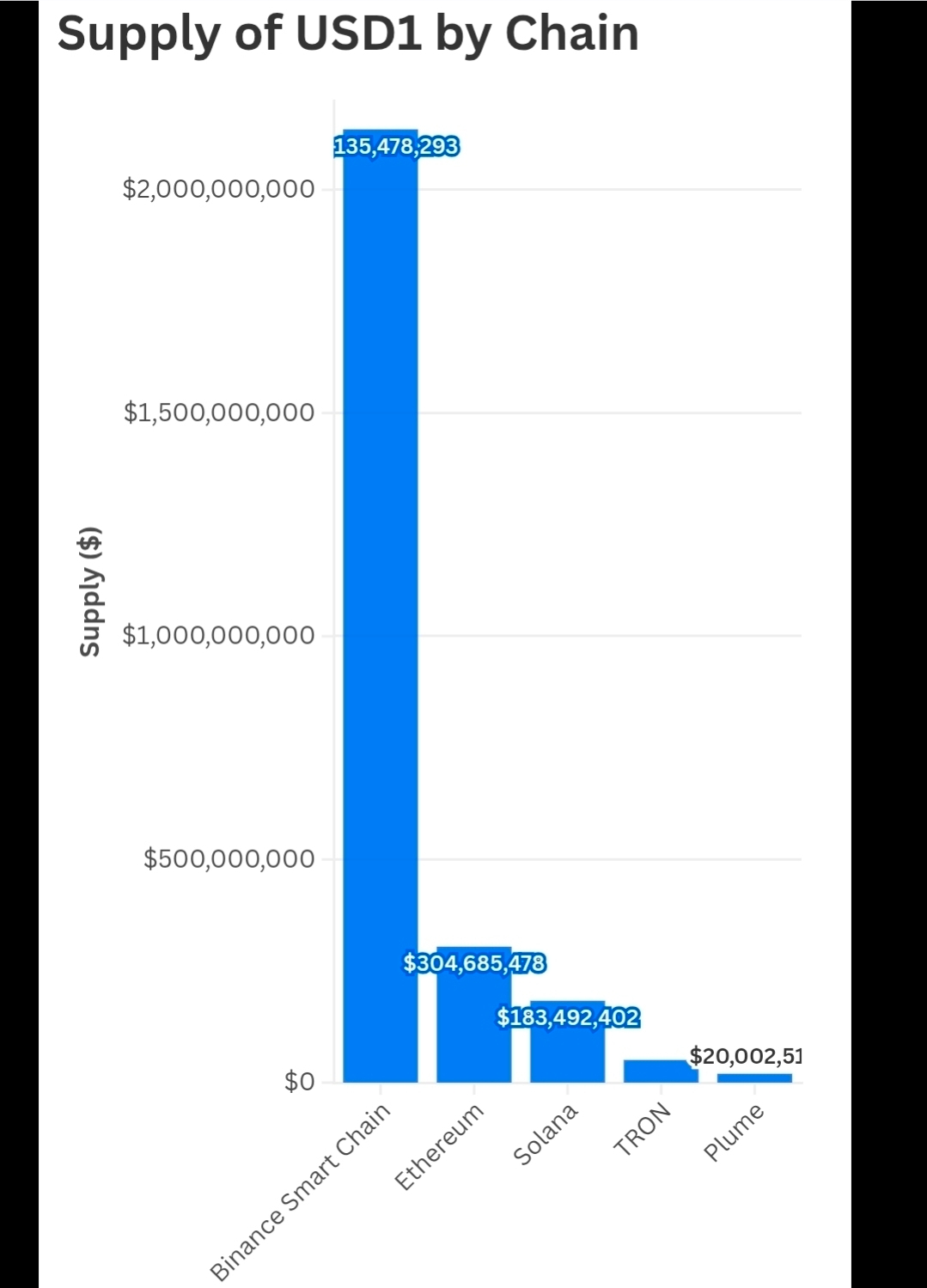
In the fast-evolving world of cryptocurrency, few events have captured attention like the meteoric rise of USD1, the US dollar-pegged stablecoin issued by World Liberty Financial (WLFI). Overnight—or more precisely, in a remarkably short span in late January and early February 2026—USD1 surged to become the fifth-largest stablecoin by market capitalization, crossing the $5 billion threshold and cementing its place among industry giants
Launched in March 2025 by WLFI—a fintech venture with prominent ties to the Trump family—USD1 was positioned from the start as an "upgraded" digital dollar: fully backed 1:1 by U.S. dollars, short-term Treasuries, and high-quality cash equivalents held in custody by regulated entities like BitGo Trust
The project emphasized transparency through regular audits, multi-chain compatibility (initially on Ethereum and BNB Chain, with expansions planned), and institutional-grade security
It aimed to bridge traditional finance (TradFi) and decentralized finance (DeFi), offering utility for payments, lending, cross-border transfers, and real-world asset tokenization.What made USD1's ascent extraordinary was its velocity
From modest beginnings, the stablecoin's supply exploded, driven by aggressive listings (notably on Binance, which now custodies an overwhelming 87–89% of circulating supply according to Arkham Intelligence and Forbes reports), promotional incentives, and strong demand amid a broader crypto market recovery
By late January 2026, USD1 surpassed major competitors like DAI and PayPal's PYUSD, reaching over $5 billion in market cap
Recent data from DefiLlama, CoinGecko, and Binance peg the circulating supply around $5.3–$5.4 billion, with 24-hour trading volumes frequently exceeding $1.5–$2 billion—figures that rival or exceed many established players
This rapid climb placed USD1 behind only the dominant trio of USDT (Tether), USDC (Circle), and newer heavyweights like USDS and USDE (Ethena), according to rankings from DefiLlama and CoinMarketCap as of early February 2026
The achievement is even more striking given the stablecoin sector's total market cap hovering near $300–$310 billion, where concentration remains high among the top issuers.Several factors fueled this overnight transformation
Binance's heavy involvement—facilitated by prior regulatory developments, including the dropping of certain lawsuits and high-profile pardons—played a pivotal role, concentrating liquidity and distribution on one platform
WLFI's ecosystem expansions, including lending protocols on platforms like Aave v3 derivatives and upcoming real-world asset suites, added practical use cases
Political and branding associations also generated massive visibility and inflows, turning USD1 into a symbol of "financial freedom" in certain circles
Critics, however, point to risks: extreme concentration on Binance raises centralization concerns, potential self-dealing allegations tied to political links have drawn scrutiny, and rapid growth invites questions about long-term sustainability and reserve management
Despite these, USD1 maintains its peg tightly around $1.00, with minimal deviations
USD1's leap to fifth place underscores a shifting stablecoin landscape in 2026—one where new entrants can challenge incumbents through strategic partnerships, compliance focus, and aggressive adoption
Whether this momentum sustains or faces headwinds, the event marks a historic milestone: proof that in crypto, overnight success is possible when timing, backing, and execution align perfectly
#USD1 #WLD #TRUMP #MarketCorrection

