

The transition of Plasma (XPL) from its Mainnet Beta phase into a fully decentralized ecosystem is coming to a head in the first quarter of 2026. This period marks the most significant shift in the network's economic model since its explosive $2 billion launch in late 2025. By activating validator delegation and a fixed reward structure, the protocol is moving beyond early stage bootstrapping and into a long term security phase designed to protect its massive stablecoin TVL.
The Staking Architecture: Moving to Public Validation
Until now, the Plasma network has been largely maintained by internal validator nodes to ensure stability during the initial rollout. The Q1 2026 upgrade officially opens the doors to external, permissionless validators. This is not merely a technical checkbox; it is the activation of the PlasmaBFT Proof of Stake (PoS) security model.
Under this new system, the network’s security is directly tied to the market value and quantity of XPL staked. For the network to securely handle over $2 billion in stablecoins (primarily USDT), the cost of attacking the network must be prohibitively expensive. By allowing for a decentralized set of validators, Plasma effectively decentralizes its trust layer, making the infrastructure industrial grade for the institutional partners and fintechs currently utilizing its zero fee payment rails.
The 5% Incentive: Balancing Inflation and Security
The protocol is launching with an initial 5% annual staking reward for validators and their delegators. This rate was chosen to be competitive enough to attract high quality infrastructure providers while remaining sustainable. According to the long term tokenomics, this 5% rate is not static; it is designed to decrease by 0.5% annually until it reaches a terminal floor of 3%.
This inflationary start is balanced by a sophisticated EIP 1559 style fee burning mechanism. While simple USDT transfers remain gasless for the end user (subsidized by the protocol managed paymaster), more complex smart contract interactions, DeFi swaps, and non USDT transactions require gas paid in XPL. A portion of these fees is permanently removed from circulation. As transaction volume scales driven by integrations like the Plasma One neobank and the Confirmo payment gateway the burn rate could theoretically offset the 5% staking inflation, creating a path toward ultrasound status for the XPL token.
Validator Delegation: Democratizing the Yield
One of the most anticipated features of this upgrade is Validator Delegation. In the Beta phase, XPL utility was largely limited to its role as a gas token for complex transactions. Now, any holder not just those with the technical expertise to run a server can participate in securing the network.
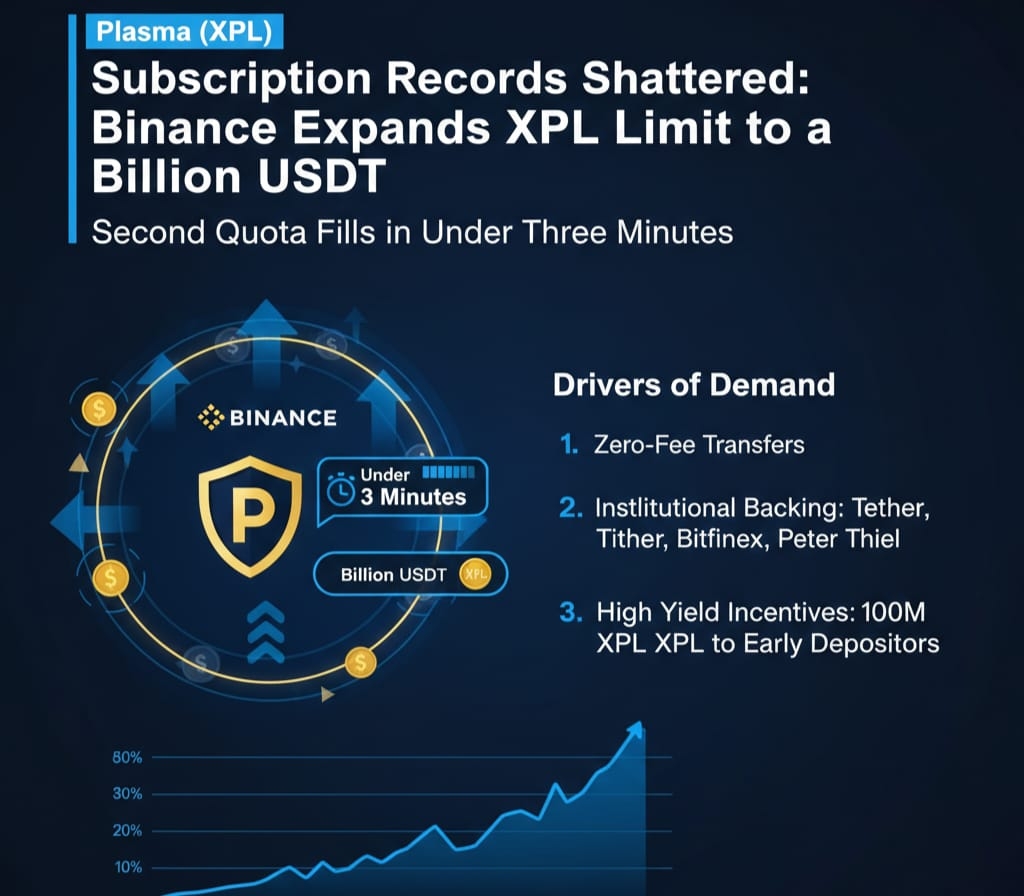
By delegating XPL to a professional validator, retail and institutional holders can earn a proportional share of the 5% rewards. This effectively locks up a significant portion of the circulating supply. Historically, when L1 networks move from a liquid state to a staked state, the reduced sell side pressure on exchanges can lead to increased price stability. For Plasma, this staking utility is the secret moat that transforms XPL from a speculative asset into a productive one.
Securing the $2 Billion Stablecoin Fortress
The primary goal of this decentralized staking launch is the protection of the $2 billion+ in stablecoin TVL currently residing on-chain. Plasma has carved out a niche as the fiber channel for global stablecoin transfers, processing billions in cross border volume through partners like Tether and Bitfinex.
Security in this context isn't just about preventing hacks; it’s about economic finality. Large-scale institutional users need to know that once a million dollar USDT settlement is sent, it cannot be reversed. The sub second finality of PlasmaBFT, combined with a globally distributed set of validators staking billions of dollars worth of XPL, provides that assurance.
Ecosystem & Supply Events: Navigating the 2026 Roadmap
While the staking activation provides a bullish utility narrative, the ecosystem is also approaching several critical Supply Events that will define XPL's market performance in 2026.
The July 2026 Overhang
The most significant date on the calendar is July 28, 2026. This marks the one year cliff for the team and early investor allocations. Approximately 2.5 billion XPL (25% of the total 10 billion supply) will begin its unlock schedule. Simultaneously, 1 billion tokens from the U.S. public sale participants will be released.
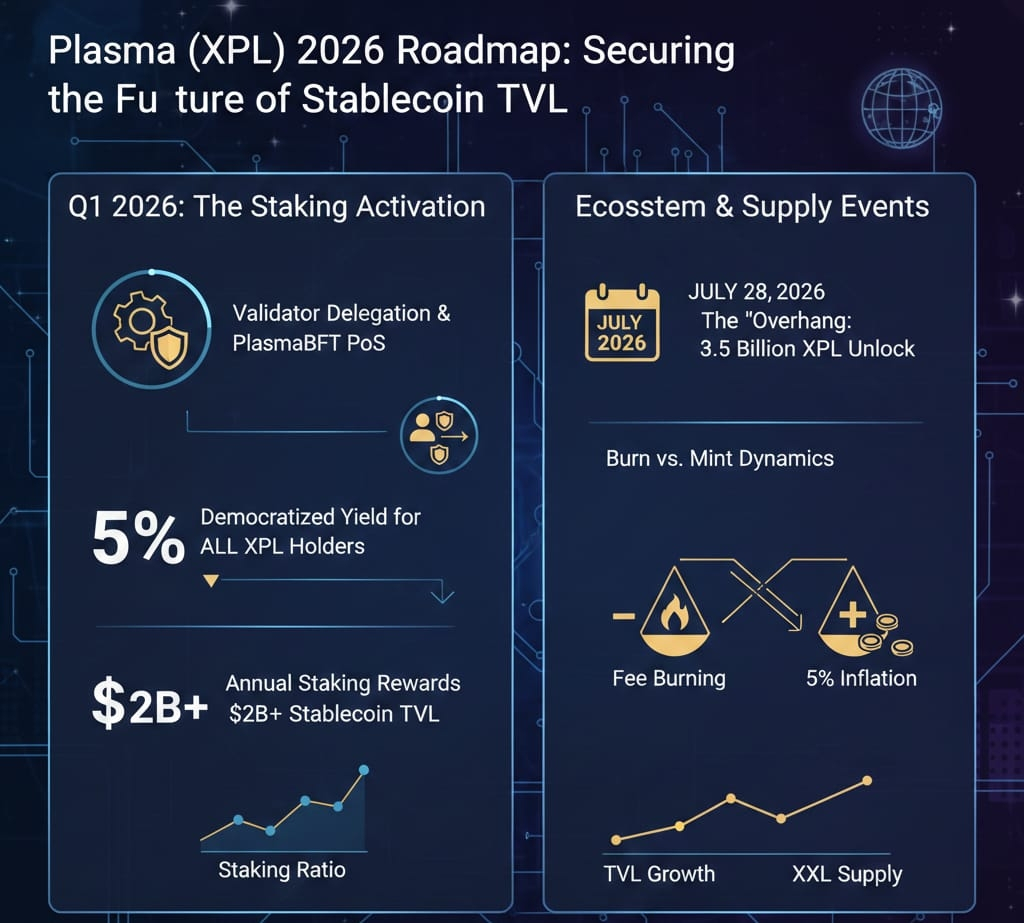
This creates a massive supply overhang that the market is already pricing in. The success of the Q1 staking launch is essential to absorbing this upcoming supply. If a large percentage of the community is already locked into 5% staking yields, the selling pressure from the July unlock may be mitigated as new holders look to acquire tokens for their own staking strategies.
Burn vs. Mint Dynamics
As we move through 2026, the community will be watching the Net Emission rate. Currently, with roughly 2.1 billion tokens in circulation, the 5% inflation adds about 100 million XPL per year to the supply. However, with daily on chain revenue now averaging hundreds of thousands of dollars, the protocol has the capacity to burn a significant amount of those new tokens.
Conclusion: The Maturation of a Payment Giant
The Q1 2026 staking activation represents the coming of age for the Plasma network. By transitioning from a centralized beta to a decentralized, yield bearing economy, XPL is proving it can handle the weight of global finance. For Md Muntajul Haque Mahasin and other analysts, the key metrics to watch in the coming months will be the Staking Ratio (what percentage of XPL is locked) and the Burn to Emission Ratio.
If the network can maintain its $2B+ TVL and continue scaling its real world payment integrations, the supply overhang of July may become a liquidity opportunity rather than a risk. The transition to a decentralized PoS model is the final piece of the puzzle in making Plasma the default rails for the digital dollar.
