
#keybank
keybank
362 Aufrufe
7 Kommentare
Hot
Zuletzt

·
--
Artikel
Übersetzung ansehen
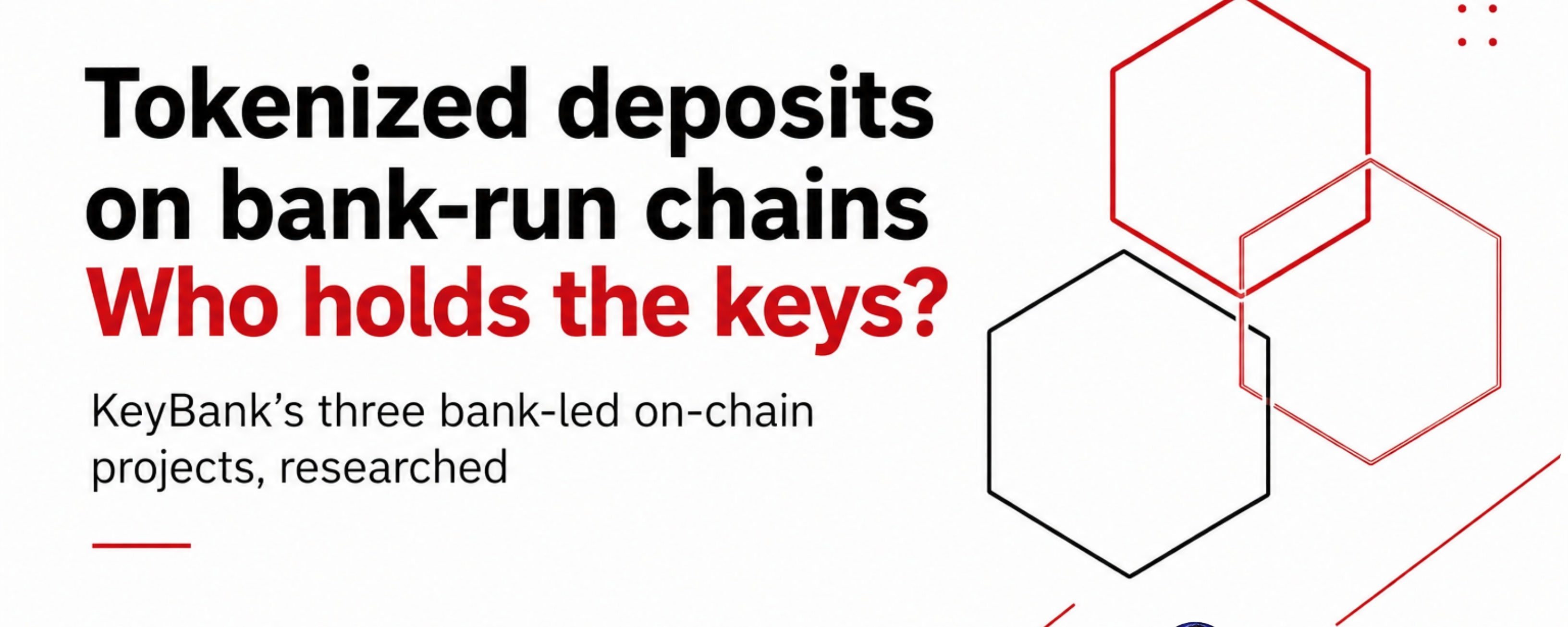
Who Holds the Keys? KeyBank and the Institutional Shift to BlockchainAs a Web3 researcher in the @DAOLabs ecosystem, I find the growing relationship between traditional banking and blockchain particularly interesting. Beyond cryptocurrency, institutions are exploring how digital infrastructure could reshape financial services. #Web3Banking raises important questions about efficiency, privacy and who ultimately controls money.
Blockchain adoption in banking is not simply about moving money onto new technology. As institutions explore blockchain based systems for issuing, transferring and settling money, they must also decide how these systems operate and who controls them. For customers, these decisions could affect access, privacy and ownership.
#KeyBank 's involvement in Cari Network, FIS Project Keystone and The Clearing House's On-Chain Money Initiative offers a useful case study.
KeyBank’s Position in the On Chain Banking Landscape
Confirmed: KeyBank is one of six design partner banks working with Cari Network, alongside First Horizon, Huntington, M&T, Old National and SouthState.
On September 2, 2026, Cari announced a $32.5 million funding round backed entirely by banks, with all six design partners participating. Founded by Gene Ludwig, former U.S. Comptroller of the Currency, Cari is developing shared infrastructure for tokenized deposits.
Reported: A November 6, 2026 GARP report stated that Cari launched its minimum viable product in March and delivered its fuller product suite in July. Design partners were expected to begin operating by year-end, indicating progress rather than confirmed full production use.
KeyBank is also a publicly named participant in FIS Project Keystone, announced April 30, 2026. FIS named Citizens, Fifth Third, Huntington, KeyBank and M&T, although six institutions are involved. The initiative aims to create a bank-administered network for issuing, transferring and settling regulated digital deposits.
The Clearing House's On Chain Money Initiative, announced in June 2026, aims to support interbank clearing and settlement of tokenized deposits. KeyBank's Head of Commercial Banking, Ken Gavrity, commented publicly. In September, Quant was selected as the technology partner, with availability targeted for the first half of 2027.
These initiatives show KeyBank exploring multiple institutional routes into digital money infrastructure.
Why Prividium Matters:
Cari uses ZKsync's Prividium technology. Cari is the network being developed with its bank partners, while Prividium provides the underlying infrastructure.
Vendor claim: ZKsync describes Prividium as a private, permissioned blockchain that keeps transaction data off the public chain while submitting state roots and zero knowledge proofs to Ethereum. It also supports identity based access and selective disclosure for authorised auditors and regulators.
This combines controlled participation and financial confidentiality with cryptographic verification anchored to Ethereum.
Tokenized deposits are also distinct from stablecoins. They represent bank-issued deposits and remain bank liabilities.
Who Holds the Keys? Five Questions:
- Access: Who can participate?
Public blockchains generally allow open participation. Prividium restricts access to authorised users, supporting compliance but making participation dependent on permissioning rules.
- Visibility: Who can see transactions?
Public chain activity can be independently inspected. Prividium keeps transaction details private, with disclosure available to authorised parties. This protects confidentiality but limits public transparency.
- Ordering: Who decides which transactions proceed?
Public networks use distributed ordering mechanisms. Prividium operates with its own sequencer, supporting predictable operations while placing transaction ordering within its governance structure.
- Verification: Who checks the records?
Prividium submits zero-knowledge proofs and state roots to Ethereum, allowing state updates to be verified without exposing private transactions. However, verification does not provide the same transparency as a fully public ledger.
- Exit: Who controls asset movement?
Public-network users can generally hold their own keys and interact directly with the network. Bank-led systems depend on custody, wallet and redemption arrangements. Customers need clarity on withdrawal options and whether independent self-custody is possible.
These trade offs highlight how bank-run chains can offer privacy, compliance and institutional control while limiting open participation compared with public blockchains.
A Wider Institutional Comparison
Deutsche Bank's Project DAMA 2 provides another example. Its 2025 litepaper, developed with Memento Blockchain and Interop Labs, describes tokenized asset infrastructure using a privacy-enabled ZKsync-based layer, Ethereum and Axelar for cross-chain distribution.
Unlike Cari's multi-bank deposit network, DAMA 2 focuses on asset servicing. Meanwhile, FIS's Lyriq and Quant demonstrate alternative institutional approaches.
My Research Perspective
Bank-led blockchain infrastructure could bring programmable money, faster settlement and improved coordination into regulated financial services, particularly corporate payments and treasury operations.
However, technology alone cannot answer questions about control. Governance, custody, data availability and withdrawal options matter equally.
I would like KeyBank and its partners to clarify three things:
1. How are access rules and network changes governed?
2. What withdrawal and redemption options, including independent custody, will customers have?
3. What can customers, auditors and researchers independently verify?
The discussion should not be reduced to public versus private blockchain, but to whether these systems balance efficiency, accountability, privacy and user control.
As banking moves on chain, who holds the keys, and what rights do customers retain?
Read full details here: https://www.linkedin.com/pulse/who-holds-keys-keybank-institutional-shift-blockchai-jenny-mary-tmuee
Independent research based on public sources. Not affiliated with any organization mentioned.
Who Holds the Keys? KeyBank and the Institutional Shift to Blockchain
As a Web3 researcher in the @DAO Labs ecosystem, I find the growing relationship between traditional banking and blockchain particularly interesting. Beyond cryptocurrency, institutions are exploring how digital infrastructure could reshape financial services. #Web3Banking raises important questions about efficiency, privacy and who ultimately controls money.
Blockchain adoption in banking is not simply about moving money onto new technology. As institutions explore blockchain based systems for issuing, transferring and settling money, they must also decide how these systems operate and who controls them. For customers, these decisions could affect access, privacy and ownership.
#KeyBank 's involvement in Cari Network, FIS Project Keystone and The Clearing House's On-Chain Money Initiative offers a useful case study.
KeyBank’s Position in the On Chain Banking Landscape
Confirmed: KeyBank is one of six design partner banks working with Cari Network, alongside First Horizon, Huntington, M&T, Old National and SouthState.
On September 2, 2026, Cari announced a $32.5 million funding round backed entirely by banks, with all six design partners participating. Founded by Gene Ludwig, former U.S. Comptroller of the Currency, Cari is developing shared infrastructure for tokenized deposits.
Reported: A November 6, 2026 GARP report stated that Cari launched its minimum viable product in March and delivered its fuller product suite in July. Design partners were expected to begin operating by year-end, indicating progress rather than confirmed full production use.
KeyBank is also a publicly named participant in FIS Project Keystone, announced April 30, 2026. FIS named Citizens, Fifth Third, Huntington, KeyBank and M&T, although six institutions are involved. The initiative aims to create a bank-administered network for issuing, transferring and settling regulated digital deposits.
The Clearing House's On Chain Money Initiative, announced in June 2026, aims to support interbank clearing and settlement of tokenized deposits. KeyBank's Head of Commercial Banking, Ken Gavrity, commented publicly. In September, Quant was selected as the technology partner, with availability targeted for the first half of 2027.
These initiatives show KeyBank exploring multiple institutional routes into digital money infrastructure.
Why Prividium Matters:
Cari uses ZKsync's Prividium technology. Cari is the network being developed with its bank partners, while Prividium provides the underlying infrastructure.
Vendor claim: ZKsync describes Prividium as a private, permissioned blockchain that keeps transaction data off the public chain while submitting state roots and zero knowledge proofs to Ethereum. It also supports identity based access and selective disclosure for authorised auditors and regulators.
This combines controlled participation and financial confidentiality with cryptographic verification anchored to Ethereum.
Tokenized deposits are also distinct from stablecoins. They represent bank-issued deposits and remain bank liabilities.
Who Holds the Keys? Five Questions:
- Access: Who can participate?
Public blockchains generally allow open participation. Prividium restricts access to authorised users, supporting compliance but making participation dependent on permissioning rules.
- Visibility: Who can see transactions?
Public chain activity can be independently inspected. Prividium keeps transaction details private, with disclosure available to authorised parties. This protects confidentiality but limits public transparency.
- Ordering: Who decides which transactions proceed?
Public networks use distributed ordering mechanisms. Prividium operates with its own sequencer, supporting predictable operations while placing transaction ordering within its governance structure.
- Verification: Who checks the records?
Prividium submits zero-knowledge proofs and state roots to Ethereum, allowing state updates to be verified without exposing private transactions. However, verification does not provide the same transparency as a fully public ledger.
- Exit: Who controls asset movement?
Public-network users can generally hold their own keys and interact directly with the network. Bank-led systems depend on custody, wallet and redemption arrangements. Customers need clarity on withdrawal options and whether independent self-custody is possible.
These trade offs highlight how bank-run chains can offer privacy, compliance and institutional control while limiting open participation compared with public blockchains.
A Wider Institutional Comparison
Deutsche Bank's Project DAMA 2 provides another example. Its 2025 litepaper, developed with Memento Blockchain and Interop Labs, describes tokenized asset infrastructure using a privacy-enabled ZKsync-based layer, Ethereum and Axelar for cross-chain distribution.
Unlike Cari's multi-bank deposit network, DAMA 2 focuses on asset servicing. Meanwhile, FIS's Lyriq and Quant demonstrate alternative institutional approaches.
My Research Perspective
Bank-led blockchain infrastructure could bring programmable money, faster settlement and improved coordination into regulated financial services, particularly corporate payments and treasury operations.
However, technology alone cannot answer questions about control. Governance, custody, data availability and withdrawal options matter equally.
I would like KeyBank and its partners to clarify three things:
1. How are access rules and network changes governed?
2. What withdrawal and redemption options, including independent custody, will customers have?
3. What can customers, auditors and researchers independently verify?
The discussion should not be reduced to public versus private blockchain, but to whether these systems balance efficiency, accountability, privacy and user control.
As banking moves on chain, who holds the keys, and what rights do customers retain?
Read full details here: https://www.linkedin.com/pulse/who-holds-keys-keybank-institutional-shift-blockchai-jenny-mary-tmuee
Independent research based on public sources. Not affiliated with any organization mentioned.
RWAemtx:
Thought-provoking perspective.
Blockchain can improve banking efficiency, but customer control, privacy, transparency and withdrawal rights must remain central as institutions build the next generation of financial infrastructure for everyone involved.
1
1
95

·
--
Artikel
Wer hält die Schlüssel, wenn eine Bank sich der Blockchain anschließt?Private Schlüssel, Bankschlüssel und die damit verbundenen Zielkonflikte.
In
, gibt es ein altes Sprichwort: Nicht deine Schlüssel, nicht deine Coins. Es erinnert uns daran, dass Eigentum und Kontrolle eng miteinander verbunden sind. Als Autor für
muss ich mich fragen, was passiert, wenn eine traditionelle Bank Geld auf eine Blockchain-Infrastruktur verlagert. Wer hält die Schlüssel: die Bank, der Netzwerkbetreiber, die Aufsichtsbehörde oder der Kunde?
#KeyBank , ein in Cleveland ansässiges Finanzinstitut, dessen Wurzeln bis ins Jahr 1825 zurückreichen, ist ein interessanter Fall. Seine Muttergesellschaft KeyCorp meldete zum 30. Juni 2026 Vermögenswerte von rund 191 Milliarden US-Dollar.
Wer hält die Schlüssel, wenn eine Bank sich der Blockchain anschließt?
Private Schlüssel, Bankschlüssel und die damit verbundenen Zielkonflikte.
In
, gibt es ein altes Sprichwort: Nicht deine Schlüssel, nicht deine Coins. Es erinnert uns daran, dass Eigentum und Kontrolle eng miteinander verbunden sind. Als Autor für
muss ich mich fragen, was passiert, wenn eine traditionelle Bank Geld auf eine Blockchain-Infrastruktur verlagert. Wer hält die Schlüssel: die Bank, der Netzwerkbetreiber, die Aufsichtsbehörde oder der Kunde?
#KeyBank , ein in Cleveland ansässiges Finanzinstitut, dessen Wurzeln bis ins Jahr 1825 zurückreichen, ist ein interessanter Fall. Seine Muttergesellschaft KeyCorp meldete zum 30. Juni 2026 Vermögenswerte von rund 191 Milliarden US-Dollar.
FHNUS+0,55%
jennyjacob01 :
The real shift is not just moving deposits onto blockchain, but deciding who controls them and how that control is protected. KeyBank's approach shows how traditional banking and Web3 can meet without abandoning the trust and accountability customers expect.
1
2
101
Anmelden und weiter Inhalte entdecken
Krypto-Nutzer weltweit auf Binance Square kennenlernen
⚡️ Bleib in Sachen Krypto stets am Puls.
💬 Die weltgrößte Kryptobörse vertraut darauf.
👍 Erhalte verlässliche Einblicke von verifizierten Creators.
E-Mail-Adresse/Telefonnummer
Trendthemen
1
#CanMarketsReboundAfterThanksgiving?
33,407 Aufrufe
716 Kommentare
2
#CouldSpaceX’sOrbitalDataCentersBoostAIChipDemand?
20,794 Aufrufe
446 Kommentare
3
#EvolveAtBinanceBlockchainWeek
682,646 Aufrufe
7,702 Kommentare
4
#CorePCEBeatLiftsFedHikeOdds
189,879 Aufrufe
1,471 Kommentare
5
#BitcoinAndStocksSlipAgainAmidTrump’sTariffPlans
234,713 Aufrufe
2,234 Kommentare
6
#JensenHuangSaysNvidiaDoesn’tNeedASuccessionPlan
111,081 Aufrufe
1,331 Kommentare
7
#NasdaqFuturesSlideMoreThan3%
48,785 Aufrufe
423 Kommentare
8
#USOctoberPCEPriceIndexAt0.3%MoM
55,075 Aufrufe
427 Kommentare
9
#BitcoinETFsPostRecord$4.94BNovemberOutflows
10,347 Aufrufe
54 Kommentare
10
#TetherInvestsInArgentinasLemon
21,060 Aufrufe
242 Kommentare