
#dowjonesadds591
dowjonesadds591
221 Aufrufe
10 Kommentare
Hot
Zuletzt

·
--
Übersetzung ansehen
Have you noticed the Dow just printed a 591-point surge while most crypto traders are still sitting in extreme fear?
The real pain is how easy it is to misread that gap. You either chase $BTC after equities already moved, or you park everything in $USDT and $USDC waiting for a perfect setup that never arrives, and both habits quietly bleed accounts.
The Dow Jones adding 591 points is a clean case study in how far crypto sentiment has drifted from actual risk appetite. Traditional markets just showed they are willing to bid. Crypto Fear and Greed is sitting at 9, which is extreme fear, not a mild dip in mood. Equities are pricing in a path forward while crypto is still pricing in a floor that might not hold.
The mainstream take is that $BTC always follows a stock rally within a few sessions. That reading is lazy. A Dow rip can just as easily mean capital is rotating into quality names and out of speculative ones. Correlation is a condition, not a law, and the last cycle punished anyone who treated it like a guarantee.
If stocks keep running from here, does crypto catch up or does this disconnect get wider first?
#DowJonesAdds591 #MalaysiaFirstBitcoinETFToListOnDecember2


·
--
#DowJonesGewinnt591,99Punkte
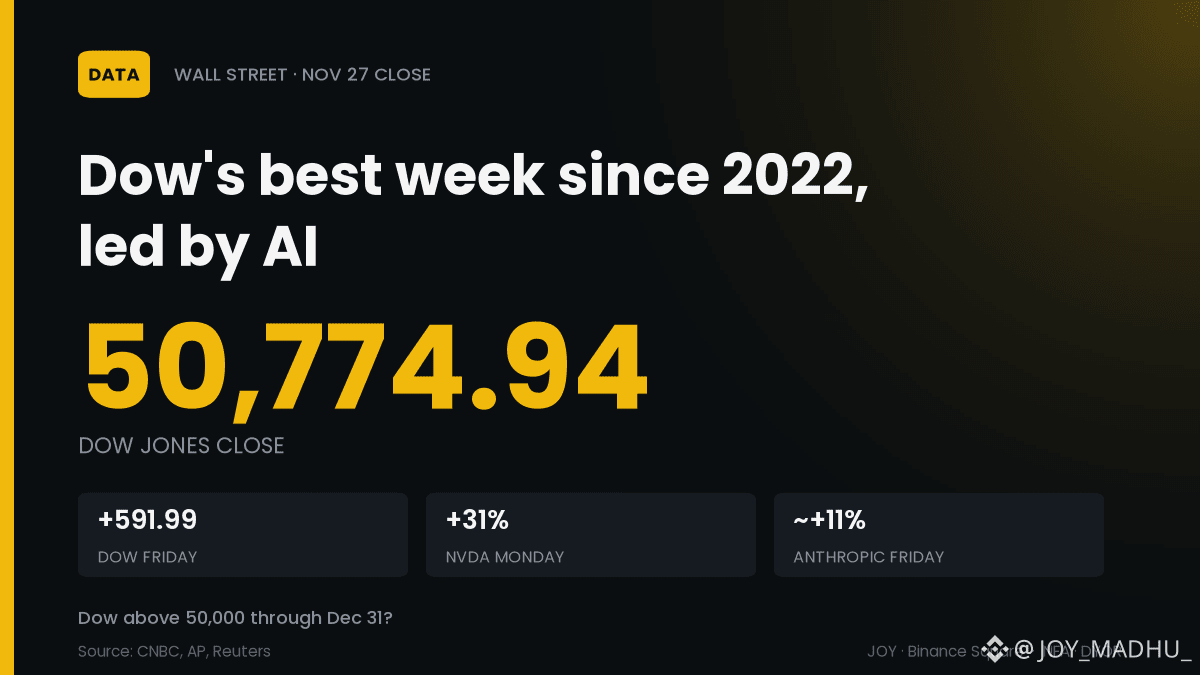
📈 Beste Dow-Woche seit 2022 – KI-Aktien sorgten für den Aufschwung
Der Dow legte am Freitag um 591,99 Punkte auf 50.774,94 zu. Damit schloss er eine Woche mit einem Plus von mehr als 5 % ab, nachdem gebeutelte KI-Aktien wieder zulegten.
🏦 Nvidia legte am Montag um 31 % zu, nachdem Jensen Huang als CEO zurückkehrte
📊 Die Anthropic-Aktie sprang am Freitag um fast 11 % nach oben
📅 Der S&P 500 stieg im Wochenverlauf um 5,6 % – der beste Wert seit April 2025
📈 Der Nasdaq legte am Freitag um 2,31 % auf 24.129,50 zu
Im größeren Bild: Eine Woche zuvor lag der S&P mehr als 10 % unter seinem Höchststand; die Volatilität ist noch nicht verschwunden.
Bleibt der Dow bis zum 31. Dezember über 50.000 oder fällt er wieder darunter? 👇
$NVDA $ANTHROPIC
#DowJonesGewinnt591,99Punkte #AIStocks #WallStreet
414

·
--
$SPYB: Der Sprung des Dow um 591,99 Punkte am Black Friday ist die Zahl in den Schlagzeilen. Warum war es dann prozentual die kleinste Bewegung der vier großen US-Indizes?
Die kurze Antwort: Punktzahlen lassen einen hoch bewerteten Index beeindruckender erscheinen. Prozentual legte der Dow am Freitag am wenigsten zu, und der Gesamtmarkt entwickelte sich stärker, als die Schlagzeile vermuten lässt.
Die Zahlen aus der Schlusstabelle der AP vom 27. November:
- Dow Jones Industrial Average: +591,99 Punkte oder 1,2 % auf 50.774,94
- S&P 500: +114,71 Punkte oder 1,6 % auf 7.297,49
- Nasdaq Composite: +2,3 %, Russell 2000: +1,7 %
- In der Woche legte der S&P 500 um 5,6 % zu – laut AP der größte Wochengewinn seit April 2025
Warum Punktzahlen irreführend sind:
- Die Punktzahl steigt mit dem Indexstand. Meiner Rechnung nach entsprechen 591,99 Punkte bei einem Schlussstand von 50.182,95 am Mittwoch etwa 1,18 %. Bei einem Dow-Stand von 25.000 wären es für denselben prozentualen Zuwachs ungefähr 295 Punkte.
- Prozentwerte sind die einzig faire Möglichkeit, zwei Indizes oder einen Index mit einem Coin zu vergleichen.
- Die Stimmung im Kryptomarkt folgte nicht den Aktien: Der Fear-&-Greed-Index auf Binance Square zeigte heute um 10:30 Uhr Kiewer Zeit 9 – extreme Angst.
Was ich als Nächstes prüfe:
- Regulärer Handel am Montag, dem 30. November: Hält sich der S&P 500 über dem Schlussstand vom Freitag von 7.297,49?
- Der SPYB-Kurs am Wochenende: 729,83 USDT laut Binance-Spot-Ticker am 28. November um 08:33 UTC. Die US-Börsen sind samstags geschlossen, es handelt sich also nicht um einen aktuellen S&P-Kurs. SPYB ist ein bStock, und laut Binance-FAQ sind bStocks „keine Aktien oder Anteile“.
- Ob dieser Index den einstelligen Bereich verlässt, falls die Aktien nächste Woche weiter steigen.
Meine Faustregel aus solchen Fällen: Bevor ich einen Tag als besonders stark bezeichne, rechne ich jede Bewegung in Prozent um.
Ich veröffentliche jeden Tag solche Analysen mit Quellenangaben – folge mir, um die nächste nicht zu verpassen.
#DowJonesAdds591.99Points #Write2Earn
Wenn du die Größe einer Marktbewegung einschätzt: Schaust du auf Punkte, Prozentwerte oder etwas anderes – und warum?
$SPYB : Der Sprung des Dow um 591,99 Punkte am Black Friday ist die Zahl in den Schlagzeilen. Warum war es dann prozentual die kleinste Bewegung der vier großen US-Indizes?
Die kurze Antwort: Punktzahlen lassen einen hoch bewerteten Index beeindruckender erscheinen. Prozentual legte der Dow am Freitag am wenigsten zu, und der Gesamtmarkt entwickelte sich stärker, als die Schlagzeile vermuten lässt.
Die Zahlen aus der Schlusstabelle der AP vom 27. November:
- Dow Jones Industrial Average: +591,99 Punkte oder 1,2 % auf 50.774,94
- S&P 500: +114,71 Punkte oder 1,6 % auf 7.297,49
- Nasdaq Composite: +2,3 %, Russell 2000: +1,7 %
- In der Woche legte der S&P 500 um 5,6 % zu – laut AP der größte Wochengewinn seit April 2025
Warum Punktzahlen irreführend sind:
- Die Punktzahl steigt mit dem Indexstand. Meiner Rechnung nach entsprechen 591,99 Punkte bei einem Schlussstand von 50.182,95 am Mittwoch etwa 1,18 %. Bei einem Dow-Stand von 25.000 wären es für denselben prozentualen Zuwachs ungefähr 295 Punkte.
- Prozentwerte sind die einzig faire Möglichkeit, zwei Indizes oder einen Index mit einem Coin zu vergleichen.
- Die Stimmung im Kryptomarkt folgte nicht den Aktien: Der Fear-&-Greed-Index auf Binance Square zeigte heute um 10:30 Uhr Kiewer Zeit 9 – extreme Angst.
Was ich als Nächstes prüfe:
- Regulärer Handel am Montag, dem 30. November: Hält sich der S&P 500 über dem Schlussstand vom Freitag von 7.297,49?
- Der SPYB-Kurs am Wochenende: 729,83 USDT laut Binance-Spot-Ticker am 28. November um 08:33 UTC. Die US-Börsen sind samstags geschlossen, es handelt sich also nicht um einen aktuellen S&P-Kurs. SPYB ist ein bStock, und laut Binance-FAQ sind bStocks „keine Aktien oder Anteile“.
- Ob dieser Index den einstelligen Bereich verlässt, falls die Aktien nächste Woche weiter steigen.
Meine Faustregel aus solchen Fällen: Bevor ich einen Tag als besonders stark bezeichne, rechne ich jede Bewegung in Prozent um.
Ich veröffentliche jeden Tag solche Analysen mit Quellenangaben – folge mir, um die nächste nicht zu verpassen.
#DowJonesAdds591.99Points #Write2Earn
Wenn du die Größe einer Marktbewegung einschätzt: Schaust du auf Punkte, Prozentwerte oder etwas anderes – und warum?
44
·
--
Übersetzung ansehen
Everyone thinks that when traditional markets surge, crypto will instantly follow, but actually, capital rotates on a much slower schedule.
Most investors lose money right here by panic-selling their beaten-down bags to chase equity green candles, only to get chopped on both sides. It feels just like switching checkout lines at the grocery store the exact moment your original lane starts moving.
Think of market liquidity like water flowing through connected garden hoses. When the Dow adds 591 points, big institutions do not instantly throw that cash into digital assets. They usually park their profits in stable reserves like $USDT or $USDC while they reassess macro risk.
That delay creates three common traps for traders. First, people mistake a quiet crypto market for a dead one, dumping their positions at heavy discounts. Second, impatient buyers use heavy leverage on $BTC to force a rally that has not arrived yet, only to get liquidated by normal sideways chop.
Third, chasing external momentum blinds you to the value sitting right in front of you. When sentiment is deep in extreme fear, preserving capital and letting the market breathe is almost always the smarter move.
Do you think traditional market momentum will spill over into crypto this week, or are we decoupling for now?
#DowJonesAdds591 #MalaysiaFirstBitcoinETFToListOnDecember2

1

Übersetzung ansehen
Historically, whenever traditional equities post aggressive triple-digit days while crypto sentiment sinks into single digits, crypto does not die, it merely lags.
Watching traditional markets rally while your portfolio sits frozen in $USDT feels like psychological torture. You start doubting your entire thesis, wondering if Wall Street permanently absorbed all the liquidity while digital assets were left behind.
I lived through this exact scenario in late 2020. The Dow broke out on institutional optimism while $BTC stumbled sideways through heavy fear, making everyone believe crypto had lost its momentum. The common mistake across cycles is expecting macro risk appetite to translate into crypto on the very same afternoon. In reality, large funds establish exposure in mature equities first, secure gains, and then rotate profits into higher-beta digital assets once stability is proven.
When the fear gauge drops down into the single digits, emotional exhaustion convinces investors to flee into $USDC at the precise moment broader risk appetite starts thawing. Capital flows like water through an irrigation system, filling the largest traditional reservoirs before spilling down into crypto markets. The hardest part of this business is not finding entries, but having the emotional stamina to wait out the rotation without abandoning your plan.
Do you view this traditional market divergence as a trap, or are you positioning for liquidity to rotate back over?
#DowJonesAdds591 #MalaysiaFirstBitcoinETFToListOnDecember2
·
--
Der ETF-Flow vom 27. Nov. liegt nun bei -389 Mio. $, IBIT bei -327 Mio. $. $BTC notiert bei knapp 59.737 $, während der Angstwert bei 10 liegt – die Marke von 60.000 $ bleibt weiter außer Reichweite. Die Liquidationen belaufen sich auf 402 Mio. $, davon entfallen 77 % auf Long-Positionen. Dip-Käufer zahlen also weiterhin Lehrgeld. Wenn die Verkäufer so lautstark auftreten, wer bleibt dann noch übrig, um in Panik zu geraten? #EvolveAtBinanceBlockchainWeek #ECBOfficialsHintAtMoreTightening #DowJoneslegt591,99Punktezu
Der ETF-Flow vom 27. Nov. liegt nun bei -389 Mio. $, IBIT bei -327 Mio. $. $BTC notiert bei knapp 59.737 $, während der Angstwert bei 10 liegt – die Marke von 60.000 $ bleibt weiter außer Reichweite. Die Liquidationen belaufen sich auf 402 Mio. $, davon entfallen 77 % auf Long-Positionen. Dip-Käufer zahlen also weiterhin Lehrgeld. Wenn die Verkäufer so lautstark auftreten, wer bleibt dann noch übrig, um in Panik zu geraten? #EvolveAtBinanceBlockchainWeek #ECBOfficialsHintAtMoreTightening #DowJoneslegt591,99Punktezu
165
Anmelden und weiter Inhalte entdecken
Krypto-Nutzer weltweit auf Binance Square kennenlernen
⚡️ Bleib in Sachen Krypto stets am Puls.
💬 Die weltgrößte Kryptobörse vertraut darauf.
👍 Erhalte verlässliche Einblicke von verifizierten Creators.
E-Mail-Adresse/Telefonnummer
Trendthemen
1
#EvolveAtBinanceBlockchainWeek
1.7M Aufrufe
17,335 Kommentare
2
#ColdcardFlawLeadsToTheftOfAtLeast1789BTC
29,528 Aufrufe
334 Kommentare
3
#VitalikWantsWalletChipDesignsOpened
42,443 Aufrufe
487 Kommentare
4
#SECIssuesNoActionLetterOnMoleculeModel
4,068 Aufrufe
60 Kommentare
5
#ChainflipVaultTheftHaltsProtocol
28,031 Aufrufe
431 Kommentare
6
#MalaysiaFirstBitcoinETFToListOnDecember2
16,700 Aufrufe
197 Kommentare
7
#DowJonesAdds591.99Points
26,394 Aufrufe
126 Kommentare
8
#EthereumGlamsterdamKeepsStorageFeeChange
60,561 Aufrufe
569 Kommentare
9
#ClaudeAccusedOfDroppingUserPreferences
12,657 Aufrufe
123 Kommentare
10
#AnzaUrgesSolanaNodesUpgradeAgave
12,235 Aufrufe
177 Kommentare