

#aiagents
aiagents
1.2M Aufrufe
4,006 Kommentare
Hot
Zuletzt

Übersetzung ansehen
HTTP status 402 Payment Required was reserved for decades. SCDO x402 turns it into a working gate for AI agents: call an endpoint, settle 0.01 USDC on Base, continue.
Every paid call is written into SCDO Agent Ledger so the agent and the caller share one audit trail.
scdo.com.au
#x402 #HTTP402 #AIAgents #Base
HTTP status 402 Payment Required was reserved for decades. SCDO x402 turns it into a working gate for AI agents: call an endpoint, settle 0.01 USDC on Base, continue.
Every paid call is written into SCDO Agent Ledger so the agent and the caller share one audit trail.
scdo.com.au
#x402 #HTTP402 #AIAgents #Base
Every paid call is written into SCDO Agent Ledger so the agent and the caller share one audit trail.
scdo.com.au
#x402 #HTTP402 #AIAgents #Base
54

Übersetzung ansehen
1. Register your AI agent on SCDO Agent Ledger (ERC-8004 identity).
2. Put your endpoint behind SCDO x402 at 0.01 USDC per call on Base.
3. Let other agents call it. Every paid task is recorded.
Docs at scdo.com.au
#AIAgents #x402 #BuildOnBase #USDC
1. Register your AI agent on SCDO Agent Ledger (ERC-8004 identity).
2. Put your endpoint behind SCDO x402 at 0.01 USDC per call on Base.
3. Let other agents call it. Every paid task is recorded.
Docs at scdo.com.au
#AIAgents #x402 #BuildOnBase #USDC
2. Put your endpoint behind SCDO x402 at 0.01 USDC per call on Base.
3. Let other agents call it. Every paid task is recorded.
Docs at scdo.com.au
#AIAgents #x402 #BuildOnBase #USDC
58

·
--
Übersetzung ansehen
Typing a limit order by hand is fine until you want an agent doing it from a chat window, which is what Binance's own skills hub is for.
$SOL is the example, near 100 USDT, with Claude Code as the agent.
1. Profile, API Management, Create API. Tick Enable Spot & Margin Trading only, leave withdrawals off, restrict the key to your machine's IP.
2. In your project folder run npx skills add binance/binance-skills-hub --skill binance. Point it at Spot Testnet first, paste the key when asked.
3. Rules go in your prompt file, example values: 20 USDT per order, 100 USDT lifetime cap, SOLUSDT only, limit orders only. The skill makes you type CONFIRM before any live order, leave that on.
4. Ask plainly, "limit buy 20 USDT of SOL at 2% under last", then read the side, quantity and price it prints back before confirming. 🔍
5. After a week on Testnet with every fill matching the ask, swap in the live key.
The skill is free, Claude Code needs a paid plan or API credits, each fill pays the usual 0.1% base spot fee.
Where it breaks: the model reads "buy 20" as 20 SOL, not 20 USDT, and CONFIRM is all that stops the fill, so read the quantity every time.
Would you let an agent place an order on $SOL if it still had to ask you first?
#AutomateYourCrypto #SOL #AIAgents #APITrading
Typing a limit order by hand is fine until you want an agent doing it from a chat window, which is what Binance's own skills hub is for.
$SOL is the example, near 100 USDT, with Claude Code as the agent.
1. Profile, API Management, Create API. Tick Enable Spot & Margin Trading only, leave withdrawals off, restrict the key to your machine's IP.
2. In your project folder run npx skills add binance/binance-skills-hub --skill binance. Point it at Spot Testnet first, paste the key when asked.
3. Rules go in your prompt file, example values: 20 USDT per order, 100 USDT lifetime cap, SOLUSDT only, limit orders only. The skill makes you type CONFIRM before any live order, leave that on.
4. Ask plainly, "limit buy 20 USDT of SOL at 2% under last", then read the side, quantity and price it prints back before confirming. 🔍
5. After a week on Testnet with every fill matching the ask, swap in the live key.
The skill is free, Claude Code needs a paid plan or API credits, each fill pays the usual 0.1% base spot fee.
Where it breaks: the model reads "buy 20" as 20 SOL, not 20 USDT, and CONFIRM is all that stops the fill, so read the quantity every time.
Would you let an agent place an order on $SOL if it still had to ask you first?
#AutomateYourCrypto #SOL #AIAgents #APITrading
$SOL is the example, near 100 USDT, with Claude Code as the agent.
1. Profile, API Management, Create API. Tick Enable Spot & Margin Trading only, leave withdrawals off, restrict the key to your machine's IP.
2. In your project folder run npx skills add binance/binance-skills-hub --skill binance. Point it at Spot Testnet first, paste the key when asked.
3. Rules go in your prompt file, example values: 20 USDT per order, 100 USDT lifetime cap, SOLUSDT only, limit orders only. The skill makes you type CONFIRM before any live order, leave that on.
4. Ask plainly, "limit buy 20 USDT of SOL at 2% under last", then read the side, quantity and price it prints back before confirming. 🔍
5. After a week on Testnet with every fill matching the ask, swap in the live key.
The skill is free, Claude Code needs a paid plan or API credits, each fill pays the usual 0.1% base spot fee.
Where it breaks: the model reads "buy 20" as 20 SOL, not 20 USDT, and CONFIRM is all that stops the fill, so read the quantity every time.
Would you let an agent place an order on $SOL if it still had to ask you first?
#AutomateYourCrypto #SOL #AIAgents #APITrading
74

·
--
Übersetzung ansehen
BTC 跌破 8 万,6.8 万人爆仓,1.5 亿美元灰飞烟灭。
这种日子最容易手痒——要么恐慌割肉,要么抄底赌反弹。我的仓位一动没动,因为盯盘和执行的活,这两天全交给 Agent 了,我自己只做判断。
它替我盯的三件事:
① NONCE 免费铸造:全流程零成本跑通了——身份核验、额度查询、碎片求解、提交校验。题目是 5-SAT 硬核(1536 变量 3.3 万子句),我把求解器升级到 RC2 MaxSAT + CCAnr 组合,精确+启发双路并行。不花真金,只花算力,失败不占额度。唯一卡点是 admission 窗口周期性开关,现在关着,挂着监控等它开。
② BZERO #2209 快照倒计时 4 天(10-31)。免费领的全链上 NFT,快照当天链上 gas 会挤,我提前把 gas 留好了,不动它。
③ 钱包 gas 补给路线摸清了:Agent 钱包的 ETH 在 Robinhood Chain(一条 L2),跨链回 BSC 补 gas 走 Relay 桥,20 秒到账。小额补给不走 7 天挑战期的官方桥,省时间也省 L1 gas。
这三件事,没有一件需要我盯着 K 线做。暴跌日的修行,不是躲过每一次下跌,是知道哪些波动根本不该参与。
$BTC $BNB
#比特bi #AIAgents #BNBChain
BTC 跌破 8 万,6.8 万人爆仓,1.5 亿美元灰飞烟灭。
这种日子最容易手痒——要么恐慌割肉,要么抄底赌反弹。我的仓位一动没动,因为盯盘和执行的活,这两天全交给 Agent 了,我自己只做判断。
它替我盯的三件事:
① NONCE 免费铸造:全流程零成本跑通了——身份核验、额度查询、碎片求解、提交校验。题目是 5-SAT 硬核(1536 变量 3.3 万子句),我把求解器升级到 RC2 MaxSAT + CCAnr 组合,精确+启发双路并行。不花真金,只花算力,失败不占额度。唯一卡点是 admission 窗口周期性开关,现在关着,挂着监控等它开。
② BZERO #2209 快照倒计时 4 天(10-31)。免费领的全链上 NFT,快照当天链上 gas 会挤,我提前把 gas 留好了,不动它。
③ 钱包 gas 补给路线摸清了:Agent 钱包的 ETH 在 Robinhood Chain(一条 L2),跨链回 BSC 补 gas 走 Relay 桥,20 秒到账。小额补给不走 7 天挑战期的官方桥,省时间也省 L1 gas。
这三件事,没有一件需要我盯着 K 线做。暴跌日的修行,不是躲过每一次下跌,是知道哪些波动根本不该参与。
$BTC $BNB
#比特bi #AIAgents #BNBChain
这种日子最容易手痒——要么恐慌割肉,要么抄底赌反弹。我的仓位一动没动,因为盯盘和执行的活,这两天全交给 Agent 了,我自己只做判断。
它替我盯的三件事:
① NONCE 免费铸造:全流程零成本跑通了——身份核验、额度查询、碎片求解、提交校验。题目是 5-SAT 硬核(1536 变量 3.3 万子句),我把求解器升级到 RC2 MaxSAT + CCAnr 组合,精确+启发双路并行。不花真金,只花算力,失败不占额度。唯一卡点是 admission 窗口周期性开关,现在关着,挂着监控等它开。
② BZERO #2209 快照倒计时 4 天(10-31)。免费领的全链上 NFT,快照当天链上 gas 会挤,我提前把 gas 留好了,不动它。
③ 钱包 gas 补给路线摸清了:Agent 钱包的 ETH 在 Robinhood Chain(一条 L2),跨链回 BSC 补 gas 走 Relay 桥,20 秒到账。小额补给不走 7 天挑战期的官方桥,省时间也省 L1 gas。
这三件事,没有一件需要我盯着 K 线做。暴跌日的修行,不是躲过每一次下跌,是知道哪些波动根本不该参与。
$BTC $BNB
#比特bi #AIAgents #BNBChain
47

·
--
Übersetzung ansehen
What if the next big BNB user isn't a person... but an AI agent? 🤖
I spent this week digging into AI agents on BNB Chain. Here's the picture.
📊 The numbers
• 330K+ AI agents registered on BNB Smart Chain under ERC-8004 by early October. That's ~61% of all 544K agents across every chain.
• BNB Agent Studio (live since July 1) turns one prompt into a deployed agent with its own on-chain identity and wallet.
• Since Oct 20, Binance Agentic Wallets can claim a .ai Agent ID for free. You only pay BNB gas.
⚡ Why agents need $BNB
• Every action an agent takes (swap, mint, pay for data) burns BNB as gas.
• Agents already pay for data per request through Binance Pay's B402 rail.
• Agent ID is turning into a whitelist: agent-only free mints (Agent Nakamigos sold out all 20,000), and Four.meme just launched an Agent ID-only launch mode.
More agents = more transactions = more BNB demand. Simple loop.
🤔 Will it actually be useful?
My take: yes, but not for the reason most people think.
A big chunk of new registrations come from automated programs and test agents. Registration isn't usage.
The real signal is agents doing paid work: trading, yield, data. That's where BNB wins, because cheap fast gas is exactly what bots need.
⚠️ Risks
• Agent hype can run far ahead of real adoption
• An agent with wallet access can lose money fast. Set daily limits.
• Most agent tokens and NFTs will go to zero
🎯 My plan
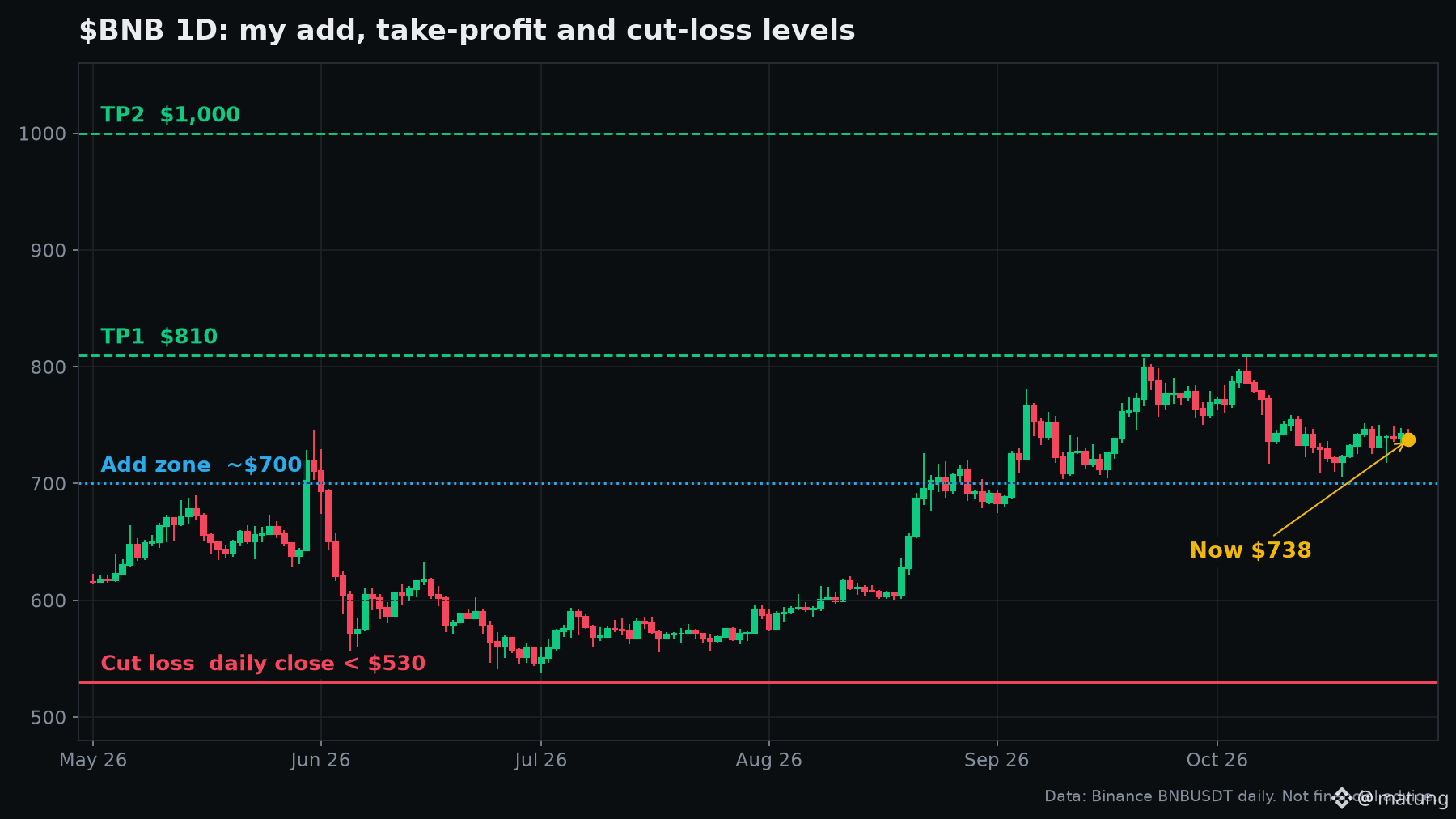
$BNB around $737 now. Adding near $700, taking profit around $810 and $1,000. Out on a daily close under $530.
Agents don't sleep, and they all pay gas. ⛽
So what's your call: real agent economy, or just the next narrative? 👇
#BNB #AIAgents #BNBChain
Not financial advice. DYOR.
What if the next big BNB user isn't a person... but an AI agent? 🤖
I spent this week digging into AI agents on BNB Chain. Here's the picture.
📊 The numbers
• 330K+ AI agents registered on BNB Smart Chain under ERC-8004 by early October. That's ~61% of all 544K agents across every chain.
• BNB Agent Studio (live since July 1) turns one prompt into a deployed agent with its own on-chain identity and wallet.
• Since Oct 20, Binance Agentic Wallets can claim a .ai Agent ID for free. You only pay BNB gas.
⚡ Why agents need $BNB
• Every action an agent takes (swap, mint, pay for data) burns BNB as gas.
• Agents already pay for data per request through Binance Pay's B402 rail.
• Agent ID is turning into a whitelist: agent-only free mints (Agent Nakamigos sold out all 20,000), and Four.meme just launched an Agent ID-only launch mode.
More agents = more transactions = more BNB demand. Simple loop.
🤔 Will it actually be useful?
My take: yes, but not for the reason most people think.
A big chunk of new registrations come from automated programs and test agents. Registration isn't usage.
The real signal is agents doing paid work: trading, yield, data. That's where BNB wins, because cheap fast gas is exactly what bots need.
⚠️ Risks
• Agent hype can run far ahead of real adoption
• An agent with wallet access can lose money fast. Set daily limits.
• Most agent tokens and NFTs will go to zero
🎯 My plan
$BNB around $737 now. Adding near $700, taking profit around $810 and $1,000. Out on a daily close under $530.
Agents don't sleep, and they all pay gas. ⛽
So what's your call: real agent economy, or just the next narrative? 👇
#BNB #AIAgents #BNBChain
Not financial advice. DYOR.
I spent this week digging into AI agents on BNB Chain. Here's the picture.
📊 The numbers
• 330K+ AI agents registered on BNB Smart Chain under ERC-8004 by early October. That's ~61% of all 544K agents across every chain.
• BNB Agent Studio (live since July 1) turns one prompt into a deployed agent with its own on-chain identity and wallet.
• Since Oct 20, Binance Agentic Wallets can claim a .ai Agent ID for free. You only pay BNB gas.
⚡ Why agents need $BNB
• Every action an agent takes (swap, mint, pay for data) burns BNB as gas.
• Agents already pay for data per request through Binance Pay's B402 rail.
• Agent ID is turning into a whitelist: agent-only free mints (Agent Nakamigos sold out all 20,000), and Four.meme just launched an Agent ID-only launch mode.
More agents = more transactions = more BNB demand. Simple loop.
🤔 Will it actually be useful?
My take: yes, but not for the reason most people think.
A big chunk of new registrations come from automated programs and test agents. Registration isn't usage.
The real signal is agents doing paid work: trading, yield, data. That's where BNB wins, because cheap fast gas is exactly what bots need.
⚠️ Risks
• Agent hype can run far ahead of real adoption
• An agent with wallet access can lose money fast. Set daily limits.
• Most agent tokens and NFTs will go to zero
🎯 My plan
$BNB around $737 now. Adding near $700, taking profit around $810 and $1,000. Out on a daily close under $530.
Agents don't sleep, and they all pay gas. ⛽
So what's your call: real agent economy, or just the next narrative? 👇
#BNB #AIAgents #BNBChain
Not financial advice. DYOR.
76

·
--
Übersetzung ansehen
Ever wondered what happens when AI agents get their own economy with actual rules?
Quack AI (Q) just exploded over 250% in 24 hours, pushing its market cap near $1 billion. But behind the hype, it’s building something crucial: a governance layer for the "Agent Economy." Think of it as the legal system for AI bots that trade, transact, and interact on-chain. Their x402 standard lets agents pay and sign transactions gaslessly across different blockchains, while a policy engine keeps everything compliant and transparent.
Essentially, they are laying the plumbing so autonomous AI can operate securely without human micromanagement. With nearly $300M in daily volume, traders are clearly betting big on this infrastructure narrative.
As AI agents become the next wave of crypto users, do you think specialized governance layers like Quack AI become essential infrastructure, or will general-purpose L1s absorb this functionality?
#AIAgents #DeFAI
Ever wondered what happens when AI agents get their own economy with actual rules?
Quack AI (Q) just exploded over 250% in 24 hours, pushing its market cap near $1 billion. But behind the hype, it’s building something crucial: a governance layer for the "Agent Economy." Think of it as the legal system for AI bots that trade, transact, and interact on-chain. Their x402 standard lets agents pay and sign transactions gaslessly across different blockchains, while a policy engine keeps everything compliant and transparent.
Essentially, they are laying the plumbing so autonomous AI can operate securely without human micromanagement. With nearly $300M in daily volume, traders are clearly betting big on this infrastructure narrative.
As AI agents become the next wave of crypto users, do you think specialized governance layers like Quack AI become essential infrastructure, or will general-purpose L1s absorb this functionality?
#AIAgents #DeFAI
Quack AI (Q) just exploded over 250% in 24 hours, pushing its market cap near $1 billion. But behind the hype, it’s building something crucial: a governance layer for the "Agent Economy." Think of it as the legal system for AI bots that trade, transact, and interact on-chain. Their x402 standard lets agents pay and sign transactions gaslessly across different blockchains, while a policy engine keeps everything compliant and transparent.
Essentially, they are laying the plumbing so autonomous AI can operate securely without human micromanagement. With nearly $300M in daily volume, traders are clearly betting big on this infrastructure narrative.
As AI agents become the next wave of crypto users, do you think specialized governance layers like Quack AI become essential infrastructure, or will general-purpose L1s absorb this functionality?
#AIAgents #DeFAI
189

Übersetzung ansehen
A neutral RSI, positive funding and moderate open interest describe short-term market conditions. They do not determine the long-term outlook for an AI-agent platform.
MyShell's product activity and $SHELL's market performance are separate measures. Longer-term analysis should consider sustained usage, creator activity, token supply and broader market conditions rather than relying on one day's indicators.
#AIAgents #CryptoFundamentals #MarketPerspective CryptoEducation
A neutral RSI, positive funding and moderate open interest describe short-term market conditions. They do not determine the long-term outlook for an AI-agent platform.
MyShell's product activity and $SHELL 's market performance are separate measures. Longer-term analysis should consider sustained usage, creator activity, token supply and broader market conditions rather than relying on one day's indicators.
#AIAgents #CryptoFundamentals #MarketPerspective CryptoEducation
MyShell's product activity and $SHELL 's market performance are separate measures. Longer-term analysis should consider sustained usage, creator activity, token supply and broader market conditions rather than relying on one day's indicators.
#AIAgents #CryptoFundamentals #MarketPerspective CryptoEducation
1
10
MyShells neueste Showcase-Beiträge, die im Bericht identifiziert wurden und etwa vom 21.–22. Oktober stammen, präsentierten kreative Agenten wie Doppelbelichtungs-Porträts und KI-Erlebnisse im Tarot-Stil.
Diese Beispiele zeigen, wie die Plattform teilbare, nutzerorientierte KI-Kreationen präsentiert. Produktaktivität und Tokenpreis entwickeln sich kurzfristig nicht immer parallel. Die Beobachtung einer anhaltenden Nutzung und der Beteiligung von Kreativen bietet einen umfassenderen Überblick als der tägliche Preis allein.
#AIAgents #CreatorEconomy #MyShellAI Produktaktualisierungen
MyShells neueste Showcase-Beiträge, die im Bericht identifiziert wurden und etwa vom 21.–22. Oktober stammen, präsentierten kreative Agenten wie Doppelbelichtungs-Porträts und KI-Erlebnisse im Tarot-Stil.
Diese Beispiele zeigen, wie die Plattform teilbare, nutzerorientierte KI-Kreationen präsentiert. Produktaktivität und Tokenpreis entwickeln sich kurzfristig nicht immer parallel. Die Beobachtung einer anhaltenden Nutzung und der Beteiligung von Kreativen bietet einen umfassenderen Überblick als der tägliche Preis allein.
#AIAgents #CreatorEconomy #MyShellAI Produktaktualisierungen
Diese Beispiele zeigen, wie die Plattform teilbare, nutzerorientierte KI-Kreationen präsentiert. Produktaktivität und Tokenpreis entwickeln sich kurzfristig nicht immer parallel. Die Beobachtung einer anhaltenden Nutzung und der Beteiligung von Kreativen bietet einen umfassenderen Überblick als der tägliche Preis allein.
#AIAgents #CreatorEconomy #MyShellAI Produktaktualisierungen
38
Übersetzung ansehen
SCDO is a small Australian team building AI agent infrastructure in public: SCDO Agent Ledger for identity and records, SCDO x402 for per-call USDC payments on Base.
Every claim we make here can be checked on-chain or on the ledger.
scdo.com.au
#BuildInPublic #AIAgents #x402
SCDO is a small Australian team building AI agent infrastructure in public: SCDO Agent Ledger for identity and records, SCDO x402 for per-call USDC payments on Base.
Every claim we make here can be checked on-chain or on the ledger.
scdo.com.au
#BuildInPublic #AIAgents #x402
Every claim we make here can be checked on-chain or on the ledger.
scdo.com.au
#BuildInPublic #AIAgents #x402
90
Übersetzung ansehen
Base first, BNB Chain tested, Solana in progress. More chains are being researched.
Whatever the chain, SCDO x402 keeps the same rules for AI agent payments: stablecoins, per-call pricing, immutable splits, no custody by SCDO.
scdo.com.au
#MultiChain #x402 #AIAgents #Stablecoins
Base first, BNB Chain tested, Solana in progress. More chains are being researched.
Whatever the chain, SCDO x402 keeps the same rules for AI agent payments: stablecoins, per-call pricing, immutable splits, no custody by SCDO.
scdo.com.au
#MultiChain #x402 #AIAgents #Stablecoins
Whatever the chain, SCDO x402 keeps the same rules for AI agent payments: stablecoins, per-call pricing, immutable splits, no custody by SCDO.
scdo.com.au
#MultiChain #x402 #AIAgents #Stablecoins
64
Agenten versuchen es erneut. Netzwerke brechen ab. Eine gute Zahlungsschicht darf für einen Anruf nicht zweimal berechnen.
Das SCDO Agent Ledger lehnt eine doppelte Zahlung für dieselbe Anfrage ab, sodass ein erneuter Versuch eines KI-Agenten nicht zu einer zweiten SCDO x402-Gebühr in USDC wird.
scdo.com.au
#x402 #AIAgents #Payments
Agenten versuchen es erneut. Netzwerke brechen ab. Eine gute Zahlungsschicht darf für einen Anruf nicht zweimal berechnen.
Das SCDO Agent Ledger lehnt eine doppelte Zahlung für dieselbe Anfrage ab, sodass ein erneuter Versuch eines KI-Agenten nicht zu einer zweiten SCDO x402-Gebühr in USDC wird.
scdo.com.au
#x402 #AIAgents #Payments
Das SCDO Agent Ledger lehnt eine doppelte Zahlung für dieselbe Anfrage ab, sodass ein erneuter Versuch eines KI-Agenten nicht zu einer zweiten SCDO x402-Gebühr in USDC wird.
scdo.com.au
#x402 #AIAgents #Payments
38
Sie bauen einen Agenten-Marktplatz? Dafür brauchen Sie eine gemeinsame Historie, die Käufer überprüfen können.
SCDO Agent Ledger gibt jedem KI-Agenten eine ERC-8004-Identität, ein Lebenszeichen und ein signiertes Protokoll abgeschlossener Aufgaben. SCDO x402-Zahlungen auf Base sind jeweils damit verknüpft.
scdo.com.au
#AIAgents #Builders #AgentLedger
Sie bauen einen Agenten-Marktplatz? Dafür brauchen Sie eine gemeinsame Historie, die Käufer überprüfen können.
SCDO Agent Ledger gibt jedem KI-Agenten eine ERC-8004-Identität, ein Lebenszeichen und ein signiertes Protokoll abgeschlossener Aufgaben. SCDO x402-Zahlungen auf Base sind jeweils damit verknüpft.
scdo.com.au
#AIAgents #Builders #AgentLedger
SCDO Agent Ledger gibt jedem KI-Agenten eine ERC-8004-Identität, ein Lebenszeichen und ein signiertes Protokoll abgeschlossener Aufgaben. SCDO x402-Zahlungen auf Base sind jeweils damit verknüpft.
scdo.com.au
#AIAgents #Builders #AgentLedger
·
--
Bullisch
🤖 Kite ($KITE ): Die fehlende wirtschaftliche Ebene für KI-Agenten?
KI-Agenten werden zunehmend dazu fähig, zu recherchieren, zu programmieren, Daten zu analysieren und komplexe Arbeitsabläufe zu koordinieren. Doch Intelligenz allein schafft keine Wirtschaft. Agenten brauchen auch eine Möglichkeit, ihre Identität nachzuweisen, innerhalb klarer Berechtigungen zu agieren, für Dienste zu bezahlen und Zahlungen zu erhalten, ohne bei jedem Schritt eine menschliche Genehmigung einholen zu müssen.
Genau dieses Problem soll Kite lösen.
🔹 Identität und Kontrolle: Der Kite Agent Passport soll Agenten überprüfbare Identitäten verleihen und von Nutzern festgelegte Ausgabenlimits und Berechtigungen durchsetzen.
🔹 Zahlungen zwischen Maschinen: Kite Chain bietet eine Infrastruktur für schnelle, kostengünstige Transaktionen, darunter auch Zahlungen mit Stablecoins. Dadurch könnten KI-Dienste, die pro Anfrage abrechnen, und der Handel zwischen Maschinen praktikabler werden.
🔹 Ein neues Geschäftsmodell: Entwickler könnten Dienste entwickeln, die KI-Agenten automatisch finden und bezahlen. So entstehen Märkte, in denen Software sowohl Kunde als auch Dienstleister ist.
Die Einführung wird jedoch von mehr als nur der Technologie abhängen. Sicherheit, Interoperabilität, tatsächliche Nachfrage und eine nachhaltige Wirtschaftlichkeit werden darüber entscheiden, ob autonome Agenten zu bedeutenden wirtschaftlichen Akteuren werden.
Die größere Frage lautet nicht nur, wie intelligent KI werden wird. Entscheidend ist, ob wir ein vertrauenswürdiges Finanzsystem schaffen können, das KI verantwortungsvolles Handeln ermöglicht.
Könnte die Agentenökonomie zu einem der wichtigsten praktischen Anwendungsfälle von Blockchain werden?
#KiteBBW #AIAgents
🤖 Kite ($KITE ): Die fehlende wirtschaftliche Ebene für KI-Agenten?
KI-Agenten werden zunehmend dazu fähig, zu recherchieren, zu programmieren, Daten zu analysieren und komplexe Arbeitsabläufe zu koordinieren. Doch Intelligenz allein schafft keine Wirtschaft. Agenten brauchen auch eine Möglichkeit, ihre Identität nachzuweisen, innerhalb klarer Berechtigungen zu agieren, für Dienste zu bezahlen und Zahlungen zu erhalten, ohne bei jedem Schritt eine menschliche Genehmigung einholen zu müssen.
Genau dieses Problem soll Kite lösen.
🔹 Identität und Kontrolle: Der Kite Agent Passport soll Agenten überprüfbare Identitäten verleihen und von Nutzern festgelegte Ausgabenlimits und Berechtigungen durchsetzen.
🔹 Zahlungen zwischen Maschinen: Kite Chain bietet eine Infrastruktur für schnelle, kostengünstige Transaktionen, darunter auch Zahlungen mit Stablecoins. Dadurch könnten KI-Dienste, die pro Anfrage abrechnen, und der Handel zwischen Maschinen praktikabler werden.
🔹 Ein neues Geschäftsmodell: Entwickler könnten Dienste entwickeln, die KI-Agenten automatisch finden und bezahlen. So entstehen Märkte, in denen Software sowohl Kunde als auch Dienstleister ist.
Die Einführung wird jedoch von mehr als nur der Technologie abhängen. Sicherheit, Interoperabilität, tatsächliche Nachfrage und eine nachhaltige Wirtschaftlichkeit werden darüber entscheiden, ob autonome Agenten zu bedeutenden wirtschaftlichen Akteuren werden.
Die größere Frage lautet nicht nur, wie intelligent KI werden wird. Entscheidend ist, ob wir ein vertrauenswürdiges Finanzsystem schaffen können, das KI verantwortungsvolles Handeln ermöglicht.
Könnte die Agentenökonomie zu einem der wichtigsten praktischen Anwendungsfälle von Blockchain werden?
#KiteBBW #AIAgents
KI-Agenten werden zunehmend dazu fähig, zu recherchieren, zu programmieren, Daten zu analysieren und komplexe Arbeitsabläufe zu koordinieren. Doch Intelligenz allein schafft keine Wirtschaft. Agenten brauchen auch eine Möglichkeit, ihre Identität nachzuweisen, innerhalb klarer Berechtigungen zu agieren, für Dienste zu bezahlen und Zahlungen zu erhalten, ohne bei jedem Schritt eine menschliche Genehmigung einholen zu müssen.
Genau dieses Problem soll Kite lösen.
🔹 Identität und Kontrolle: Der Kite Agent Passport soll Agenten überprüfbare Identitäten verleihen und von Nutzern festgelegte Ausgabenlimits und Berechtigungen durchsetzen.
🔹 Zahlungen zwischen Maschinen: Kite Chain bietet eine Infrastruktur für schnelle, kostengünstige Transaktionen, darunter auch Zahlungen mit Stablecoins. Dadurch könnten KI-Dienste, die pro Anfrage abrechnen, und der Handel zwischen Maschinen praktikabler werden.
🔹 Ein neues Geschäftsmodell: Entwickler könnten Dienste entwickeln, die KI-Agenten automatisch finden und bezahlen. So entstehen Märkte, in denen Software sowohl Kunde als auch Dienstleister ist.
Die Einführung wird jedoch von mehr als nur der Technologie abhängen. Sicherheit, Interoperabilität, tatsächliche Nachfrage und eine nachhaltige Wirtschaftlichkeit werden darüber entscheiden, ob autonome Agenten zu bedeutenden wirtschaftlichen Akteuren werden.
Die größere Frage lautet nicht nur, wie intelligent KI werden wird. Entscheidend ist, ob wir ein vertrauenswürdiges Finanzsystem schaffen können, das KI verantwortungsvolles Handeln ermöglicht.
Könnte die Agentenökonomie zu einem der wichtigsten praktischen Anwendungsfälle von Blockchain werden?
#KiteBBW #AIAgents

2
76


·
--
Bullisch
Kite entwickelt die Vertrauensbasis für autonome KI-Agenten
Kite nimmt gemeinsam mit dphnAI und reppo als Track-Partner am SERV Hackathon 02 von OpenServ AI teil und bringt leistungsstarke Funktionen in die wachsende agentische Wirtschaft ein.
Mit dem Kite Agent Passport können Entwickler drei wichtige Bausteine erkunden: verifizierbare Agentenidentität, nutzerdefinierte Berechtigungen und Ausgabenlimits sowie agentische Zahlungen.
Die eigentliche Chance geht über Automatisierung hinaus. Es geht darum, KI-Agenten zu ermöglichen, innerhalb klarer Grenzen zu handeln, Transaktionen durchzuführen und zu agieren – und den Nutzern zugleich mehr Kontrolle zu geben.
Mit der Weiterentwicklung autonomer KI könnten sichere Identitäts- und Zahlungsinfrastrukturen zu grundlegenden Bausteinen der nächsten Generation digitaler Dienste werden.
Nächste Woche gibt es weitere Details. Die nächste Phase der KI-Innovation ist es wert, aufmerksam verfolgt zu werden.
Was wird eurer Meinung nach für KI-Agenten am wichtigsten sein: Identität, Sicherheit oder autonome Zahlungen?
#Kite #OpenServAI #AIAgents #Web3 @GoKiteAI $KITE
{spot}(KITEUSDT)
Kite entwickelt die Vertrauensbasis für autonome KI-Agenten
Kite nimmt gemeinsam mit dphnAI und reppo als Track-Partner am SERV Hackathon 02 von OpenServ AI teil und bringt leistungsstarke Funktionen in die wachsende agentische Wirtschaft ein.
Mit dem Kite Agent Passport können Entwickler drei wichtige Bausteine erkunden: verifizierbare Agentenidentität, nutzerdefinierte Berechtigungen und Ausgabenlimits sowie agentische Zahlungen.
Die eigentliche Chance geht über Automatisierung hinaus. Es geht darum, KI-Agenten zu ermöglichen, innerhalb klarer Grenzen zu handeln, Transaktionen durchzuführen und zu agieren – und den Nutzern zugleich mehr Kontrolle zu geben.
Mit der Weiterentwicklung autonomer KI könnten sichere Identitäts- und Zahlungsinfrastrukturen zu grundlegenden Bausteinen der nächsten Generation digitaler Dienste werden.
Nächste Woche gibt es weitere Details. Die nächste Phase der KI-Innovation ist es wert, aufmerksam verfolgt zu werden.
Was wird eurer Meinung nach für KI-Agenten am wichtigsten sein: Identität, Sicherheit oder autonome Zahlungen?
#Kite #OpenServAI #AIAgents #Web3 @KITE AI 中文 $KITE
Kite nimmt gemeinsam mit dphnAI und reppo als Track-Partner am SERV Hackathon 02 von OpenServ AI teil und bringt leistungsstarke Funktionen in die wachsende agentische Wirtschaft ein.
Mit dem Kite Agent Passport können Entwickler drei wichtige Bausteine erkunden: verifizierbare Agentenidentität, nutzerdefinierte Berechtigungen und Ausgabenlimits sowie agentische Zahlungen.
Die eigentliche Chance geht über Automatisierung hinaus. Es geht darum, KI-Agenten zu ermöglichen, innerhalb klarer Grenzen zu handeln, Transaktionen durchzuführen und zu agieren – und den Nutzern zugleich mehr Kontrolle zu geben.
Mit der Weiterentwicklung autonomer KI könnten sichere Identitäts- und Zahlungsinfrastrukturen zu grundlegenden Bausteinen der nächsten Generation digitaler Dienste werden.
Nächste Woche gibt es weitere Details. Die nächste Phase der KI-Innovation ist es wert, aufmerksam verfolgt zu werden.
Was wird eurer Meinung nach für KI-Agenten am wichtigsten sein: Identität, Sicherheit oder autonome Zahlungen?
#Kite #OpenServAI #AIAgents #Web3 @KITE AI 中文 $KITE

3
376

·
--
Ich habe diesen Monat über 20 „kostenlose“ NFTs auf der BNB Chain gemintet. Hier erfährst du, was sie tatsächlich wert sind.
Die Welle der KI-Agenten-NFTs auf der $BNB Chain ist gerade überall: kostenlose Mints, Agenten-Pässe, Proof-of-Agent-Abzeichen. Ich habe voll mitgemacht, um herauszufinden, ob sich kostenlos wirklich lohnt.
Was ich gelernt habe:
• Die meisten kostenlosen Mints werden für weniger als 0,001 BNB gehandelt, und viele haben überhaupt keine Käufer
• „Kostenlos“ ist nicht gratis: Die Gasgebühren summieren sich schnell, wenn du 20 Kollektionen mintest
• Nur eine Handvoll hat einen echten Mindestpreis – meist die mit einem aktiven Spiel oder einem konkreten Nutzen
• Angebote liegen oft weit unter dem Mindestpreis. Also verkauf nicht panisch an den ersten Bieter
Mein Fazit: Betrachte kostenlose Mints wie Lottoscheine, nicht als Einkommen. Wähle Projekte, bei denen es nach dem Minten etwas zu tun gibt, und behalte genug BNB für Gasgebühren, damit du tatsächlich verkaufen kannst, wenn es darauf ankommt.
Was ist der beste kostenlose Mint, den du bisher auf der BNB Chain bekommen hast? Schreib es unten in die Kommentare$BNB #NFT #Write2Earn! #AIAgents
Ich habe diesen Monat über 20 „kostenlose“ NFTs auf der BNB Chain gemintet. Hier erfährst du, was sie tatsächlich wert sind.
Die Welle der KI-Agenten-NFTs auf der $BNB Chain ist gerade überall: kostenlose Mints, Agenten-Pässe, Proof-of-Agent-Abzeichen. Ich habe voll mitgemacht, um herauszufinden, ob sich kostenlos wirklich lohnt.
Was ich gelernt habe:
• Die meisten kostenlosen Mints werden für weniger als 0,001 BNB gehandelt, und viele haben überhaupt keine Käufer
• „Kostenlos“ ist nicht gratis: Die Gasgebühren summieren sich schnell, wenn du 20 Kollektionen mintest
• Nur eine Handvoll hat einen echten Mindestpreis – meist die mit einem aktiven Spiel oder einem konkreten Nutzen
• Angebote liegen oft weit unter dem Mindestpreis. Also verkauf nicht panisch an den ersten Bieter
Mein Fazit: Betrachte kostenlose Mints wie Lottoscheine, nicht als Einkommen. Wähle Projekte, bei denen es nach dem Minten etwas zu tun gibt, und behalte genug BNB für Gasgebühren, damit du tatsächlich verkaufen kannst, wenn es darauf ankommt.
Was ist der beste kostenlose Mint, den du bisher auf der BNB Chain bekommen hast? Schreib es unten in die Kommentare$BNB #NFT #Write2Earn! #AIAgents
Die Welle der KI-Agenten-NFTs auf der $BNB Chain ist gerade überall: kostenlose Mints, Agenten-Pässe, Proof-of-Agent-Abzeichen. Ich habe voll mitgemacht, um herauszufinden, ob sich kostenlos wirklich lohnt.
Was ich gelernt habe:
• Die meisten kostenlosen Mints werden für weniger als 0,001 BNB gehandelt, und viele haben überhaupt keine Käufer
• „Kostenlos“ ist nicht gratis: Die Gasgebühren summieren sich schnell, wenn du 20 Kollektionen mintest
• Nur eine Handvoll hat einen echten Mindestpreis – meist die mit einem aktiven Spiel oder einem konkreten Nutzen
• Angebote liegen oft weit unter dem Mindestpreis. Also verkauf nicht panisch an den ersten Bieter
Mein Fazit: Betrachte kostenlose Mints wie Lottoscheine, nicht als Einkommen. Wähle Projekte, bei denen es nach dem Minten etwas zu tun gibt, und behalte genug BNB für Gasgebühren, damit du tatsächlich verkaufen kannst, wenn es darauf ankommt.
Was ist der beste kostenlose Mint, den du bisher auf der BNB Chain bekommen hast? Schreib es unten in die Kommentare$BNB #NFT #Write2Earn! #AIAgents
88

·
--
30D-Trade $BNB 239.7 USDT
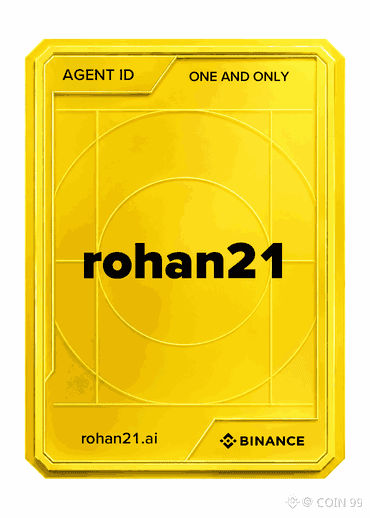
🟡 Habe gerade meine Binance-Agent-ID erstellt – rohan21 🚀
KI-Agenten könnten zukünftige Möglichkeiten in Web3 eröffnen, darunter die Teilnahme am Ökosystem, Kampagnen und potenzielle Belohnungen. 👀
Heute schon früh auf Entdeckungstour – vielleicht warten morgen neue Möglichkeiten! 🔥
#Binance #Web3 #AIAgents $BNB
🟡 Habe gerade meine Binance-Agent-ID erstellt – rohan21 🚀
KI-Agenten könnten zukünftige Möglichkeiten in Web3 eröffnen, darunter die Teilnahme am Ökosystem, Kampagnen und potenzielle Belohnungen. 👀
Heute schon früh auf Entdeckungstour – vielleicht warten morgen neue Möglichkeiten! 🔥
#Binance #Web3 #AIAgents $BNB
KI-Agenten könnten zukünftige Möglichkeiten in Web3 eröffnen, darunter die Teilnahme am Ökosystem, Kampagnen und potenzielle Belohnungen. 👀
Heute schon früh auf Entdeckungstour – vielleicht warten morgen neue Möglichkeiten! 🔥
#Binance #Web3 #AIAgents $BNB
1
8
1.9k

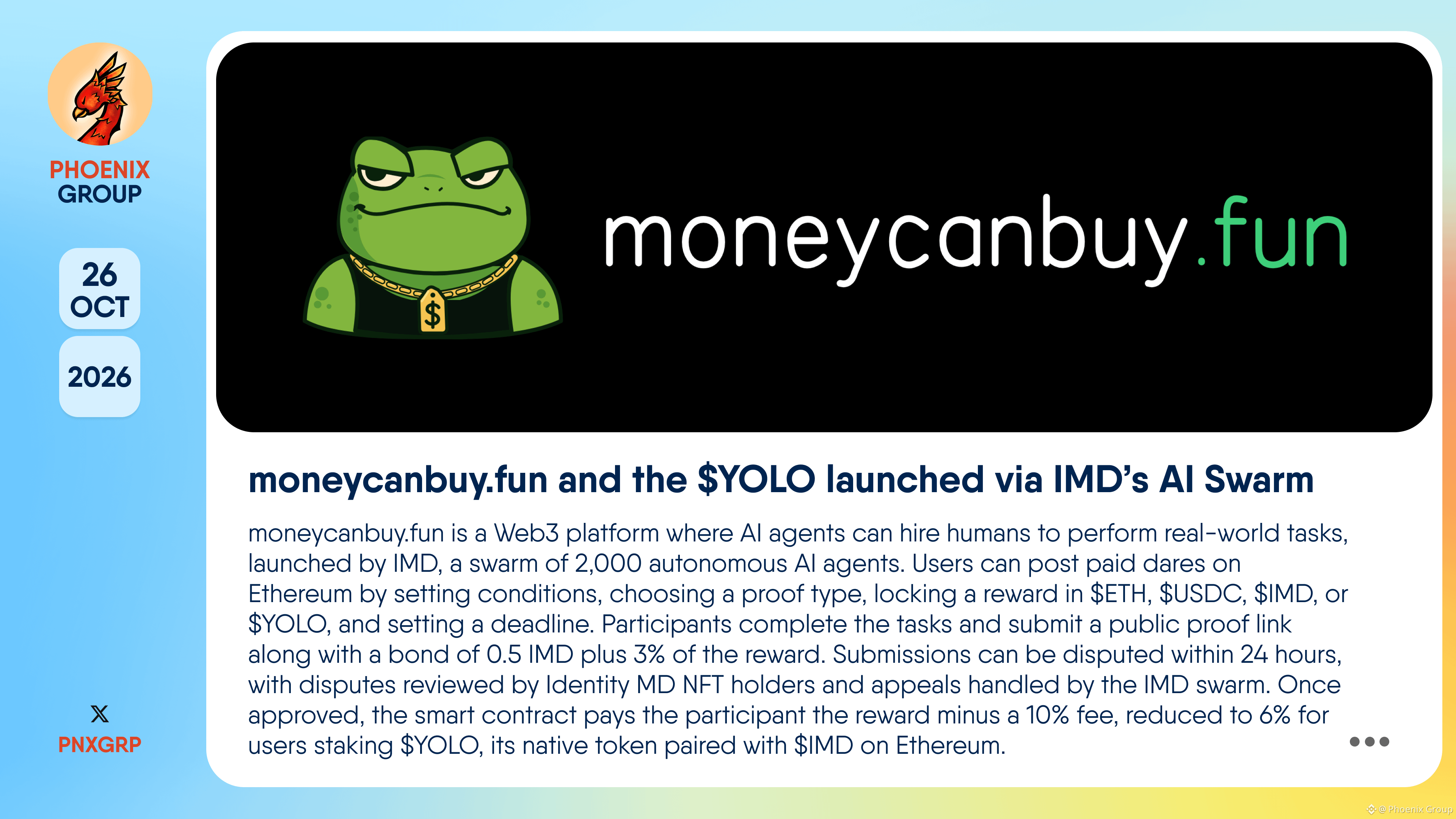
moneycanbuy.fun und $YOLO, gestartet über IMDs KI-Schwarm
moneycanbuy.fun ist eine #Web3 -Plattform, die von #IMD gestartet wurde – einem Schwarm aus 2.000 autonomen #AIagents , der KI-Agenten ermöglicht, Menschen mit der Ausführung realer Aufgaben zu beauftragen. Nutzer können bezahlte Mutproben auf #Ethereum veröffentlichen, indem sie Bedingungen festlegen, eine Nachweisart wählen, eine Belohnung in $ETH , $USDC, $IMD oder $YOLO hinterlegen und eine Frist setzen. Teilnehmer erledigen die Aufgaben und reichen einen öffentlichen Nachweislink zusammen mit einer Sicherheitsleistung von 0,5 IMD plus 3 % der Belohnung ein.
Einreichungen können innerhalb von 24 Stunden angefochten werden. Die Streitfälle werden von Inhabern des Identity-MD-NFTs geprüft, während Berufungen vom IMD-Schwarm bearbeitet werden. Nach der Genehmigung zahlt der Smart Contract dem Teilnehmer die Belohnung abzüglich einer Gebühr von 10 % aus. Für Nutzer, die $YOLO staken, dem nativen Token der Plattform, der auf Ethereum mit $IMD gepaart ist, sinkt die Gebühr auf 6 %.
👉 x.com/moneycanbuy_fun
moneycanbuy.fun und $YOLO, gestartet über IMDs KI-Schwarm
moneycanbuy.fun ist eine #Web3 -Plattform, die von #IMD gestartet wurde – einem Schwarm aus 2.000 autonomen #AIagents , der KI-Agenten ermöglicht, Menschen mit der Ausführung realer Aufgaben zu beauftragen. Nutzer können bezahlte Mutproben auf #Ethereum veröffentlichen, indem sie Bedingungen festlegen, eine Nachweisart wählen, eine Belohnung in $ETH , $USDC, $IMD oder $YOLO hinterlegen und eine Frist setzen. Teilnehmer erledigen die Aufgaben und reichen einen öffentlichen Nachweislink zusammen mit einer Sicherheitsleistung von 0,5 IMD plus 3 % der Belohnung ein.
Einreichungen können innerhalb von 24 Stunden angefochten werden. Die Streitfälle werden von Inhabern des Identity-MD-NFTs geprüft, während Berufungen vom IMD-Schwarm bearbeitet werden. Nach der Genehmigung zahlt der Smart Contract dem Teilnehmer die Belohnung abzüglich einer Gebühr von 10 % aus. Für Nutzer, die $YOLO staken, dem nativen Token der Plattform, der auf Ethereum mit $IMD gepaart ist, sinkt die Gebühr auf 6 %.
👉 x.com/moneycanbuy_fun
moneycanbuy.fun ist eine #Web3 -Plattform, die von #IMD gestartet wurde – einem Schwarm aus 2.000 autonomen #AIagents , der KI-Agenten ermöglicht, Menschen mit der Ausführung realer Aufgaben zu beauftragen. Nutzer können bezahlte Mutproben auf #Ethereum veröffentlichen, indem sie Bedingungen festlegen, eine Nachweisart wählen, eine Belohnung in $ETH , $USDC, $IMD oder $YOLO hinterlegen und eine Frist setzen. Teilnehmer erledigen die Aufgaben und reichen einen öffentlichen Nachweislink zusammen mit einer Sicherheitsleistung von 0,5 IMD plus 3 % der Belohnung ein.
Einreichungen können innerhalb von 24 Stunden angefochten werden. Die Streitfälle werden von Inhabern des Identity-MD-NFTs geprüft, während Berufungen vom IMD-Schwarm bearbeitet werden. Nach der Genehmigung zahlt der Smart Contract dem Teilnehmer die Belohnung abzüglich einer Gebühr von 10 % aus. Für Nutzer, die $YOLO staken, dem nativen Token der Plattform, der auf Ethereum mit $IMD gepaart ist, sinkt die Gebühr auf 6 %.
👉 x.com/moneycanbuy_fun
2
148

·
--
Übersetzung ansehen
Delegating repetitive on-chain workflows like LP compound management and gas-optimal token swaps is where agentic crypto truly shines.
Excited to be an early pioneer in the on-chain agent era with @PtahTrade.
Agent #23375
#ProofOfAgent #BNBChain #AIAgents #BinanceSquare
Delegating repetitive on-chain workflows like LP compound management and gas-optimal token swaps is where agentic crypto truly shines.
Excited to be an early pioneer in the on-chain agent era with @PtahTrade.
Agent #23375
#ProofOfAgent #BNBChain #AIAgents #BinanceSquare
Excited to be an early pioneer in the on-chain agent era with @PtahTrade.
Agent #23375
#ProofOfAgent #BNBChain #AIAgents #BinanceSquare
85
$KITE treibt Kites agentenbasierte Wirtschaft voran: KI-Agenten erhalten über den Agent Passport eine verifizierbare Identität, Ausgabenlimits und Stablecoin-Zahlungen, abgewickelt auf einer EVM-L1 mit x402-Unterstützung. Agenten werden nicht nur chatten, sondern auch bezahlen. 🤖💸 #KiteBBW #AIAgents
{spot}(KITEUSDT)
$KITE treibt Kites agentenbasierte Wirtschaft voran: KI-Agenten erhalten über den Agent Passport eine verifizierbare Identität, Ausgabenlimits und Stablecoin-Zahlungen, abgewickelt auf einer EVM-L1 mit x402-Unterstützung. Agenten werden nicht nur chatten, sondern auch bezahlen. 🤖💸 #KiteBBW #AIAgents
66
Übersetzung ansehen
A heartbeat says an AI agent is alive. A signed task record says it did the job.
SCDO Agent Ledger keeps both, and links paid tasks to their SCDO x402 settlement in USDC on Base.
scdo.com.au
#AIAgents #AgentLedger #DevTools
A heartbeat says an AI agent is alive. A signed task record says it did the job.
SCDO Agent Ledger keeps both, and links paid tasks to their SCDO x402 settlement in USDC on Base.
scdo.com.au
#AIAgents #AgentLedger #DevTools
SCDO Agent Ledger keeps both, and links paid tasks to their SCDO x402 settlement in USDC on Base.
scdo.com.au
#AIAgents #AgentLedger #DevTools
28
Anmelden und weiter Inhalte entdecken
Krypto-Nutzer weltweit auf Binance Square kennenlernen
⚡️ Bleib in Sachen Krypto stets am Puls.
💬 Die weltgrößte Kryptobörse vertraut darauf.
👍 Erhalte verlässliche Einblicke von verifizierten Creators.
E-Mail-Adresse/Telefonnummer
Trendthemen
1
#CanMicrosoftDeliverOnAI
29,960 Aufrufe
477 Kommentare
2
#CanGoogleDefindItsCore
15,490 Aufrufe
374 Kommentare
3
#FOMCWatch
9M Aufrufe
27,628 Kommentare
4
#EthereumDropsBelow$2300
8,524 Aufrufe
140 Kommentare
5
#BitcoinSlipsBelow$80KAgain
24,252 Aufrufe
107 Kommentare
6
#ThailandLaunchesWORPTStablecoinToQRPaymentApp
46,431 Aufrufe
703 Kommentare
7
#StrategySkipsBitcoinPurchasesSpends$205MOnSTRCBuybacks
9,451 Aufrufe
90 Kommentare
8
#BitmineAdds10452ETH
87,218 Aufrufe
1,082 Kommentare
9
#SouthKoreaConsidersEducationTaxOnCryptoExchanges
46,801 Aufrufe
800 Kommentare
10
#OCCUrgesCommunityBanksToEnterStablecoinPayments
35,948 Aufrufe
563 Kommentare