
#butcoin
butcoin
2,311 Aufrufe
32 Kommentare
Hot
Zuletzt




Artikel
Übersetzung ansehen
Why Does Bitcoin Price Go Up and Down? Understanding the Reasons Behind Its Volatility Introduction
$BTC is the world's most popular cryptocurrency, but one thing makes it particularly interesting: its price never stays the same for long.
Sometimes $BTC experiences a massive price increase, while at other times it suddenly drops. But have you ever wondered why this happens?
Bitcoin's price movements are not random. Several important factors influence its value, including supply and demand, investor sentiment, global economic conditions, market news, and institutional activity.
Let's understand the major reasons behind Bitcoin's price fluctuations.
1. Supply and Demand
Supply and demand are among the biggest factors affecting Bitcoin's price.
When more people want to buy Bitcoin than sell it, buying pressure increases and its price generally moves upward.
On the other hand, when more people want to sell Bitcoin than buy it, selling pressure increases and its price generally moves downward.
Bitcoin also has a maximum supply of 21 million coins. This limited supply is an important part of its economic design.
2. Market Sentiment: Fear and Greed
Investor emotions can have a powerful influence on Bitcoin's price.
When investors feel optimistic about the market, they may become more interested in buying Bitcoin. This positive sentiment can increase demand.
However, when fear spreads through the market, investors may become more cautious and selling pressure can increase.
This is why market sentiment is an important factor in understanding cryptocurrency movements.
3. Global Economic Conditions
Bitcoin does not operate separately from the global economy.
Economic developments, inflation, interest rates, the strength of the US dollar, and central bank decisions can influence investor behaviour.
For example, when investors become concerned about economic uncertainty, they may reduce exposure to risky assets, including cryptocurrencies.
Positive economic developments can sometimes improve confidence in financial markets.
4. News and Government Regulations
News can quickly change the direction of the cryptocurrency market.
Positive developments, such as clearer cryptocurrency regulations or increased institutional adoption, may improve confidence and increase demand.
Negative news, such as regulatory restrictions, security incidents, or major exchange problems, can create uncertainty and selling pressure.
Therefore, staying informed about reliable cryptocurrency news is important.
5. Institutional Investment
Large financial institutions and investment companies can influence Bitcoin's market.
When institutions increase their Bitcoin exposure, it can create additional buying demand and improve market confidence.
However, when large investors reduce their holdings, selling pressure may increase.
Institutional activity has become an important part of Bitcoin's relationship with traditional financial markets.
6. Bitcoin Halving
Bitcoin halving is another important event in Bitcoin's economic system.
Approximately every four years, the reward miners receive for adding new blocks to the Bitcoin blockchain is reduced by half.
This slows the rate at which new Bitcoin enters circulation.
Halving can influence market expectations about future supply, although it does not guarantee that Bitcoin's price will increase.
7. Trading Activity and Market Liquidity
Bitcoin trades around the clock, seven days a week.
Millions of market participants across the world buy and sell it, creating continuous price movements.
When buying and selling activity is balanced, prices may remain relatively stable.
However, when buying or selling pressure becomes unusually strong, Bitcoin can experience significant price changes.
Conclusion
Bitcoin's price movements are influenced by many interconnected factors. Supply and demand, market sentiment, economic conditions, news, institutional activity, and halving all contribute to its volatility.
Understanding these factors helps us look beyond daily price changes and understand what is happening in the cryptocurrency market.
Remember: Bitcoin's price does not move in only one direction. Understanding the reasons behind its movements is an important part of becoming a more informed cryptocurrency learner.
Disclaimer: This article is for educational purposes only and does not constitute financial advice.
#Butcoin $BTC
Why Does Bitcoin Price Go Up and Down? Understanding the Reasons Behind Its Volatility
Introduction
$BTC is the world's most popular cryptocurrency, but one thing makes it particularly interesting: its price never stays the same for long.
Sometimes $BTC experiences a massive price increase, while at other times it suddenly drops. But have you ever wondered why this happens?
Bitcoin's price movements are not random. Several important factors influence its value, including supply and demand, investor sentiment, global economic conditions, market news, and institutional activity.
Let's understand the major reasons behind Bitcoin's price fluctuations.
1. Supply and Demand
Supply and demand are among the biggest factors affecting Bitcoin's price.
When more people want to buy Bitcoin than sell it, buying pressure increases and its price generally moves upward.
On the other hand, when more people want to sell Bitcoin than buy it, selling pressure increases and its price generally moves downward.
Bitcoin also has a maximum supply of 21 million coins. This limited supply is an important part of its economic design.
2. Market Sentiment: Fear and Greed
Investor emotions can have a powerful influence on Bitcoin's price.
When investors feel optimistic about the market, they may become more interested in buying Bitcoin. This positive sentiment can increase demand.
However, when fear spreads through the market, investors may become more cautious and selling pressure can increase.
This is why market sentiment is an important factor in understanding cryptocurrency movements.
3. Global Economic Conditions
Bitcoin does not operate separately from the global economy.
Economic developments, inflation, interest rates, the strength of the US dollar, and central bank decisions can influence investor behaviour.
For example, when investors become concerned about economic uncertainty, they may reduce exposure to risky assets, including cryptocurrencies.
Positive economic developments can sometimes improve confidence in financial markets.
4. News and Government Regulations
News can quickly change the direction of the cryptocurrency market.
Positive developments, such as clearer cryptocurrency regulations or increased institutional adoption, may improve confidence and increase demand.
Negative news, such as regulatory restrictions, security incidents, or major exchange problems, can create uncertainty and selling pressure.
Therefore, staying informed about reliable cryptocurrency news is important.
5. Institutional Investment
Large financial institutions and investment companies can influence Bitcoin's market.
When institutions increase their Bitcoin exposure, it can create additional buying demand and improve market confidence.
However, when large investors reduce their holdings, selling pressure may increase.
Institutional activity has become an important part of Bitcoin's relationship with traditional financial markets.
6. Bitcoin Halving
Bitcoin halving is another important event in Bitcoin's economic system.
Approximately every four years, the reward miners receive for adding new blocks to the Bitcoin blockchain is reduced by half.
This slows the rate at which new Bitcoin enters circulation.
Halving can influence market expectations about future supply, although it does not guarantee that Bitcoin's price will increase.
7. Trading Activity and Market Liquidity
Bitcoin trades around the clock, seven days a week.
Millions of market participants across the world buy and sell it, creating continuous price movements.
When buying and selling activity is balanced, prices may remain relatively stable.
However, when buying or selling pressure becomes unusually strong, Bitcoin can experience significant price changes.
Conclusion
Bitcoin's price movements are influenced by many interconnected factors. Supply and demand, market sentiment, economic conditions, news, institutional activity, and halving all contribute to its volatility.
Understanding these factors helps us look beyond daily price changes and understand what is happening in the cryptocurrency market.
Remember: Bitcoin's price does not move in only one direction. Understanding the reasons behind its movements is an important part of becoming a more informed cryptocurrency learner.
Disclaimer: This article is for educational purposes only and does not constitute financial advice.
#Butcoin $BTC
1
93

·
--
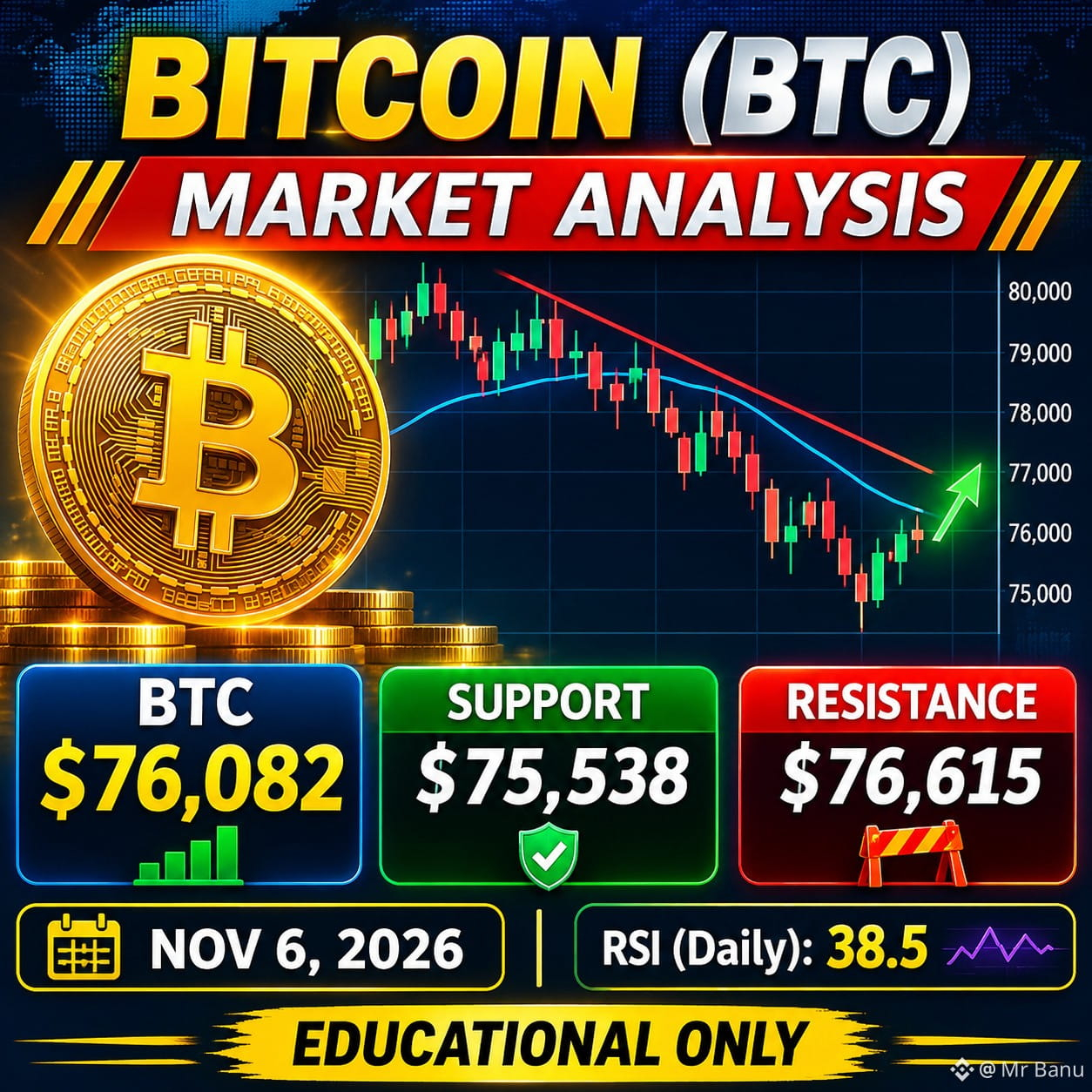
📊 BITCOIN $BTC
MARKTANALYSE — 6. NOVEMBER 2026
Bitcoin wird derzeit bei etwa $76,082 gehandelt und steht unter erheblichem Verkaufsdruck.
🔴 Markttrend: Kurzfristig bearish.
🟢 Unterstützungsniveau: $75,538
🔴 Widerstandsniveau: $76,615
📉 Täglicher RSI: 38.5, was auf eine schwache Dynamik hindeutet.
Bullishes Szenario:
Wenn Bitcoin die Marke von $76,615 überschreitet und dieses Niveau hält, könnte eine Erholung in Richtung $78,004 möglich werden.
Bearishes Szenario:
Wenn BTC unter $75,538 schließt, könnte ein weiterer Rückgang in Richtung $74,438 möglich sein.
#Bitcoin #BTC #CryptoAnalysis #BinanceSquare #Trading #butcoin #trading
{spot}(BTCUSDT)
📊 BITCOIN $BTC
MARKTANALYSE — 6. NOVEMBER 2026
Bitcoin wird derzeit bei etwa $76,082 gehandelt und steht unter erheblichem Verkaufsdruck.
🔴 Markttrend: Kurzfristig bearish.
🟢 Unterstützungsniveau: $75,538
🔴 Widerstandsniveau: $76,615
📉 Täglicher RSI: 38.5, was auf eine schwache Dynamik hindeutet.
Bullishes Szenario:
Wenn Bitcoin die Marke von $76,615 überschreitet und dieses Niveau hält, könnte eine Erholung in Richtung $78,004 möglich werden.
Bearishes Szenario:
Wenn BTC unter $75,538 schließt, könnte ein weiterer Rückgang in Richtung $74,438 möglich sein.
#Bitcoin #BTC #CryptoAnalysis #BinanceSquare #Trading #butcoin #trading
68

Bitcoin (BTC) ist die erste und beliebteste Kryptowährung der Welt. Es handelt sich um eine dezentralisierte digitale Währung, die es den Leuten ermöglicht, Geld sicher zu senden und zu empfangen, ohne Banken oder Zwischenhändler. Bekannt für sein begrenztes Angebot von 21 Millionen Coins, wird Bitcoin oft als digitales Gold bezeichnet und wird weit verbreitet für Investitionen und Online-Transaktionen über Plattformen wie binance.com�.#BTC #butcoin $BTC
{spot}(BTCUSDT)
Bitcoin (BTC) ist die erste und beliebteste Kryptowährung der Welt. Es handelt sich um eine dezentralisierte digitale Währung, die es den Leuten ermöglicht, Geld sicher zu senden und zu empfangen, ohne Banken oder Zwischenhändler. Bekannt für sein begrenztes Angebot von 21 Millionen Coins, wird Bitcoin oft als digitales Gold bezeichnet und wird weit verbreitet für Investitionen und Online-Transaktionen über Plattformen wie binance.com�.#BTC #butcoin $BTC
83

🚨 Dringendes Update zu Bitcoin ($BTC): Bären haben die Kontrolle? 📉Gestern hat der Preis von Bitcoin zum ersten Mal unter $60.000 geschlossen. Wenn wir uns die Marktstruktur ansehen, dann hat der Markt seit dem Hoch von $126.000 nun ein weiteres New Lower Low und New Lower High gebildet.
Solange der Gesamttrend des Marktes bärisch ist, sind die Chancen auf weiteres Abwärts-Potenzial (Preis fällt) höher. Inmitten dieses Abwärtstrends werden immer wieder kleine Gegenbewegungen (vorübergehende Erleichterung) auftreten—die wir bereits zuvor gehandelt haben und auch weiterhin handeln werden.
📌 Mein einfacher Plan:
Kein Bottom Fishing: Solange sich die Marktstruktur nicht bullish gedreht hat, besteht keine Notwendigkeit, gezwungen zu sagen, dass „das Bitcoin-Tief da ist“.
🚨 Dringendes Update zu Bitcoin ($BTC): Bären haben die Kontrolle? 📉
Gestern hat der Preis von Bitcoin zum ersten Mal unter $60.000 geschlossen. Wenn wir uns die Marktstruktur ansehen, dann hat der Markt seit dem Hoch von $126.000 nun ein weiteres New Lower Low und New Lower High gebildet.
Solange der Gesamttrend des Marktes bärisch ist, sind die Chancen auf weiteres Abwärts-Potenzial (Preis fällt) höher. Inmitten dieses Abwärtstrends werden immer wieder kleine Gegenbewegungen (vorübergehende Erleichterung) auftreten—die wir bereits zuvor gehandelt haben und auch weiterhin handeln werden.
📌 Mein einfacher Plan:
Kein Bottom Fishing: Solange sich die Marktstruktur nicht bullish gedreht hat, besteht keine Notwendigkeit, gezwungen zu sagen, dass „das Bitcoin-Tief da ist“.
91

·
--
Bullisch
Heute Handel versuchen wir einen Einstieg, der gleich wieder das ist, lange Entry, $BEAT 🚀🚀🚀🚀
$BTC $ETH
#butcoin #buyBTC #ETH #BinanceSquare
Heute Handel versuchen wir einen Einstieg, der gleich wieder das ist, lange Entry, $BEAT 🚀🚀🚀🚀
$BTC $ETH
#butcoin #buyBTC #ETH #BinanceSquare
$BTC $ETH
#butcoin #buyBTC #ETH #BinanceSquare

2
329
Anmelden und weiter Inhalte entdecken
Krypto-Nutzer weltweit auf Binance Square kennenlernen
⚡️ Bleib in Sachen Krypto stets am Puls.
💬 Die weltgrößte Kryptobörse vertraut darauf.
👍 Erhalte verlässliche Einblicke von verifizierten Creators.
E-Mail-Adresse/Telefonnummer
Trendthemen
1
#A Packed Week of Earnings and Data Tests Markets
6,977 Aufrufe
104 Kommentare
2
#AnthropicIPOTestsInvestorAppetiteForAI
3,691 Aufrufe
144 Kommentare
3
#HuangReportedlyConsidersReturnToNvidia
23,268 Aufrufe
368 Kommentare
4
#CryptoSelloffTriggersMultipleWhaleLiquidations
293,361 Aufrufe
2,415 Kommentare
5
#BitcoinSpotETFsPost$1.065BOutflowsForThirdStraightWeek
1,911 Aufrufe
51 Kommentare
6
#About64000BitcoinMiningMachinesReportedlyHijacked
20,341 Aufrufe
271 Kommentare
7
#USSpotXRPETFsSeeLargestWeeklyOutflowIn8Months
231,024 Aufrufe
1,884 Kommentare
8
#WillFOMCMinutesReinforceRateHikeExpectations?
87,002 Aufrufe
958 Kommentare
9
#BitcoinActiveSupplyInProfitDropsBelow45%
304,282 Aufrufe
2,095 Kommentare
10
#KavaSaysAbnormalActivityLimitedToKavaLend
198,610 Aufrufe
1,186 Kommentare